- AI Fire
- Posts
- 🧨 Don't Set a Business Goal For 2026 Until You Watch This New Year Trap
🧨 Don't Set a Business Goal For 2026 Until You Watch This New Year Trap
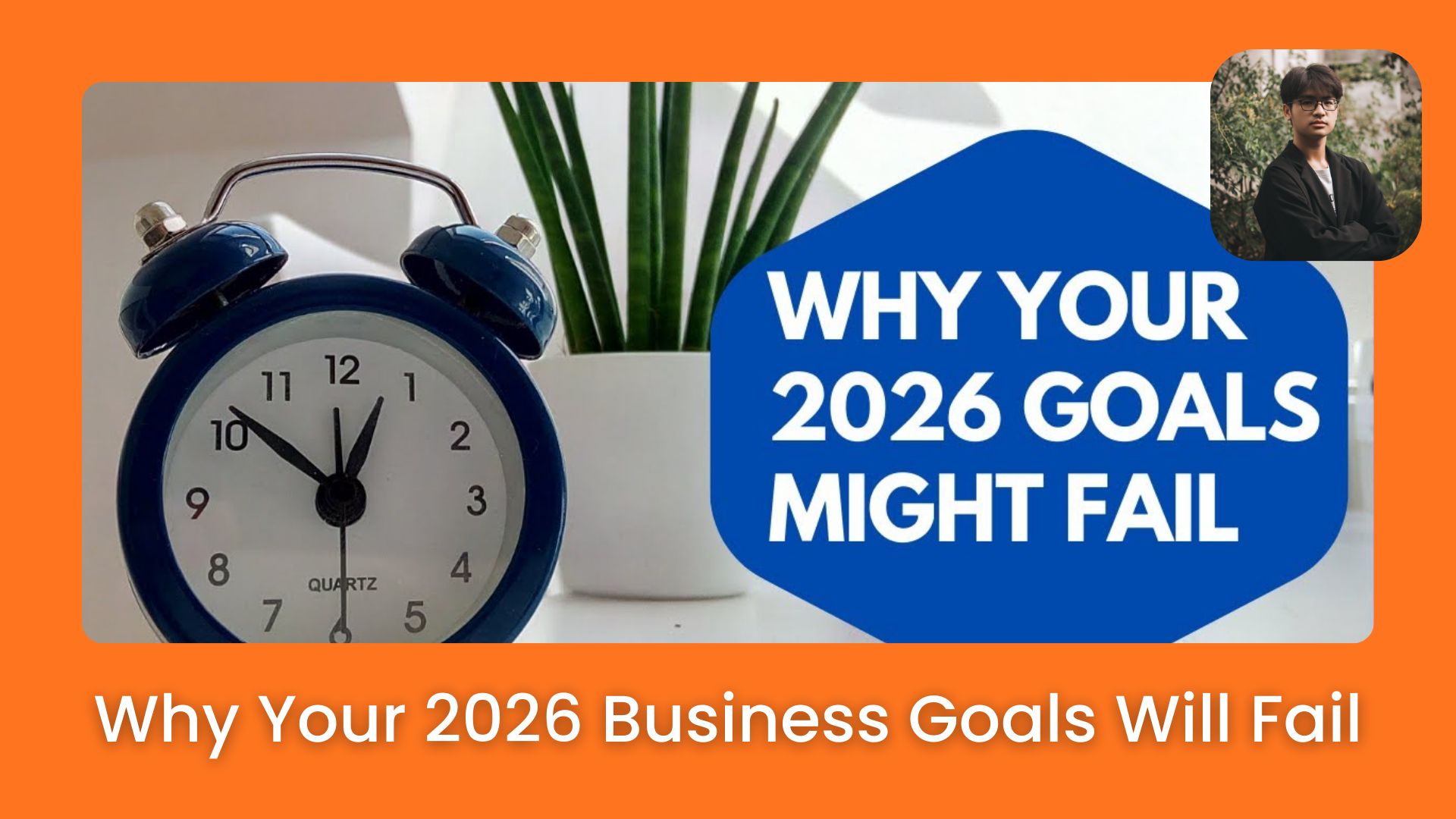
Hustle culture is a lie. I’ll break down the 5 A’s Framework that turns motivation into a weekly operating system.

Max Anh
January 14, 2026
TL;DR BOX
Most business goals fail for one simple reason: we set big targets and hope motivation will do the heavy lifting. I’ve done it too and it always breaks the moment real work shows up. In 2026, if you want your goals to survive real life, you need execution layers. The 5 A’s (Alignment, Awareness, Accountability, Activities, Assets) is the simplest framework I’ve found that actually sticks. Once I stopped trying to “work harder” and instead focused on assets and boring weekly activities, my goals stopped feeling emotional and started feeling systematic.
Key Points
Alignment: Choose between a "Lifestyle" ($1M-$3M, freedom-focused) or "Performance" ($50M+, legacy-focused) business early; mixing them causes burnout.
Awareness: Maintain an "Awareness List" to document inconsistent lead gen or team friction before they become fatal.
Accountability: Use the "Who Not How" principle; every quarterly breakthrough must have one specific owner.
Activities: Use the Monday/Friday rhythm (MMM/FAD) to ensure the team executes 3-6 high-leverage moves weekly.
Assets: You build wealth by creating things that work while you are sleeping (like systems or software).
Critical Insight
Success in 2026 isn't about motivation; it's about Systemic Pressure. When you replace the "Hustle" with a weekly operating rhythm and asset-building, your business goals become a math problem, not a wishing game.
📉 Which "A" is your weak link right now? |
Table of Contents
I. Introduction: The New Year Trap
It’s 2026 already and if you’re being honest, you’re probably about to do the same thing again: write goals that sound exciting… and then watch them die by February.
"I'm going to 10X my revenue!" "We're hitting $1M this year!"
I’ve done this more times than I’d like to admit. Cool goal. But where’s the plan? Who owns what? And what are you doing next Monday morning to make it real?
Listen, I'm not here to crush your dreams. I'm here to stop you from wasting another year on goals that were doomed from day one.
The answer, at least in my experience, is the 5 A’s Framework. This guide breaks down every piece of that framework. By the end, you'll know exactly why your previous goals crashed and how to build business goals that actually stick.
*Note: The post may not focus entirely on AI but but it’s important to read before delivering any AI project. You can think of it as a checklist and that’s exactly how it’s meant to be used.
Let’s fix this properly this time.
II. Why Your Business Goals Keep Failing?
The “hope strategy” is setting a target without building the structure to reach it. It feels good for a day or two. Then reality shows up and the goal gets buried. The problem is missing execution layers, not missing desire.
Key takeaways
Hope fades when bills and clients hit.
Big goals need weekly operating steps.
If you miss even one "A", your entire goal will fail.
A system should work even when you feel tired.
Motivation comes and goes. Routines don’t. That’s the difference that actually matters.
First, you need to see the real enemy: goals with no weekly structure. Let's talk about why most business goals are basically expensive hobbies.
Have you ever watched a reel of Elon Musk, felt invincible for 48 hours and then reality (unpaid bills, angry clients and daily fires) hits you? By February, the goal is gone. By December, you’re annoyed at yourself and make empty promises about "next year".

Here is the truth: Goals don't fail because you lack motivation. They fail because you lack a SYSTEM.
These goals usually share a few traits:

Alignment: Everyone pulling in the same direction.
Awareness: Honest acknowledgment of what is actually wrong.
Accountability: People who won't let you quit.
Activities: Non-negotiable weekly actions.
Assets: Things that compound year over year.
Miss any one of these and your goal is dead on arrival. Not because you didn’t want it badly enough but because nothing was built to carry it when life got loud.
Learn How to Make AI Work For You!
Transform your AI skills with the AI Fire Academy Premium Plan - FREE for 14 days! Gain instant access to 500+ AI workflows, advanced tutorials, exclusive case studies and unbeatable discounts. No risks, cancel anytime.
III. A #1: ALIGNMENT (The Part Everyone Skips)
Let’s start with the first A.
Alignment is another word for focus. Most founders are miserable because they are building a business that contradicts their desired life. You cannot win a race if you are running in two directions at once.
1. Define Your 3-Year Perfect State
Most people skip this step because it feels uncomfortable. Getting specific means committing and committing feels scary. But vague goals create vague results.

You need uncomfortable levels of specificity. Not "successful business" but the exact size of your team, your daily schedule and your lifestyle goals.
Now, could you answer these questions without hedging:
What is your exact revenue?
How many people on your team?
What is your role? (Are you the CEO or the lead technician?)
This level of detail forces clarity. You can't build what you can't see.
Like I said earlier, founders struggle because they mix two very different goals. There are two common paths:
The Lifestyle Business focuses on freedom and time. You want a team of 5-10 people, $1M-$3M in revenue and the ability to take a 6-week vacation without the world ending. You are the "Lead Artist" or "Expert".
Example: Greg Merrilees, founder of Studio1Design, runs a 7‑figure design agency with a tight team and clear processes, serving online businesses with branding and website design.
The Performance Business focuses on building a huge legacy and high revenue. You are building to sell for $50M+. This requires a team of 50+, intense stress, high-stakes management and a CEO mindset.
Example: Kyle Norton (CRO) has talked about scaling Owner from $2M to $50M+ ARR. That’s a “performance business” game: bigger team, higher pressure and a CEO mindset.

Neither path is better. If you’re trying to mix it, you will be miserable. So, pick your own path.
2. Align the People Closest to You
Misalignment usually doesn’t come from enemies. It comes from partners who think they’re supporting one plan while you’re secretly pursuing another.
There’s a reason this matters. Richard Ezekiel has cited that a large share of partnerships fail within the first two years. Misalignment is usually the real killer.

Source: Journeybee.
You can have the best plan in the world but if your spouse or co-founder isn't aligned, they will subconsciously sabotage your business goals.
There is no point in becoming a multi-millionaire if you lose your family in the process. You must be honest about time demands, financial risk, stress levels and exit expectations.
If someone cannot support the plan, it is still better to know now than discover it later when resentment has built up.
Last thing about this A. Alignment is not a one-time conversation. It is a system. Without it, even good goals quietly fall apart.
IV. A #2: AWARENESS (The Brutal Truths)
Once you set ambitious business goals, all the problems you've been ignoring suddenly become impossible to avoid. These are your Awareness issues. This is the moment you stop pretending that everything is okay.
Most people ignore these. They think, "I'll fix the lead gen problem once we hit $500k". That is a lie. Problems don't fix themselves; they just get bigger.
1. Examples of Real Business Awareness
These aren't theoretical. These are the actual concerns that surface when business owners get honest:
"Our lead gen is inconsistent".
“We have almost zero recurring revenue; everything is project-based.”
"I don't actually know how to manage a team".
"AI might make our service obsolete".
Notice how specific these are. Not "we need more customers" but "our lead generation is unpredictable". That specificity enables solutions.
2. The Fix: The Awareness List
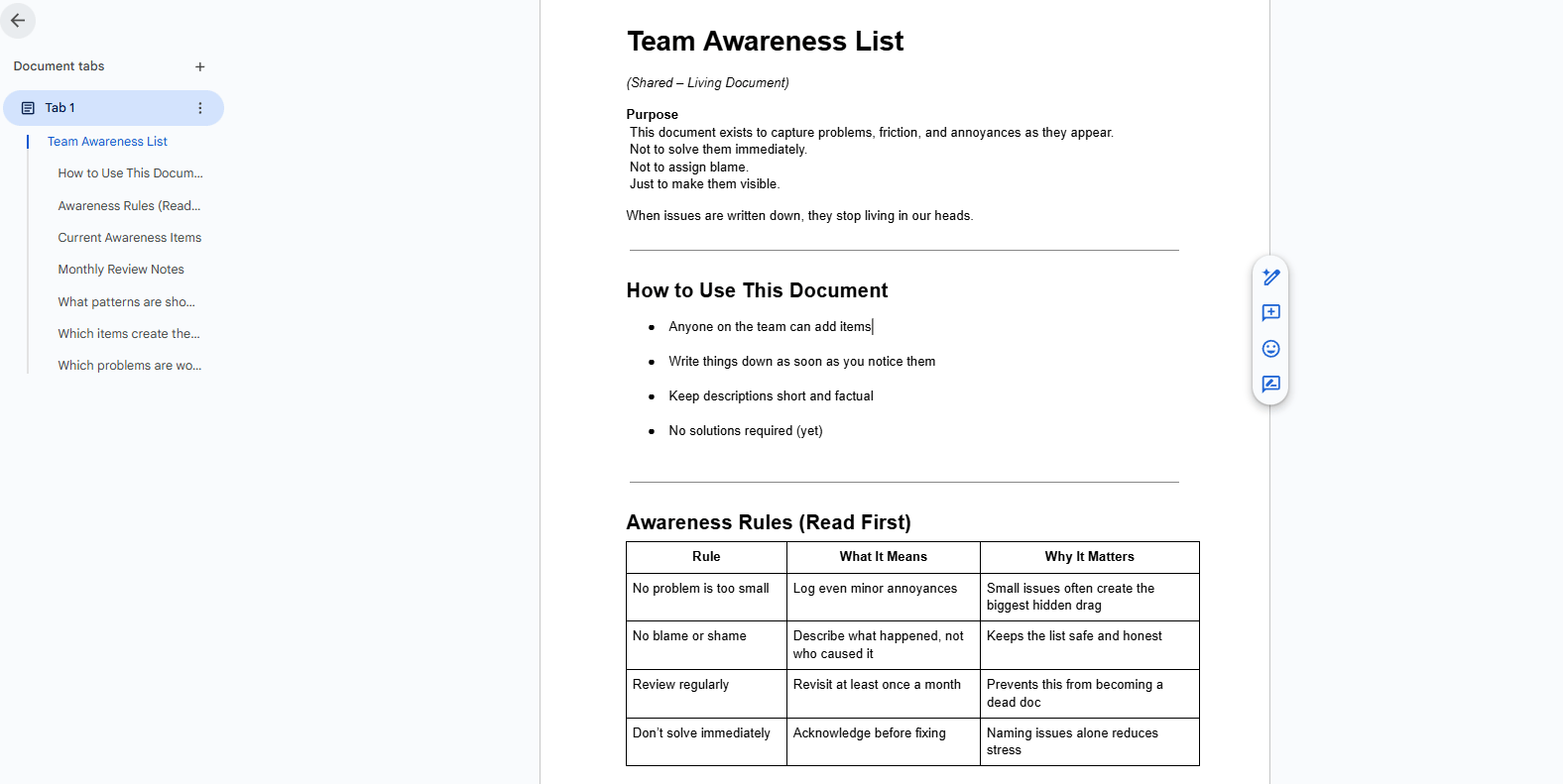
The solution is simple: you create one shared doc the whole team can see (Google Doc, Notion, Airtable,… the tool doesn’t matter). What matters is that you actually use it.
All you need to do is follow the rules for the Awareness List:
Rule | What It Means | Why It Matters |
|---|---|---|
No problem is too small | Document even minor issues or annoyances | Small problems often create the biggest hidden drag |
No blame or shame | Observe honestly without pointing fingers | Keeps the list safe and useful, not political |
Review regularly | Revisit the list at least once a month | Prevents it from becoming a forgotten doc |
Don’t solve immediately | Acknowledge issues before fixing them | Acknowledgment alone reduces anxiety and overwhelm |
Once problems are documented, they stop living in your subconscious, causing anxiety. The "Awareness List" turns your stress into a clear plan of action.
V. A #3: ACCOUNTABILITY (Build Your Power Team)
Here is where most entrepreneurs trip up: they try to solve every problem themselves. Success follows the "Who Not How" principle. If you are the only person responsible for every success, you have a job, not a business.
So instead of asking “How do I solve this?”, I force myself to ask “Who can solve this better than me?” The difference seems small but creates a massive advantage.
1. The 90-Day Breakdown
Every quarter, you need to identify exactly four major breakthroughs that must happen. Then, you assign a human name to each one.
Here is an example of Q1 2026 Breakthroughs:
Launch AI-integrated service offering → Owner: Head of Product + External AI consultant
Build a predictable lead generation system → Owner: Marketing Manager + Growth agency
Standardize premium delivery process → Owner: Operations Manager
Hire senior salesperson → Owner: You + Recruiter
Now you notice how each has clear ownership. When something has two owners, it has no owner. When something has one owner with clear responsibility, it gets done.
2. External Pressure
External accountability might be the most underrated success factor in business. You need someone who isn't on your payroll to hold you accountable. Whether it’s a high-ticket mastermind, a coach or a peer board, you need someone who will call you out when you try to hide from your goals.
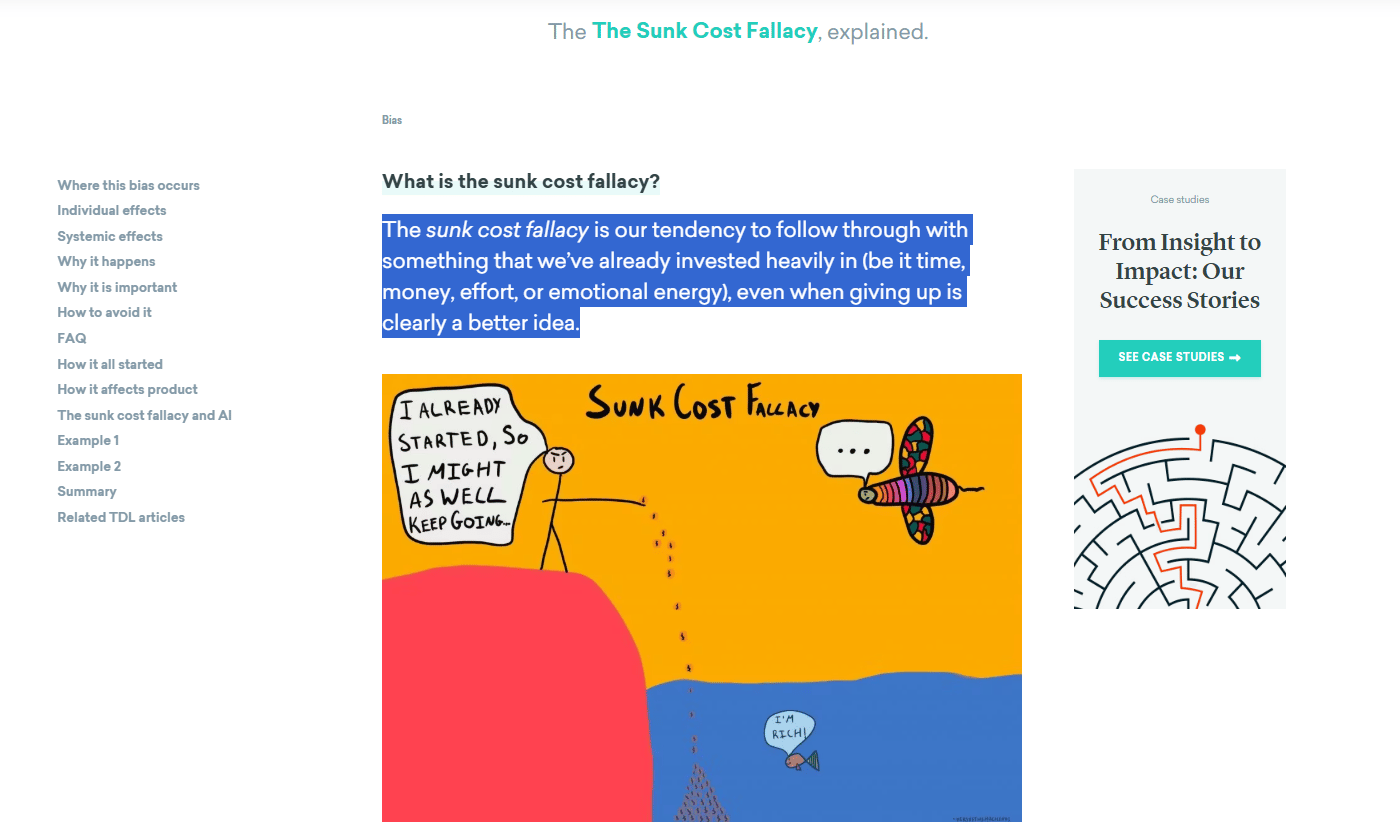
And yeah, there’s psychology behind why paid accountability works. It’s basically sunk cost fallacy: once you’ve invested time and money, you’re less likely to quit when it gets uncomfortable.
Source: The Decision Lab.
When you've invested $20,000 in a business coach or accelerator program, you become dramatically less likely to quit when things get hard. The financial commitment creates psychological pressure that internal motivation alone can't match.
Accountability creates pressure you can't escape from. That pressure forces action when willpower fades.
VI. A #4: ACTIVITIES (The Boring Weekly Stuff)
This is where theory meets reality. Business goals get achieved through repetitive, boring, non-negotiable activities done week after week.
I’ve watched founders stay “busy” for years without progress because their weeks weren’t anchored to outcomes.
1. The Monday/Friday Rhythm
Success is just the result of doing the same "boring" high-leverage activities week after week.
The Monday Morning Meeting (MMM) is for planning. Every team member declares 3-6 non-negotiable activities for the week. Not 50 tasks, just the 3-6 that actually move the needle.
This creates peer accountability and forces people to focus on what actually matters instead of what feels comfortable.

In AI Fire, we run a simple weekly rhythm. One meeting to lock the week’s 3-6 moves and one meeting to review what actually got done, just “what worked, what didn’t and what we change next week.”
The Friday Afternoon Debrief (FAD) is for checking what you actually finished. You review the list. What got done? What failed? Why?
You need to do this without shame or blame; just an honest assessment.
2. Peer Pressure for Productivity
When your team sees you declaring your activities and you see theirs, over time it creates a culture of execution.
You stop "playing business" and start producing results. If your activity list is full of "emails" and "meetings", you are failing. It should be full of "sales calls", "content pieces" and "system builds".
Most importantly, it turns goals from aspirational statements into operational reality.
VII. A #5: ASSETS (Compound Growth)
Here's where wealthy entrepreneurs think fundamentally differently from struggling ones.
Struggling entrepreneur mindset: "I need to work harder and hustle more".
Wealthy entrepreneur mindset: "What asset can I build, buy or improve that makes this permanently easier?"
The difference compounds dramatically over time.
1. What Qualifies as an Asset?
A job pays for your hours. A business pays for the assets you own. An asset is something you build once that makes your life easier forever.
Intellectual Property: Your frameworks, courses or books.
Brand Assets: A YouTube channel or an email list of 50,000 people.
Systems: Automated lead gen workflows using AI tools (Zapier, AI agents, simple automations) that run 24/7.
Financial Assets: Investment portfolio compounding in the background.
I build these kinds of workflows all the time. I set one up once, then it keeps saving me hours every week. That’s what I mean by an “asset”.
The workflow below, built in n8n, helps me research all the local markets I want. If you want, I already wrote a guide that walks through the exact workflow + templates. You can copy it without being technical.

With every asset, you have exactly three options:
Buy it: Acquire an existing asset (hire an expert, buy a business, purchase software).
Build it: Create it yourself from scratch (create content, develop systems).
Improve it: Optimize what you already have (update your website, refresh your course).
Example of an asset investment meeting: Regularly, quarterly works well, ask: "Where should we invest our capital and time for the highest ROI?"
Now, if you have $10,000 to invest, there are two options you could choose:
Option A: Build a lead generation "scorecard" tool that generates 500+ qualified leads per month indefinitely.
Option B: Down payment on a $1M rental property that generates $3,000/month passive income.
Both are solid investments. But if your goal is growing your business to $1.2M, Option A probably accelerates that goal more directly, even though Option B sounds like the "smarter" long-term business goal.

Asset thinking changes everything. Instead of just completing tasks, you're constantly building things that compound.
2. The Assets Concept
There’s a finite set of assets that actually make a business valuable: brand trust, customer data, systems, IP, partnerships, cash and capability. You don’t need all of them at once. Pick 2-3 per quarter to build, buy or improve.
For example, investing $10k in a "Lead Generation Scorecard" (an asset) is far better than spending $10k on a one-time ad campaign (an activity). The asset stays and the ad disappears.
Over time, you systematically transform from a hustle-dependent business into an asset-rich business that runs increasingly well without your constant intervention.
I put the entire 5 A’s Framework into a simple 1-page checklist you can follow this week.
VIII. Real-World Example: The $300k Lifestyle Business
Theory is useful but concrete examples are better. Let's see exactly how the 5 A's work in practice.
The Goal: Build a lifestyle business that pays you $300,000 per year in profit
Total Business Revenue Required: $1.2M annually
Business Type: Service-based business (coaching, consulting, agency, etc.)
Phase | Action Step |
|---|---|
Alignment | Choose "Lifestyle Business". $1.2M revenue goal. 8-person team. |
Awareness | Admit that the current lead gen is "referral only" and inconsistent. |
Accountability | Hire a Growth Agency to own the "Lead Gen System" breakthrough |
Activities | Salespeople must do 15 discovery calls per week, every week. |
Assets | Create a special "Methodology Guide" to build trust and charge higher prices. |
Total Investment: Approximately $25K to $35K plus significant time.
Expected ROI: If it generates 30 extra qualified leads monthly and closes 6 extra deals yearly at $30K each, that's $180K additional revenue. That's a 500%+ ROI on the asset investment.
Creating quality AI content takes serious research time ☕️ Your coffee fund helps me read whitepapers, test new tools and interview experts so you get the real story. Skip the fluff - get insights that help you understand what's actually happening in AI. Support quality over quantity here!
IX. What Should You Do This Week to Apply The 5 A’s?
Turn this into a 5-day sprint to reset your business goals. All you need to do is do one “A” per day. It doesn’t require big work, just real action. By Friday, you should have a system you can run weekly.
The framework only works when it becomes a weekly habit.
Here’s a simple breakdown you can actually finish in one week:
Monday: Write your Alignment doc. Be uncomfortably specific about the end state.
Tuesday: Start your Awareness List. Write down every problem you are ignoring.
Wednesday: Set your Q1 Breakthroughs. Assign owners.
Thursday: Map out your Weekly Activities.
Friday: Plan your first Asset Investment.
X. Final Thoughts: Stop Wishing, Start Building
The "hustle culture" is a lie. You don't need to work 100 hours a week to hit your goals; you need to work on the right things with the right people.
The 5 A's framework isn't magic; it's just a systematic approach to breaking down big, scary business goals into manageable steps.
Most people will read this, agree with it and then change nothing. That is the real trap. But the fact that you are still here means you are ready for the upgrade.
2026 can be the year you finally stop "trying" and start "succeeding". Pick one area and fix it this week. Your future self is waiting for you to upgrade your business.
If you are interested in other topics and how AI is transforming different aspects of our lives or even in making money using AI with more detailed, step-by-step guidance, you can find our other articles here:
Overall, how would you rate the AI Workflows Series? |
Reply