- AI Fire
- Posts
- ⚠️ This “Super Agent” Update Changed How You Work (ChatGPT Can Compete or Not?)
⚠️ This “Super Agent” Update Changed How You Work (ChatGPT Can Compete or Not?)
This isn’t another prompt hack. I’ll show you how this new Manus update actually works, how it BEATS ChatGPT and when it’s worth paying for.

Max Anh
December 17, 2025

TL;DR BOX
Manus AI’s "Super Agent" update introduces an autonomous system that plans, executes and self-corrects complex workflows using GPT-5 integration.
Unlike reactive tools, Manus coordinates specialized agents to handle multi-step tasks like deep research in parallel. It navigates the web autonomously and sustains reasoning for 20-30 steps, replacing hours of human labor.
Key points
Stat: The GPT-5 engine allows Manus to execute 20-30 step workflows without losing coherence.
Mistake: Treating Manus as a "set and forget" magic wand; large projects still require phased milestones.
Action: Use Manus for structured data gathering, reserving human effort for creative judgment.
Critical insight
The revolution lies in the "army architecture" that splits complex goals into parallel workstreams executed simultaneously by specialized agents
📉 What is killing your productivity the most? |
Table of Contents
I. Introduction: The Seismic Shift
Right now, most people still use AI like a slightly smarter Google. You ask questions, it answers and then you do the real work.
Manus AI’s new Super Agent doesn’t work like that. You give it a real business objective and it plans, researches, clicks through the web and fixes its own mistakes while you’re doing something else.
I’ve been testing this update for a while and it honestly makes most “AI tools” feel like calculators. In this Part 1, I’ll walk you through what changed, what it can really do and where the limits are so you don’t treat it like magic.
II. What Is Manus AI And How Is It Different?
Manus is basically an autonomous worker. You give it a goal and it plans and runs multi-step workflows without you hovering over it. You give it an objective and it figures out how to reach it. It browses, researches, compares data and self-corrects as it goes. Normal tools wait for you to tell them what to do next. Manus takes a goal and runs the whole process on its own.
Key takeaways
Plans tasks independently.
Executes research and data extraction across the web.
Self-corrects when blocked.
Coordinates many specialized agents in parallel.
It behaves like an operational system, not a chat assistant.
So, most AI tools follow a simple pattern: You input a request, AI processes it, you get a response and you decide what to do with that response. This is the ChatGPT model. They are reactive systems, waiting for your instructions.
Manus AI works in a completely different way. It is an autonomous super agent system, meaning it:
Plans Complex Tasks By Itself: You give it an objective ("Research the top 20 MBA programs and compare them by ROI") and it breaks down what research needs to be done, what data points matter and how to structure the analysis.
Works Without Help: It doesn't ask permission at each step. It accesses web browsers, navigates to relevant sources, extracts information and cross-references data autonomously.
Fixes Mistakes While Working: When it encounters errors (paywalls, broken links), it tries alternative approaches. This isn't weak automation that breaks when things change; it is smart work.
Manages Many Special Agents: For complex projects, it uses 100+ specialized agents (research, data analysis, coding) that work in parallel.

The Big Change: Normal AI loses the thread on long, complex work. Manus can keep going for 20+ hours, remember what it decided earlier and still give you a clean, coherent result.
Learn How to Make AI Work For You!
Transform your AI skills with the AI Fire Academy Premium Plan - FREE for 14 days! Gain instant access to 500+ AI workflows, advanced tutorials, exclusive case studies and unbeatable discounts. No risks, cancel anytime.
III. The Super Agent Update: What Actually Changed
The update introduces several capabilities that I’ve seen produce massive speed improvements.
Upgrade 1: GPT-5 Integration (The Intelligence Leap)
Manus upgraded its core reasoning engine to GPT-5 (or GPT-5-class models). This isn't just "slightly smarter answers". It helps with agentic tasks (complex, multi-step workflows requiring deep thinking).
Previous Capability: Handle 3-5 step workflows before losing coherence.
Current Capability: Execute 20-30 step workflows while maintaining consistency.
What This Means For Money: Work that previously required 8-12 hours of human research now completes in under an hour for the cost of a Manus subscription.
For example, below is one of my chats about researching all the posts on Facebook from e-commerce founders in the UK seeking support. As you can see, it does a lot of things, from thinking, searching,… to even browsing a new tab on its own server.


Upgrade 2: Advanced Image Editing (Beyond Generation)
It’s not just smarter at text. Manus also pushed a big upgrade in image editing. Most AI image tools generate images from scratch. Manus edits images based on simple text instructions.
Color Replacement: "Change all blue elements in this image to red". Manus identifies every blue component and adjusts hue values precisely.
Batch Processing Intelligence: "Apply these edits to 100 product photos but adjust for each product's unique lighting". Manus processes the entire set adaptively.
Why This Matters: E-commerce sellers spend thousands monthly on image editing. Manus processes batches in under an hour for a low cost.


Upgrade 3: Smart Task Assigning (The "Army" Architecture)
The most significant upgrade is how Manus coordinates its specialized agents.
Previous Model: Sequential execution. Agent A passes to Agent B. If B gets stuck, the workflow stalls.
Super Agent Model: Doing tasks at the same time.
Step 1: Analyze requirements and break them into parallel workstreams.
Step 2: Assign specialized agents to each workstream simultaneously.
Step 3: Agents work independently, sharing findings in real-time.
Step 4: Combines results into one clear final answer.

Real Example: I know a guy who tested this by asking it to create its own open-source alternative. Instead of one agent doing everything sequentially,
Agent 1 researched existing open-source AI agents.
Agent 2 analyzed the OpenManus repository structure and features.
Agent 3 analyzed OWL repository architecture and components.
Agent 4 defined the Anus AI agent (really, no joke) architecture and core features.
,… all at the same time.
The result was a complete AI agent system from scratch.

Creating quality AI content takes serious research time ☕️ Your coffee fund helps me read whitepapers, test new tools and interview experts so you get the real story. Skip the fluff - get insights that help you understand what's actually happening in AI. Support quality over quantity here!
IV. The Practical Limitations You Need to Know
We all agree Manus Super Agent is really good but that doesn't mean it's perfect. Here are the current limitations of the super agent you must navigate.
1. Hard Tasks Can Fail
Manus is amazing at structured research and data gathering. It still struggles with very creative work or niche expert judgment that isn’t well documented online (e.g., specific medical diagnosis).
→ Use it to stop doing boring work. Apply your expertise to creative elements.

2. Web Browsing Limits
Manus can move around the open web pretty well but it still hits walls with paywalls, CAPTCHA and tricky logins. So, for this, I highly recommend you maintain human subscriptions for critical paywalled sources. Use Manus for 80-90% of research and supplement manually.

3. Context Memory Limits
Even GPT-5 has limits. Very large projects (100+ page reports synthesizing 500 sources) need to be broken into phases. Treat Manus like a capable team member who benefits from clear milestones rather than a "set it and forget it" magic wand for infinite complexity.
4. Learning Curve Exists
Many people think, “Manus runs on its own, so I don’t need to learn anything.” That’s not how it works. You still need to break big goals into clear steps and give the system proper context. Most users need 10–20 hours of hands-on use before it starts feeling smooth and reliable
V. Bonus Part: Manus Projects - The System That Keeps Everything Organized
Once you see what the Super Agent can do, the real power comes when you plug it into Projects so nothing gets lost between sessions.
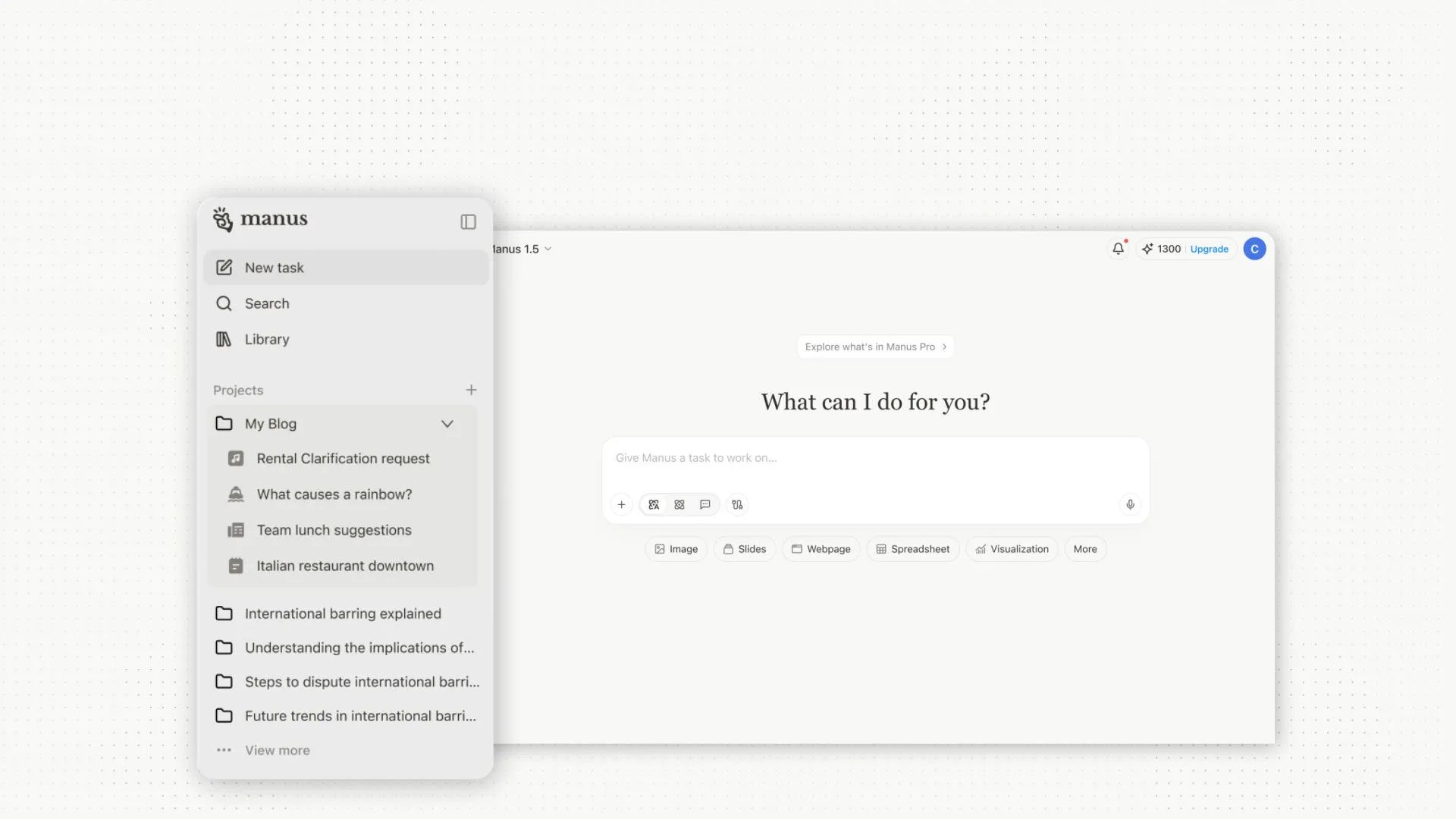
Projects turn Manus from a powerful agent into a full workflow system. Instead of running everything in one long chat, you get a structured space where tasks, files and research stay organized across days or even weeks.
1. What Projects Do
Store your goals, files, notes and past outputs.
Keep memory across tasks.
Track progress and versions.
Give Manus a stable context for long workflows.
It’s a project folder, not a temporary conversation.
2. How It Works
Manus is not like other simple chatbots. It’s designed to handle really hard projects. Here’s how it keeps work organized and moving forward without losing context:
Persistent Memory: Upload PDFs, spreadsheets or past research. Manus uses them automatically in all future work.
Clear Tasks: You can assign simple, separated tasks (“Find competitors,” “Extract pricing,” “Summarize differences”). Manus tracks each step.
Long-Running Workflows: Close your laptop and return days later. The project still knows what’s done and what’s next.
Version Control: Every update is saved as a new version. You can compare or revert anytime.

3. Where Projects Shine
Projects are where Manus becomes truly useful. They’re built for work that doesn’t fit into a single chat and needs structure over time.
Multi-country market research.
Content systems with brand voice + past drafts.
Client work: audits, reports, weekly deliverables.
Any task that needs structure beyond one session.
The Super Agent handles complex tasks. Projects make those tasks manageable, repeatable and continuous.
Together, they behave like a small operations team that never loses context.
Below is an image that I uploaded a Golf Rules PDF in Manus Project and Manus will never forget it, even in other chats in the same project.

VI. Is The Pricing Worth It?
For anyone who bills for research, analysis or operations, yes. Even the mid-tier plans pay for themselves if Manus saves a few hours each month. Agencies and freelancers benefit the most because they turn time saved directly into revenue.
Key takeaways
Free tier is good for testing.
$19-$39 tiers fit solo operators.
Pro tier suits agencies and heavy workloads.
Value comes from replacing 20-40 hours of manual work.
If one client project covers the entire subscription cost, the tool becomes pure profit.
Manus offers tiered pricing designed for different users:
Free ($0): For testing and learning.
Basic ($20/mo): For solo entrepreneurs running regular workflows.
Plus ($40/mo): For established freelancers handling 5-10 projects.
Pro ($200/mo): For agencies and high-volume users. Maximum credits and faster speed.
If Manus cuts even 20 hours of work a month, that’s easily $1,000-$2,000 in time saved for most service providers. In a lot of cases, one client project can pay for the whole year of the tool.

VII. Conclusion to Part 1
You now understand the tool. You know it’s not just a chatbot; it’s a super agent army of interns that can do work at the same time.
But having a powerful tool doesn't put money in your bank account. You need a business model.
In Part 2, I will show you exactly how to make money with this. I will break down the 4 specific business models my colleagues and I are using, the customer finding strategy and the "time-saving" secret that makes this so profitable right now.
If you are interested in other topics and how AI is transforming different aspects of our lives or even in making money using AI with more detailed, step-by-step guidance, you can find our other articles here:
How would you rate this article on AI Tools?Your opinion matters! Let us know how we did so we can continue improving our content and help you get the most out of AI tools. |
Reply