- AI Fire
- Posts
- 📈 If You Start a SaaS in 2026, Do This To Hit 1,000 Users With Only 5 AI Employees
📈 If You Start a SaaS in 2026, Do This To Hit 1,000 Users With Only 5 AI Employees
Forget venture capital and expensive ads. Steal the "Inbound-Led Outbound" plan that turned a simple Slack tool into a $5M profit machine for a tiny team.

Neil Phan
January 19, 2026
TL;DR
A successful SaaS strategy in 2026 relies on finding a problem first, not just building a product. By validating ideas with "300 calls" and building a "painkiller" rather than a vitamin, founders can minimize risk before writing code. Combine usage-based pricing with a "Sales Assist" model to convert users, and leverage "Building in Public" on LinkedIn to attract an audience without expensive ads.
Key points
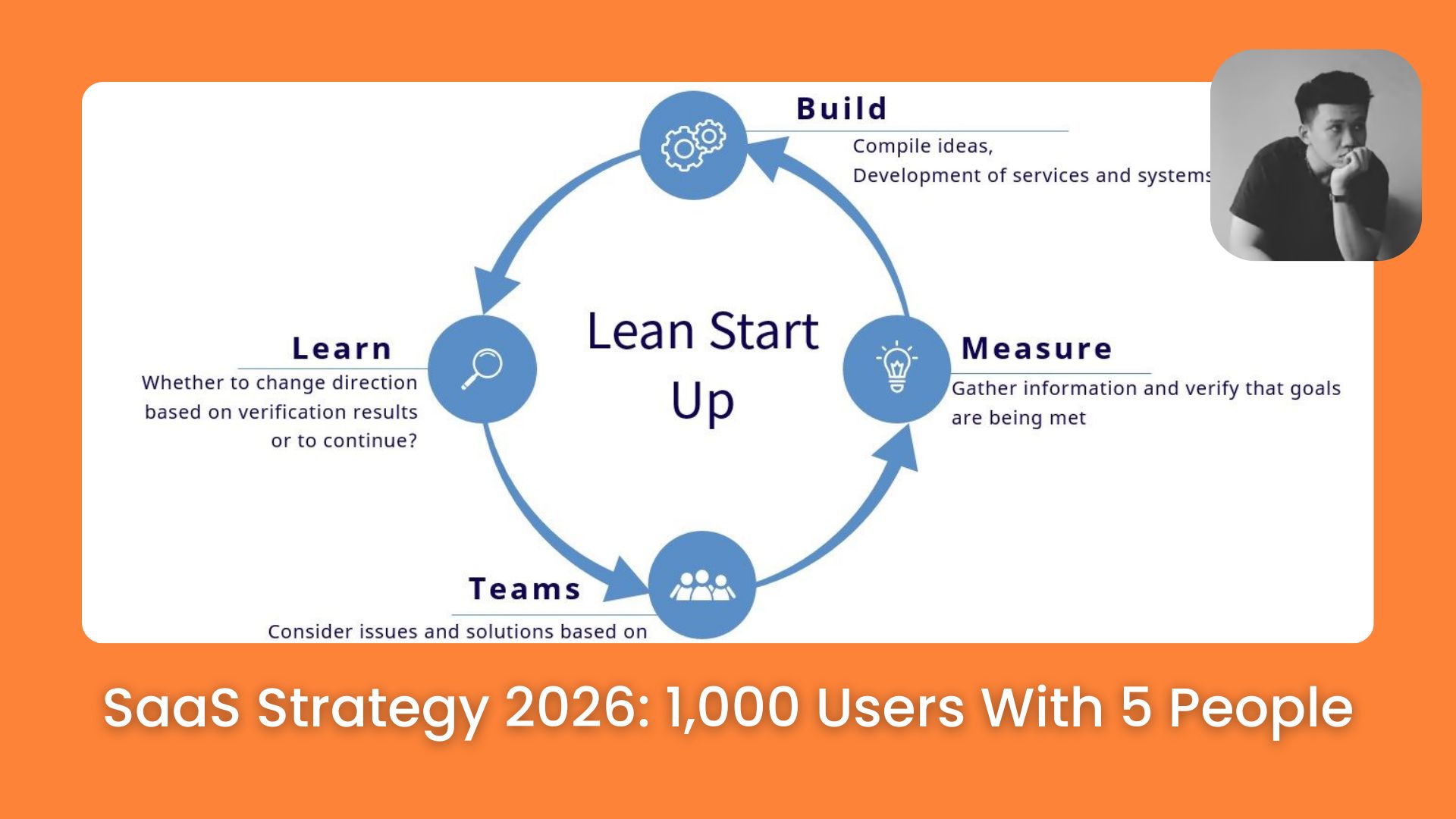
Strategy: Use the "Lean Startup" method to validate ideas before coding.
Tactic: Talk to 300 potential customers to find a "painkiller" problem.
Pricing: Usage-based models (pay-per-lead) convert better than flat monthly fees.
Critical insight
If you can't get 100 people to join a free waitlist, you will never get them to pay for the final product.
🤔 What is your biggest fear when starting a SaaS in 2026? 📉 |
Table of Contents
Starting a software business in 2026 is a wild ride. You probably see new AI tools popping up every hour and feel like you are already late to the party.
Most people will tell you that you need a huge team, millions of dollars in funding, or a revolutionary idea that no one has ever thought of before. But that is just not true.
A great SaaS strategy 2026 is not about having the most money; it is about having the best plan to solve a real problem for real people.
In this guide, I will show you how to build a software company from scratch and get your first 1,000 users without losing your mind or your savings. We are going to look at the exact steps used by successful founders like Adam Robinson to hit millions in revenue with tiny teams.
The magic of a tiny team lies in picking the right niche. Before we dive into the steps, it helps to understand the market by looking at 5 profitable SaaS ideas making $50k/month that most founders often overlook.
Part I: Why Do You Need A Solid SaaS Strategy To Avoid Early Failure?
Founders often fail because they build a key (product) and search for a lock (problem), wasting months and money on ideas nobody wants.
A solid strategy reverses this: validate the market need first using the Lean Startup method, ensuring you solve a painful problem before writing code.
This approach prevents "sunk cost" fallacies where you refuse to delete unwanted features just because you spent time making them. A solid strategy reverses this: validate the market need first using the Lean Startup method, ensuring you solve a painful problem before writing code.
Since your time is limited, it is essential to work smarter by using free AI tools that handle the heavy lifting of data collection and content drafting while you focus on talking to real users.
Key takeaways
Concept: Product-Market Fit means solving a problem people actually have.
Mistake: Building in secret for months leads to wasted money.
Product Type: Build a Painkiller (must-have), not a Vitamin (nice-to-have).
Action: Set checkpoints; if 30 people reject a feature, delete it immediately.
For any tech founder, there is a famous concept called Product-Market Fit. This means your product and what people want are a "perfect match."
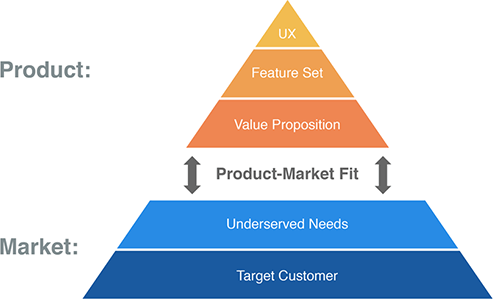
A professional SaaS strategy helps you do the opposite. You find the lock first, then you build the key.
1. The Trap Of Building In Secret
When you spend 6 to 12 months coding without talking to anyone, you are wasting two very important things: Money and Time.
The "Parent" Mistake: Founders often love their ideas too much, like a parent loves their child. You think you know what the market needs. But in reality, the market is always the boss. If the market says "No," you are wrong.
Waiting too long for feedback: If you wait until the product is perfect to launch, it is too late. If you find out that no one wants a specific feature, you have already wasted thousands of hours.
The Smart Strategy: You must use the Lean Startup way. Build a very simple version quickly. Your goal is not to be rich on day one. Your goal is to "learn" from customers' complaints.

2. Is Your Product A Vitamin Or A Painkiller?
In the software business, your product is usually one of these two things:
Vitamins (Nice to have): These make the user feel a little bit better or work a little bit faster. When a company wants to save money, they cancel these subscriptions first.
Painkillers (Must have): These solve a burning problem. For example, losing money, breaking the law, or doing a task that takes 20 people to finish. Customers cannot live without these.
If your idea falls into the Vitamin bucket, stop. Do not write a single line of code. It requires too much marketing effort to convince people they need a "nice-to-have" tool.
In 2026, budgets are tight. CFOs sign checks for painkillers instantly, but they debate vitamins for months before saying no. Go back to your research until you find a problem that hurts enough to pay for.
Learn How to Make AI Work For You!
Transform your AI skills with the AI Fire Academy Premium Plan - FREE for 14 days! Gain instant access to 500+ AI workflows, advanced tutorials, exclusive case studies and unbeatable discounts. No risks, cancel anytime.
3. The Danger Of "Sunk Cost"
The more time you spend building in secret, the harder it is to stop. You might think: "I spent 5 months on this feature, I cannot delete it now!"
A good strategy sets Checkpoints. If you talk to 30 people and nobody wants to pay for that feature, you must delete it immediately. It does not matter how long you spent coding it.
Forget about the code you threw away. Pushing a dead-end feature is a double loss: wasted time and zero revenue. Stop digging a hole and start building a ladder. Do it right, and the results will follow.
Part II: How Can You Use Validation As Your Primary SaaS Strategy?
Validate your idea by talking to 300 potential users to identify shared complaints before building anything. Use Perplexity to scan forums like Reddit for real-time frustrations, then create a simple "terrible" Version 1 (MVP) to test if the solution works.
Launch a waitlist page immediately; if you can't get emails for a free promise, you won't get dollars for a paid product. Following this validation path is exactly how tiny teams create a repeatable recipe to hit $200k/month in revenue without needing a large staff or complex tech.
Key takeaways
Rule: Talk to 300 people to find a common, expensive problem.
Tool: Use Perplexity to find real-time user complaints on Reddit.
Tactic: Build a simple MVP (even a PDF) to test the solution quickly.
Test: A waitlist with zero sign-ups means you have zero business.
Before you do anything else, you must prove that people want what you are thinking of building. I call this "de-risking" your life. You want to be 90% sure people will buy it before you spend a single dollar on developers.
1. The 300-Call Rule
Adam Robinson called over 300 marketing leaders before he built his latest tool, RB2B. He didn't ask "Would you buy this?" because people lie to be nice.

He asked, "How do you solve this problem right now?" and "How much does that problem cost you?"
If you talk to 100 people and 80 of them have the same complaint, you have found a gold mine. If only 5 people care, you need a new idea.
2. Building A Terrible Version 1
After you talk to people, you need to build something. But do not try to build a giant machine. Your first version (MVP) should be very simple. It should almost be embarrassing.
If you are building a tool to help people write emails, Version 1 could just be a PDF guide or a simple list of templates. The goal is to see if people actually use the solution, even if it looks ugly.
3. How To Use Perplexity For Deep Research
Before I build, I always use Perplexity to research. In my experience, Perplexity is much better than other AI tools because:
It uses real-time data: It searches the internet right now to find the latest complaints from users.
It gives sources: It shows you exactly which websites or forums (like Reddit) the information came from.
It is specific: It doesn't give "general" advice; it gives real facts.
Example Prompt for Research:
Search Reddit, Quora, and software review sites for small gym owners. List the top 10 biggest frustrations they have with tools like Mindbody or Zen Planner. Look for complaints about price, speed, and 'hard to use' features. Highlight things that cost them money or waste at least 5 hours a week.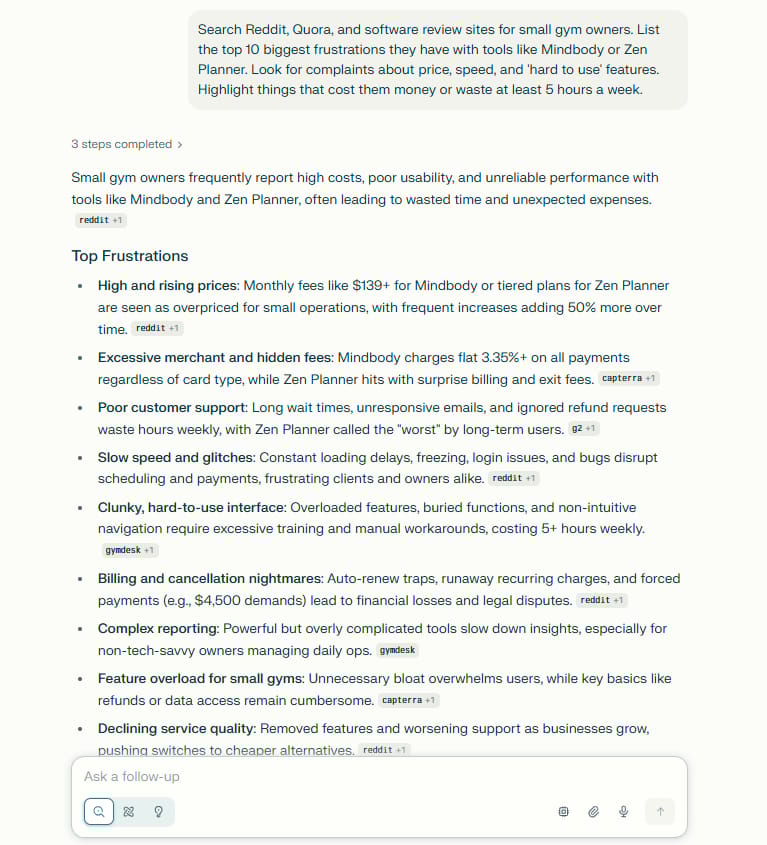
Analyze the "Why": When Perplexity gives you the list, look for patterns. If 5 different sources say "Mindbody is too slow on mobile," then you know your Version 1 must be very fast on mobile.
The Rule: If people are not willing to use your "ugly" Google Sheet to solve their big problem, they probably won't pay for your expensive app either.
4. Creating A Waitlist
Do not wait for the product to be finished to get users. Create a simple page on Carrd or Framer that says: "I am building X to solve Y. Join the waitlist for early access."
If you can't get 100 people to give you their email address for a free waitlist, you will never get them to give you money later.
Part III: How Does Building An Audience Fit Into A Modern SaaS Strategy?
Many founders think marketing is just about paying for ads. But in 2026, ads are very expensive. If you don't have an audience, you have to pay money to get people to look at you. If you have an audience, people look at you for free.
1. Break The Corporate Wall
Today, people hate looking at shiny ads. A smart SaaS strategy is to make the founder a trusted guide.
The Power of Being Honest: When you talk about a mistake, you don't look weak. Instead, you build trust. Customers think: "If this founder is honest about mistakes, I can trust them when I use their software."
Be a Character in a Movie: People love stories with ups and downs, failures, and wins. Turn your SaaS journey into a "show" where your audience is cheering for you.
Your competitors can copy your features, match your pricing, and steal your design. But they cannot copy you.
In a crowded market, your unique story and personality are the only competitive advantages that are truly 100% yours.
2. The 80/20 Content Rule: Making "Trust Deposits"
Imagine trust is like a bank account. Every time you share something helpful, you "put money in." Every time you ask someone to buy, you "take money out."
80% Value and Stories (Putting money in):
Behind the scenes: Show yourself working at 2 AM to fix a bug for a customer.
Real data: Share your revenue charts (even if they are small). This shows you have nothing to hide.
Expert tips: Teach people how to solve a problem without your software. This proves you are an expert.
20% Promotion (Taking money out): After you put in enough trust, asking people to try your demo feels very natural. They buy because they want to support your journey.
3. LinkedIn: The Best Place For B2B Founders
LinkedIn is not just for finding jobs anymore. It is where big business conversations happen. The strategy here is not "post and run." It is Networking at Scale.
Stories win: Posts about personal stories get 5 to 10 times more views than boring technical posts.
Comments are content: Spend 30 minutes every day answering every comment. Every reply is a chance to show you care.
Detailed Prompt for Content Creation:
I am a founder building a tool to help Shopify shop owners get fewer returns. Write 5 LinkedIn post ideas for me using the 'Build in Public' style:

Post 1 (Failure): Tell a story about a code mistake that stopped the system for 1 hour. Show how I said sorry to my customers.

Post 2 (Win): Share how I felt when the first stranger paid for my software.

Post 3 (Feedback): Show 2 designs for an 'Automatic Refund' feature and ask people which one they like more.

Post 4 (Opinion): Explain why the current way shops handle returns is 'killing' their profit.

Post 5 (Daily Life): A photo of my messy desk at 11 PM. Talk about the stress of building a startup alone. Language: Friendly, no hard words, focus on feelings.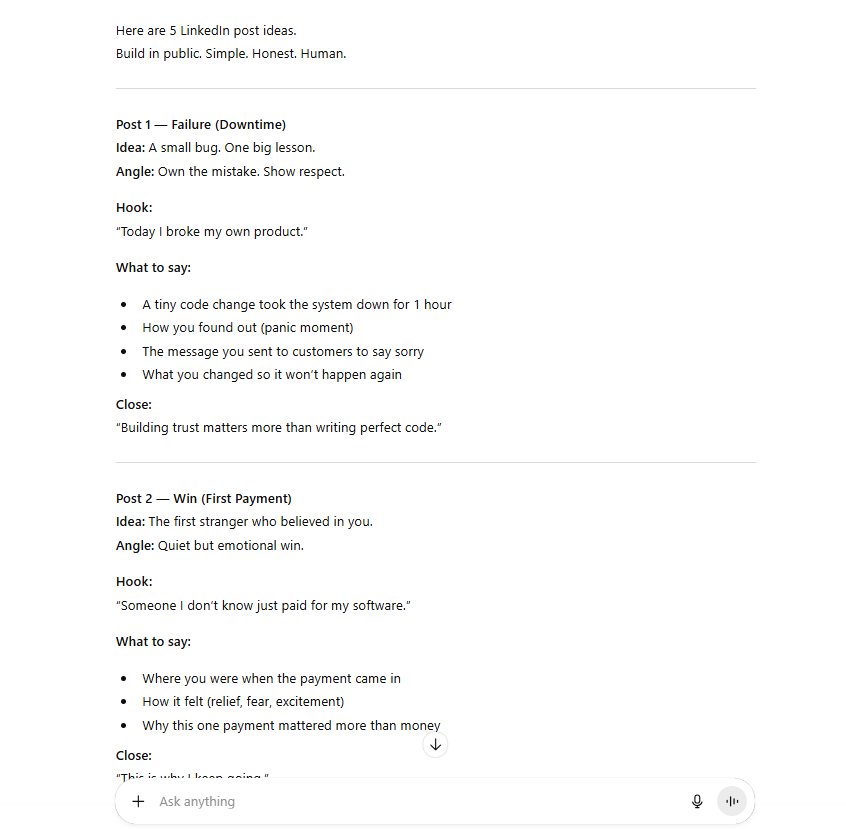
The Lesson: Your Audience Is Your "Safety Wall"
A competitor can copy your features in one week. But they cannot copy the relationship between you and your audience. This is the hardest part to build, but it lasts the longest in any SaaS strategy.
Part IV: Why Is Usage-Based Pricing A Game-Changer For Your SaaS Strategy?
Pricing is where most founders get stuck. They pick a random number like $49/month because everyone else does it. But what if your user only uses the tool once a month? Or what if they use it 1,000 times?
1. The problem with flat fees
If you charge everyone $500, small users won't sign up. If you make it free, you make no money. The "middle ground" is usage-based pricing.
2. The RB2B Example

Adam Robinson's tool started with a $495/month plan. No one bought it. Then he changed it:
Free: Up to 200 leads.
Pro: Pay per lead after that.
Suddenly, revenue jumped from $5,000 to $80,000 in a few months. Why? Because users only paid as they got value.
3. Creating Upgrade Moments
You want your users to hit a wall that makes them happy to pay. For example, "You just reached your limit of 50 reports this month.
Upgrade now to keep seeing your data!" If the data is valuable, they will click "Buy" in a heartbeat.
Part V: How Can You Combine Self-Service And Human Help In Your SaaS Strategy?
There is a big debate: should users sign up themselves (Self-Serve) or should they have to talk to a salesperson (Sales-Led)? The best SaaS strategy uses both.
Let people sign up for free. But the moment they sign up, send them a personal message. Not an automated robot email, but a real note from you.
"Hi [Name], I saw you just signed up for [Tool]. I am the founder. Do you need 5 minutes of help setting up your first project?"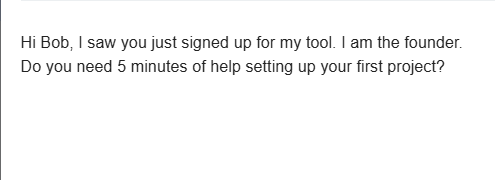
Most users quit because they get confused in the first 10 minutes. If you help them personally, they stay.
Adam Robinson found that when he or a teammate helped people install their code, the success rate went from 40% to 80%.
If you have a tool that shows you who is visiting your site, use it! Reach out to the people who are looking at your pricing page but didn't buy. Ask them if they have any questions. It feels like magic to the customer.
Part VI: What Are The Best Ways To Turn Stories Into A SaaS Strategy Growth Engine?
In 2026, customers don't trust ads; they trust real stories. A smart SaaS strategy uses content to find customers for free.
1. Finding Your "Villain"

Every great story needs a bad guy. In business, the "Villain" is not a person, it is the old, broken way of doing things.
Attack the problem: Is the villain "too much manual work" or "expensive agencies"?
Show the contrast: For example: "Why pay an agency $2,000 for work that my AI tool does in 5 minutes for $20?"
Result: When you attack the villain, people who suffer from that problem will see you as a hero and try your software.l
When you share a win (like hitting $10k MRR), people celebrate with you. This brings more traffic. More traffic means more users. More users mean more wins to share. It is a loop that feeds itself.
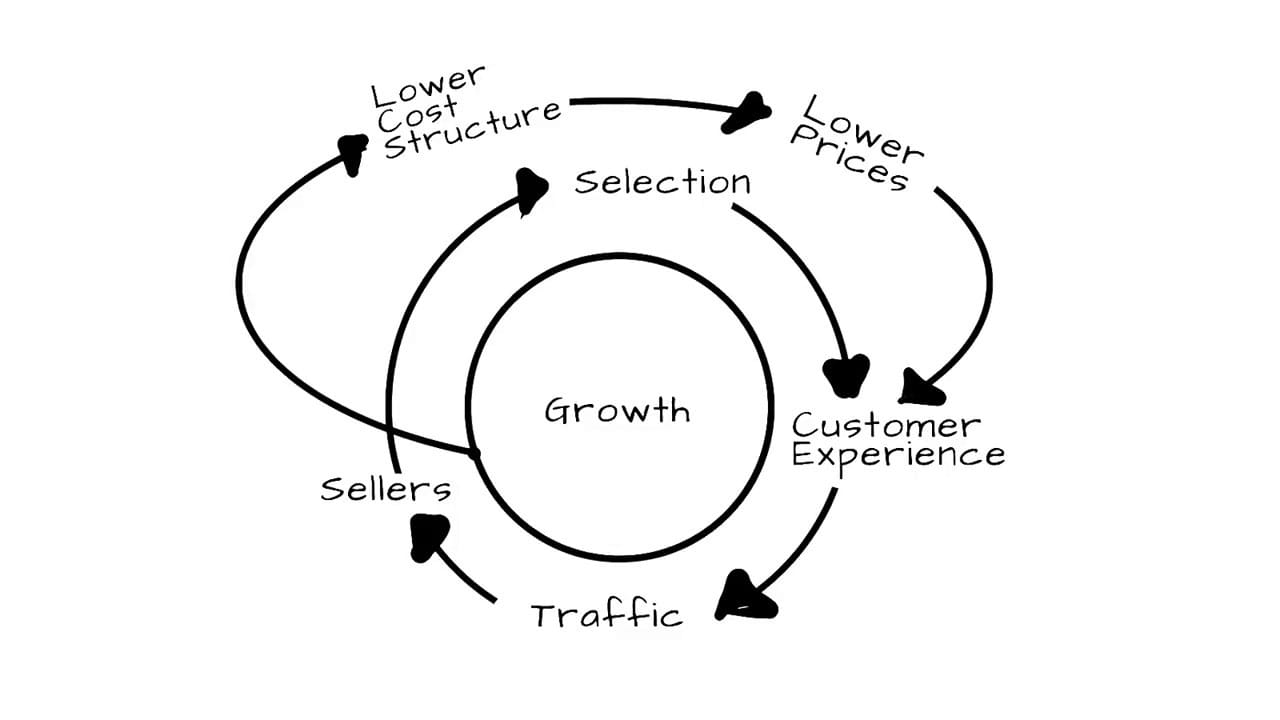
Your content should be a loop that feeds itself. Every win you share brings more users, and more users create more wins to share.
Share real numbers: Don't just say "we are growing." Say "We hit 50 new users and $1,000 in revenue this week."
Use FOMO: When people see your software growing fast, they don't want to be left behind. They will sign up just to see what the excitement is about.
3. Teach, Don't Sell
The best way to sell is to stop selling. Just help people and show them how your tool makes life easier.
Show, Don't Tell: Instead of a long sales pitch, record a 90-second video of your screen. Show exactly how to fix a problem using your tool.
Build Authority: If you teach people how to save 5 hours a week for free, they will think: "If their free tips are this good, their paid software must be amazing."
This is exactly why 80% of the content, guides, and video tutorials at AI Fire are free. Now you know our secret!
Part VII: How To Handle The Common Mistakes In Your SaaS Strategy?
To build a strong business, you must know what to do and more importantly, what not to do. These mistakes can kill a startup in just a few months if you are not careful.
Mistake | Why it hurts you | How to fix it |
Too much free stuff | You have 10,000 users and $0 revenue. | Add limits (features or numbers) to your free plan early. |
Ignoring churn | You lose users as fast as you get them. | Call or message everyone who leaves and ask why. |
Buying ads too early | You waste money on people who aren't ready. | Stick to organic social media until you hit $10k/month. |
Complex onboarding | Users get bored and leave immediately. | Make the "Aha!" moment happen in under 2 minutes. |
1. The "Feature Creep" danger
Don't add 100 features just because a customer asked. If you add too much, your software becomes hard to use. Stick to the core problem. Be the best at one thing.
2. Not Tracking The Right Numbers
Focus on MRR (Monthly Recurring Revenue) and Churn (how many people quit). If your churn is high (over 10%), stop marketing and fix the product. Adding more users to a leaky bucket is a waste of time.
Part VIII: What Is The Step-By-Step Timeline For This SaaS Strategy?
If you started today, here is what your first year should look like.
Month 1-3: The Discovery Phase
Talk to 50-100 potential users.
Find the one "pain point" they all share.
Start posting on LinkedIn 3 times a week about your findings.
Month 4-6: The MVP Phase
Build the smallest possible version of your tool.
Give it to 20 "Beta" users for free in exchange for feedback.
Fix the bugs and make it easy to use.
Month 7-9: The Launch Phase
Open your waitlist.
Introduce usage-based pricing.
Start your "Sales Assist" outreach to every new sign-up.
Month 10-12: The Scale Phase
Double down on the content that worked.
Automate the parts of the business that are repetitive.
Look for "Mid-Market" customers who can pay more.
Conclusion: It Is About Humans, Not Code
The most important part of any SaaS strategy is remembering that there is a person on the other side of the screen. They don't care about your "proprietary algorithm." They care about getting home to their family on time because your software saved them two hours of work.
If you stay honest, share your journey, and focus obsessively on helping your users win, you will win too. Adam Robinson proved that a 5-person team can out-earn a 50-person company if they are more human and move faster.
If you are interested in other topics and how AI is transforming different aspects of our lives or even in making money using AI with more detailed, step-by-step guidance, you can find our other articles here:
I'm Revealing The Marketing Tools They Gatekeep In $5k Courses
AI Automation: Your Secret Weapon for Content and SEO Success*
*indicates a premium content, if any
How useful do you find the AI startup articles? 🤖📈Please select the option that best describes your experience with these articles. |
Reply