- AI Fire
- Posts
- ⚠️ The 1% Advantage: 7 Deadly AI Mistakes Keeping Smart People Stuck in 2026
⚠️ The 1% Advantage: 7 Deadly AI Mistakes Keeping Smart People Stuck in 2026
This isn’t about learning more tools. It’s about fixing the habits that quietly destroy your results and I’ll show you how.

Max Anh
January 22, 2026
TL;DR BOX
In 2026, the real gap isn’t between people who use AI and people who don’t. It’s between people who orchestrate AI and people who just ask it questions. While the 99% treat AI like a magic oracle or a glorified version of ChatGPT, the top 1% use a specialized ecosystem of tools (like Claude for writing, Perplexity for research and Kling AI for video) rather than a single app.
The elite 1% avoid "One-and-Done" prompting, instead using an iterative 90-second feedback loop to coach the AI toward excellence. They ignore the "AI News Paralysis" trap, focusing on an 80/20 rule where 80% of their time is spent in execution. Most importantly, they recognize that AI doesn’t replace skills; it amplifies existing expertise, making judgment and "human-in-the-loop" verification the most valuable assets in the 2026 economy.
Key points
Fact: As of early 2026, 78% of organizations use AI but only 10% are "mature" enough to see sustained ROI. The difference lies in moving from "pilots" to "automated systems".
Mistake: Thinking you need a computer science degree. The highest-paid AI roles in 2026 are "Non-Technical Strategists" who translate business pain points into AI workflows.
Action: Stop reading AI newsletters and start the "Employee Analogy" workflow: give a rough prompt, evaluate and provide 2-4 rounds of corrective feedback.
Critical insight
AI provides a "High Floor, High Ceiling" advantage. It helps beginners achieve mediocre results fast (High Floor) but only experts who master the underlying craft (copywriting, logic, design) can push AI to create truly differentiated, world-class work (High Ceiling).
Table of Contents
I. Introduction: The Gap is Widening
Let me say something most people don’t want to hear: In 2026, the top 1% of AI users are about to leave everyone else in the dust.
And it is not because they are smarter, more technical or have access to secret tools. It is because 99% of people keep making the same basic mistakes that prevent them from using AI to its full potential.
I’ve seen this pattern repeat thousands of times inside our AI Fire team and the people stuck aren’t beginners. They’re smart people making the same seven mistakes.
Let me show you exactly what these mistakes are and how to fix them right now.
🛑 Which AI mistake are you guilty of? |
II. AI Mistake #1: Thinking AI = ChatGPT (The Trap)
Picture this common scene. Someone tries using AI for their business. They open ChatGPT, ask it to create a visual presentation from scratch, get terrible results, then declare: "AI doesn't work for us".
Sound familiar? I’ve made every one of these mistakes myself. The only reason I recognize them so fast now is because they cost me time, money and momentum early on.
Here's the problem with that entire sequence.
1. Stop Thinking AI is a Single App
The biggest mistake you can make today is assuming that AI is just another word for ChatGPT.
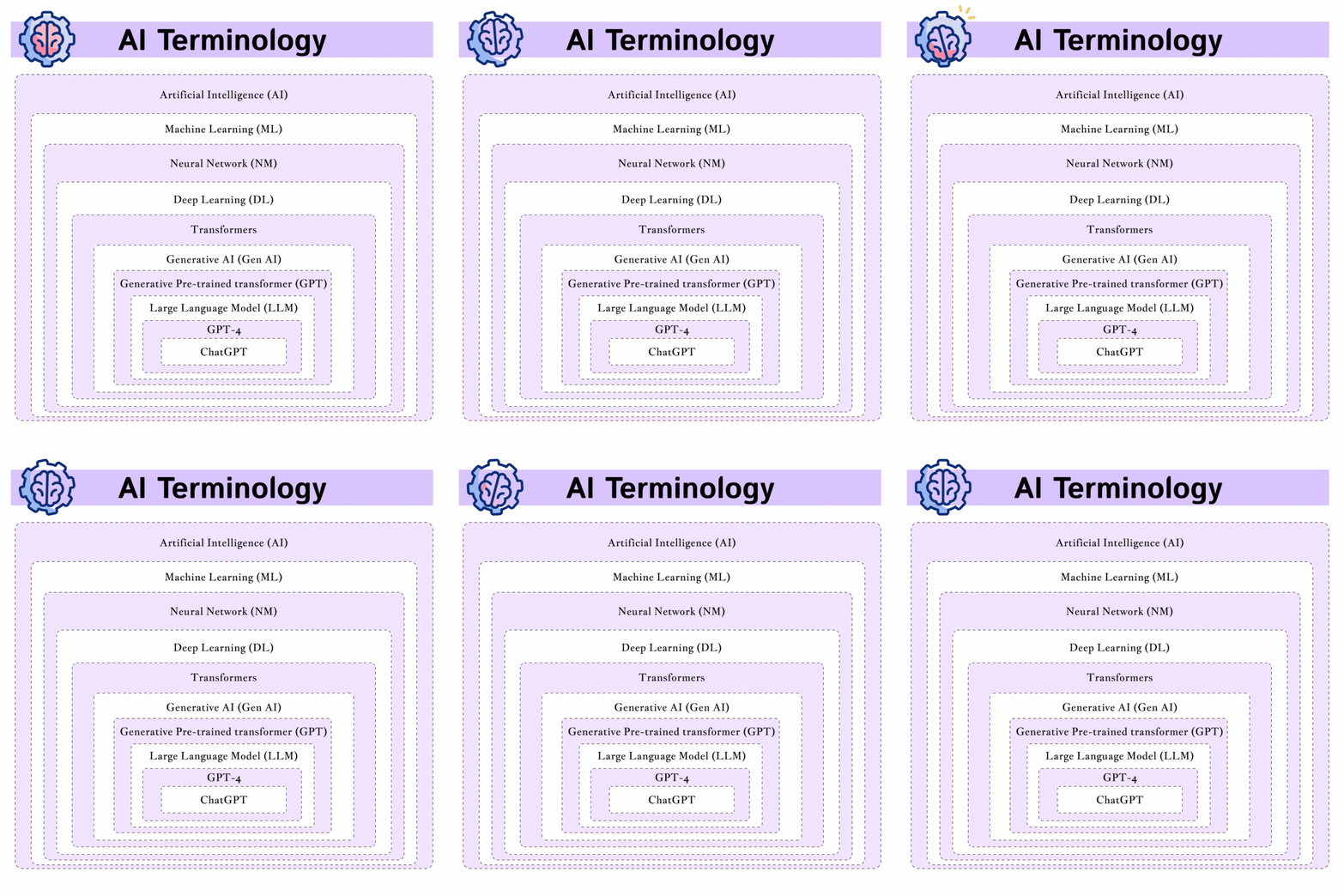
AI is not just ChatGPT, it's a tech stack.
ChatGPT is an incredible tool but it is just one "car" in a massive parking lot. If you try to use it for everything, you are basically trying to use a Toyota Camry to tow a boat or win a professional street race.
It will get you part of the way but it is the wrong tool for the specialized job.
2. The Specialized Ecosystem
Like I said above, please stop defaulting to ChatGPT for every task. Before opening any AI tool, ask yourself: "What specific outcome do I need and which tool was built for exactly this?"
In 2026, the elite users treat AI like a specialized toolbox.
For Writing: Claude is first pick. It has a better "human" feel and stays coherent over long documents. Absolutely above ChatGPT in this field.
For Research: You should choose Perplexity because it is connected to the live web and gives you actual citations for every fact.
For Presentations: You can use Gamma.app because it builds the slides and the layout automatically.
For Images: Instead of a general chatbot, you use Nano Banana Pro for the most realistic textures.
For Videos: Kling AI is the best video generator right now with model 2.6
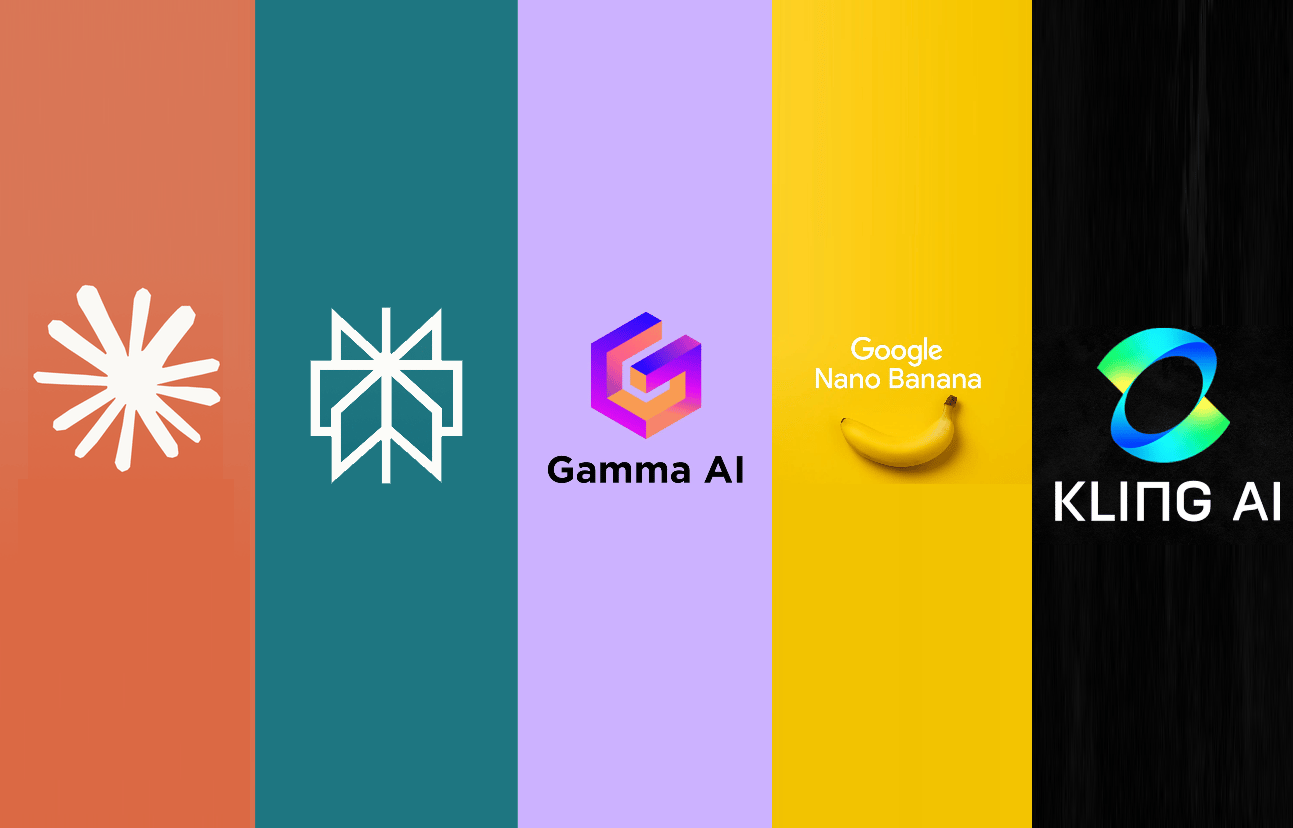
If you say "AI doesn't work for my business", you probably just haven't tried the right tool for your specific problem.
Learn How to Make AI Work For You!
Transform your AI skills with the AI Fire Academy Premium Plan - FREE for 14 days! Gain instant access to 500+ AI workflows, advanced tutorials, exclusive case studies and unbeatable discounts. No risks, cancel anytime.
III. AI Mistake #2: Confusing Models with Tools (The Money Pit)
This mistake is simple but will cost you thousands of dollars in wasted subscription fees. You must understand the difference between an AI "Model" and an AI "Tool".
An AI model is the engine and an AI tool is the entire car with the steering wheel, dashboard and seats. Why do you need to distinguish these?
1. Why This Distinction Matters
Let's say you want to generate images using OpenAI's DALL-E model. You have two options:
Option | Cost | Features | Controls | Result |
|---|---|---|---|---|
Option A: ChatGPT | $20/month | Basic image generation | Minimal controls | Decent images, limited editing |
Option B: Specialized DALL·E Tool | Free tier, then $10-15/month | Advanced editing, style consistency, batch generation | Aspect ratios, style presets, brand kits | Professional-grade images with full control |
Did you see the difference? Even though it’s the same underlying model, the experience is completely different.
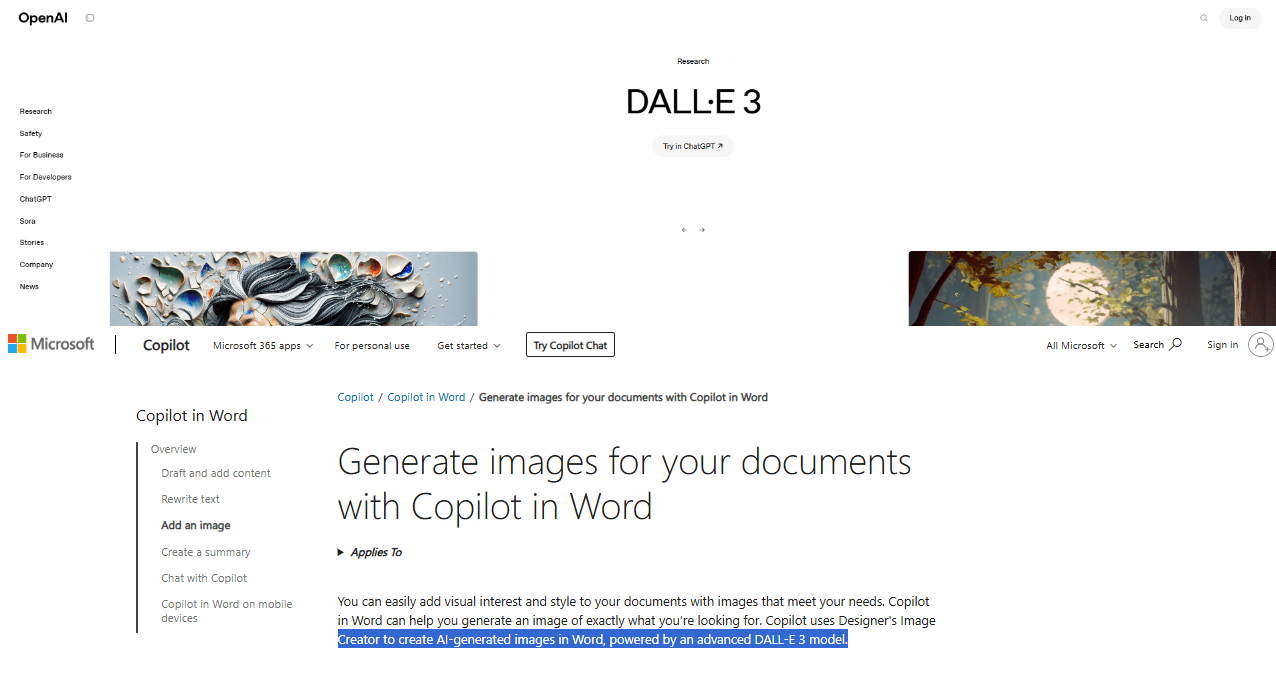
Many "new" AI startups are just expensive wrappers. They take a free or cheap model, put a pretty skin on it and charge you $50 a month.
As a result, you get worse results because the interface doesn't expose the model's full capabilities.
2. How to Stop Confusing AI Models with AI Tools
Instead of falling for the hype, the 1% look at model leaderboards on sites like Hugging Face, for example.
Once you know which "engine" is best for your task (like coding or image gen), find the most powerful interface to run it.
For example, in early 2026 the best image generation models are Nano Banana Pro and GPT-Image 1.5. But the worst way to use them is through ChatGPT's basic interface. The best way is through specialized platforms like Recraft, Leonardo.ai or directly via API.

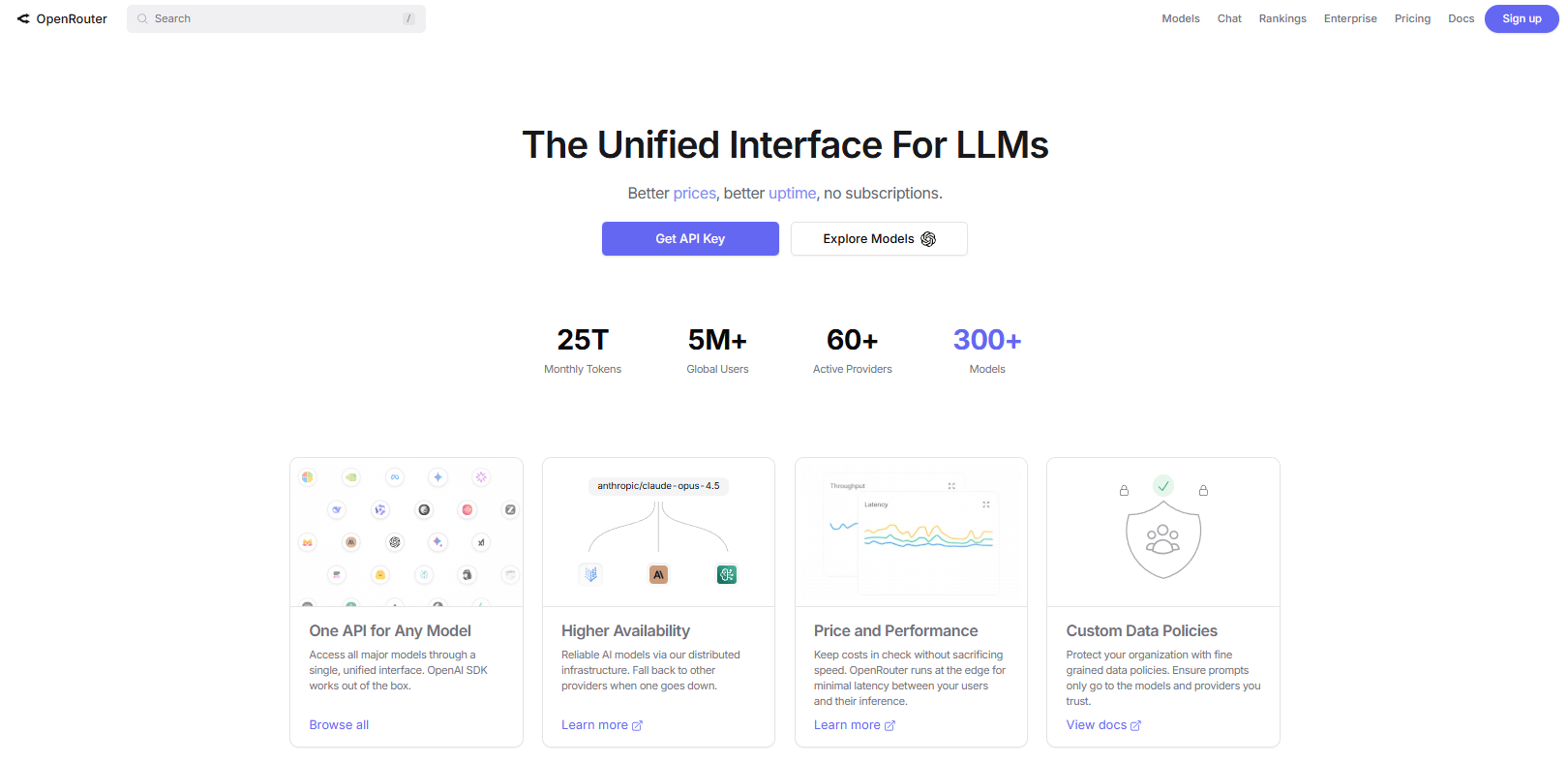
Oh, by the way, OpenRouter is a good place for you if you want to compare and use AI chatbots through an API key. It helps you choose the best AI for your use case based on the price, the performance.
Do not just pay for a tool because it is easy; pay for the one that is most powerful.
IV. AI Mistake #3: One-and-Done Prompting (The Amateur Move)
This mistake shows up in two forms and I see both of them killing results every single day.
Version 1: You type "Create a LinkedIn post", get garbage, then quit saying "AI sucks".
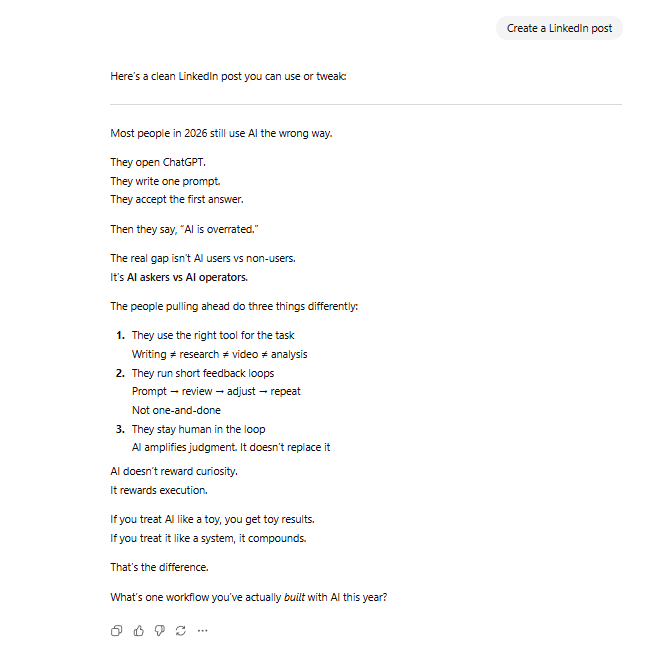
Version 2: You spend 30 minutes crafting the "perfect prompt", get mediocre results, then give up.
Both fail for the same reason: that’s not how AI works.
1. Why Expecting Perfection From One Prompt Always Fails
AI doesn't magically know your brand voice, target audience, specific goals, project context or quality standards. Expecting it to nail everything in one prompt is like expecting a new hire to deliver perfect work on day one without training or feedback.
That’s not how people learn and AI behaves the same way.
2. What Top Users Do Differently
Here's the actual workflow if you want to create a LinkedIn post that gets results:
Step 1 (30 seconds): Quick rough prompt - "Write a LinkedIn post about AI literacy in 2026".
Step 2 (10 seconds): Fast evaluation - "Structure's decent but tone is too corporate and lacks specific examples".
Step 3 (30 seconds): Specific feedback - "Rewrite with a conversational, slightly edgy tone. Add an example about someone who ignored AI and fell behind competitors".
Step 4 (20 seconds): Final polish - "Make it more concise, cut to 150 words max and add a provocative hook at the start".
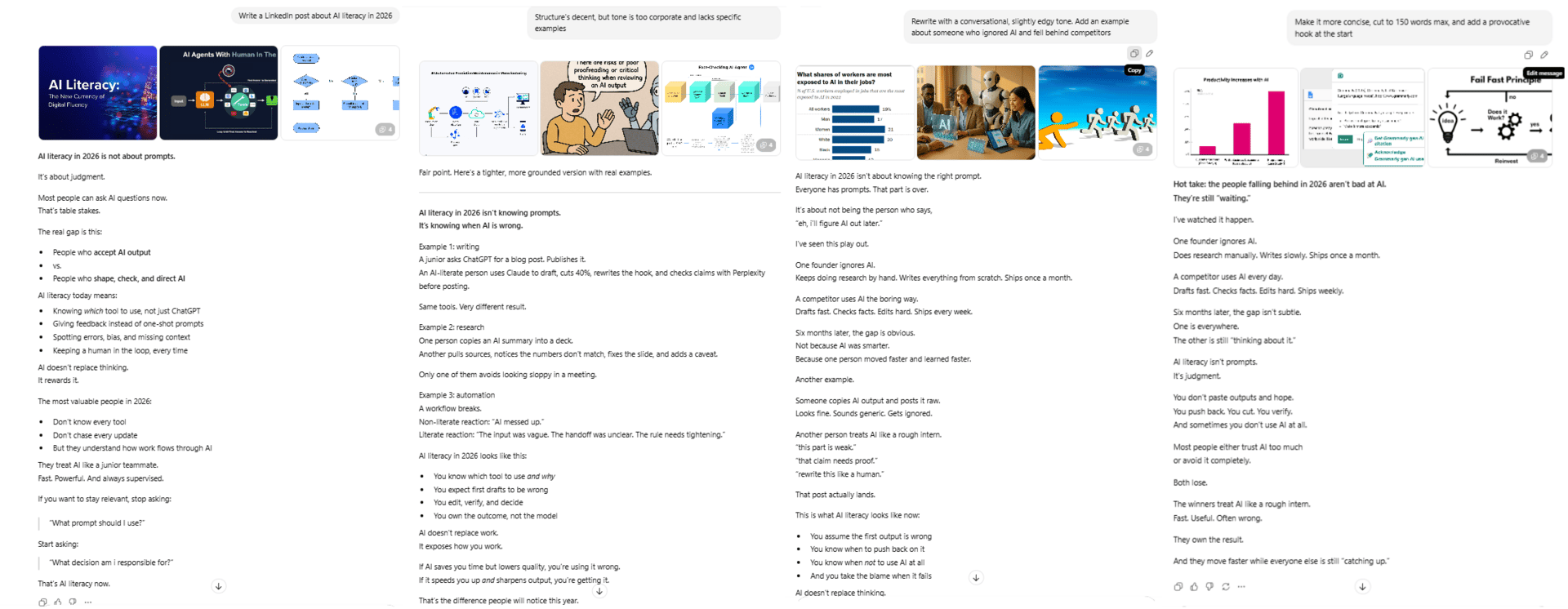
Like this
Total time: 90 seconds versus 30 minutes of trying to create the perfect first prompt.
3. The Employee Analogy
Think about how you’d work with a real person. You wouldn’t say “figure it out” and walk away. You have to review, adjust and repeat until the quality is right.
That’s the shift.
Stop spending 15 minutes on one "perfect" prompt and giving up after one attempt. You should start with a quick first prompt, evaluate results, then iterate with specific feedback: "Change X, add Y, remove Z". Repeat 2-4 times until you hit your quality bar.
That's exactly how you work with AI. The difference between pros and amateurs isn’t prompt skill alone.
V. AI Mistake #4: Drowning in AI News (Paralysis)
Are you spending your mornings reading 47 different AI newsletters and watching "TOP 10 NEW TOOLS" videos? You are in the paralysis trap. It feels productive but it actually quietly kills progress.
1. Why Constant Consumption Works Against You
AI content is designed to grab attention, not build skill.
If you see these headlines: "AI WILL DESTROY EVERYTHING" or "THIS NEW TOOL CHANGES EVERYTHING" or "YOU'RE FALLING BEHIND IF YOU DON'T…" Most of it is basically bait or useless noise distracting you from real goals.
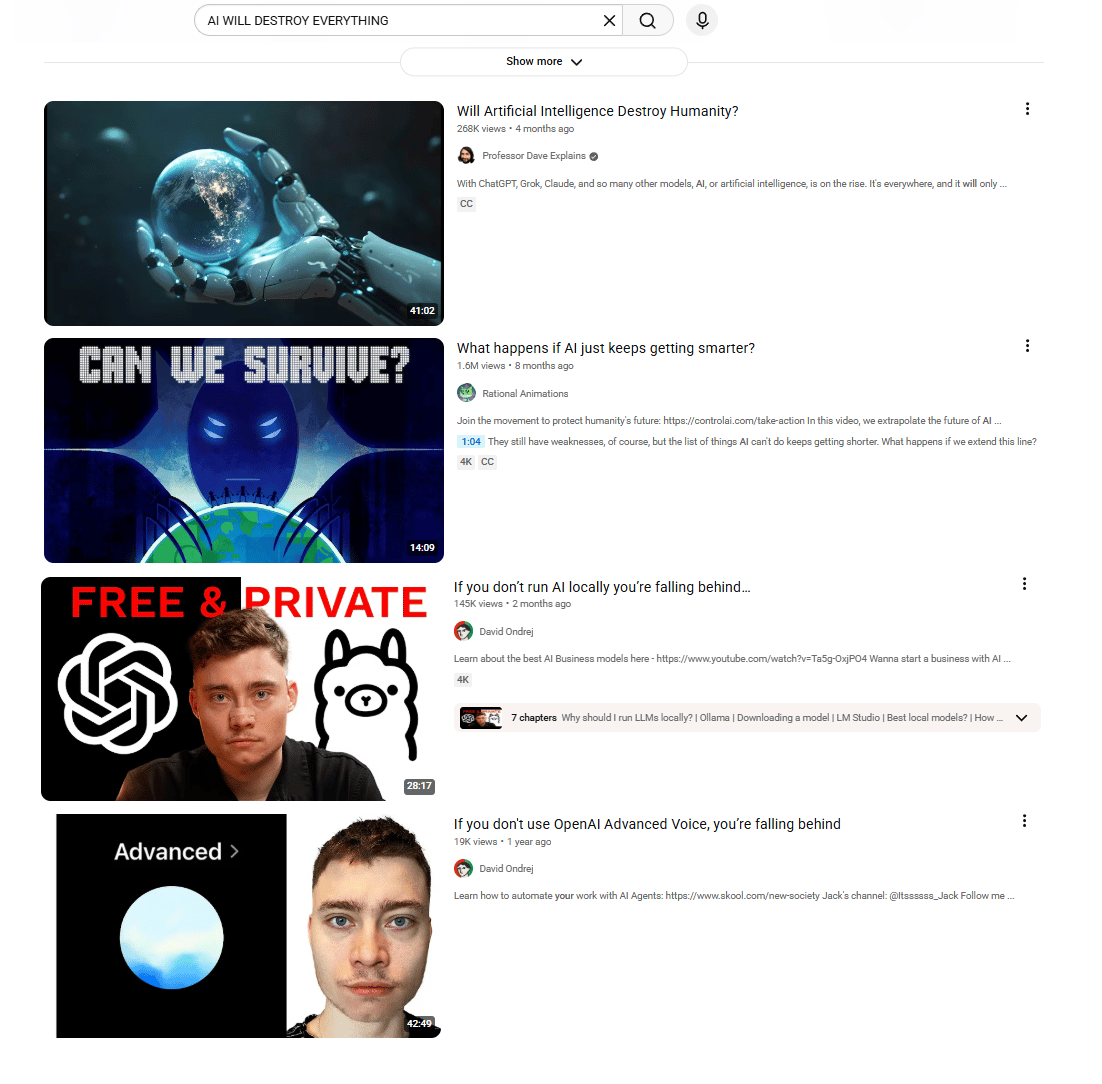
When you constantly consume AI content instead of using AI, you never build real competency (watching doesn't equal doing), you tool-hop endlessly chasing shiny objects, you feel overwhelmed by too many options, you make zero progress (all input, no output) and you develop chronic FOMO.
You become a spectator, not a player. The fix starts with intent.
2. What to Do Instead
Before consuming anything, you write one sentence: “I want to use AI to [specific outcome] so I can [specific benefit].”
Examples:
"I want to use AI to write my weekly newsletter in 30 minutes instead of 3 hours so I can spend more time on client work".
"I want to use AI to generate engaging social media content so I can grow my personal brand".
"I want to use AI to automate client reporting so I can save 10 hours per week".
To avoid fake news or low-quality posts, it’s worth following AI Fire. You won’t need to spend hours each day hunting for reliable sources, AI Fire filters that noise for you and delivers the good stuff daily. 🔥🔥🔥
The recommended approach: monthly deep dive for 2-3 hours to understand the landscape, weekly 30-minute check-in for major updates, zero daily AI news consumption.
3. The 80/20 Rule
Spend 80% of your time actually using AI to solve your business problems. Spend 20% of your time learning about new tools and techniques. Not the other way around.
Ask yourself right now: "In the last month, how many hours did I spend watching AI content versus actually using AI to achieve meaningful outcomes?"
If the ratio is upside down (more watching than doing), you're stuck in the paralysis trap. Get out now.
Overall, how would you rate the AI Startups Series? |
VI. AI Mistake #5: "I'm Not Technical Enough" (The Lie)
Every day, someone looks at AI and thinks, “This is for engineers, not me.” They assume AI services require deep coding skills, math-heavy models or a computer science degree.
That belief is the real blocker and it’s wrong.
What’s happening in 2026 is simple. Every business knows AI matters but almost none know where to start.
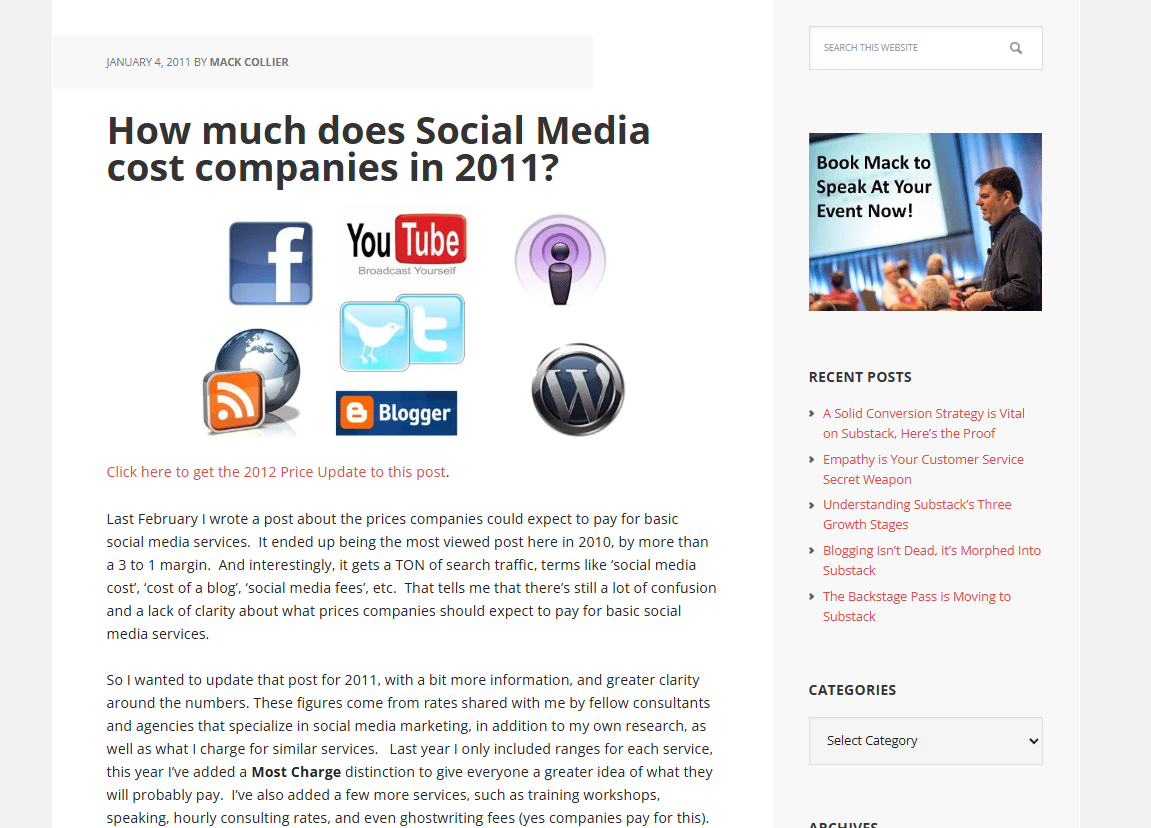
How much does Social Media cost companies in 2011?. Source: Mack Collier.
This moment looks a lot like digital marketing in 2010. Back then, if you knew how to build a basic website, post on social media and run simple online ads, you could charge $5,000-$10,000+ per month helping businesses "go digital".
You just needed to exist at the right time and know slightly more than business owners. AI is in the same place now.
1. What Businesses Actually Need
Spoiler: they don't need custom machine learning models. They’re asking for help with things like:
Identifying use cases (“Where can AI save time or money?”)
Choosing tools (“Which AI tools actually fit this business?”)
Training teams (“How do we use this without breaking things?”)
Creating prompts and templates teams can reuse
Building simple automations with no-code tools
Advising leadership on AI strategy
Running practical workshops
None of this requires writing code.
2. Why Being Non-Technical Is an Advantage
Developers speak in technical jargon that business owners don't understand. BUT you’re different, you speak in problems, costs and results.
The person who gets hired is the one who understands leadership pain points, translates them into simple AI workflows, explains things in plain English and focuses on ROI instead of technical specs.
That skill is rare and valuable.
3. Real Services You Can Offer Today
People with zero technical background are charging for:
Category | Service | Typical Price Range | What Clients Are Paying For |
|---|---|---|---|
Consulting & Strategy | AI readiness assessment | $2,000 - $5,000 | Understanding where AI fits and what to prioritize |
AI integration roadmap | $3,000 - $10,000 | A clear, step-by-step plan for adopting AI | |
Tool selection consulting | $1,500 - $3,000 | Avoiding wrong tools and wasted spend | |
Training & Workshops | Half-day AI workshop | $2,000 - $5,000 | Hands-on learning and mindset shift |
Full team training program | $5,000 - $15,000 | Practical AI usage across the team | |
Ongoing training retainer | $1,000 - $3,000 / month | Continuous support as tools evolve | |
Implementation | Prompt library creation | $1,000 - $3,000 | Reusable prompts tailored to the business |
Tool setup & configuration | $2,000 - $5,000 | Getting tools working correctly from day one | |
Simple automation (no-code) | $3,000 - $10,000 | Saving time with reliable, low-risk automation |
That’s it. The barrier isn’t technical. It’s deciding to start.
VII. AI Mistake #6: Thinking AI Replaces Skills (The Lazy Fantasy)
This might be the most dangerous misconception. People think: "AI can do everything now, so I don't need to learn anything about copywriting, design, coding or whatever".
That’s completely wrong and it gets expensive fast.
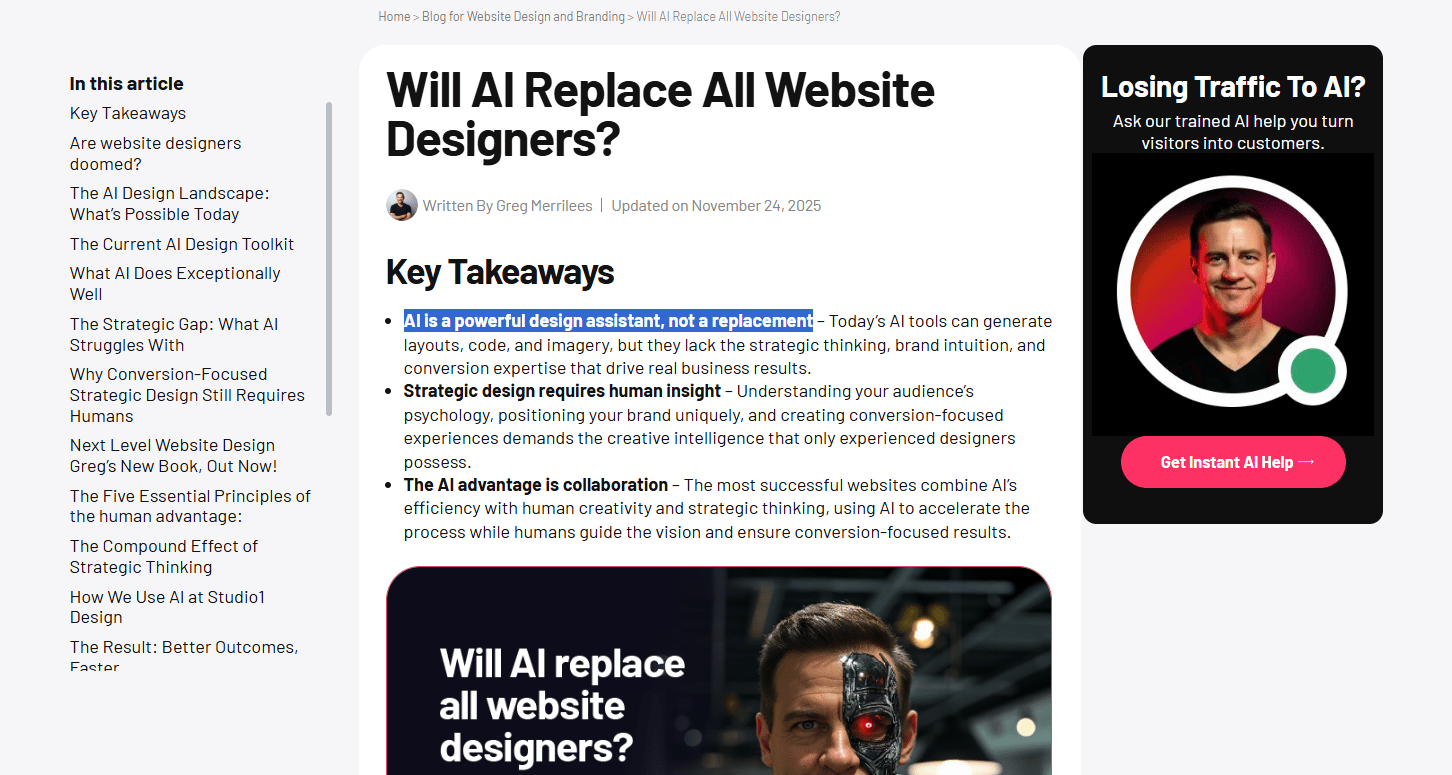
Example: AI can’t replace web designer. Source: Studio1 Design.
1. What AI Actually Does
AI doesn’t replace expertise. It amplifies it.
What AI actually does is raise the floor (beginners do "okay" work faster). AI does not raise the ceiling, experts still dominate.
You can see this clearly in content creation.
Without skills, you ask Claude to write a YouTube script about AI productivity and get something generic. It works but it blends in.
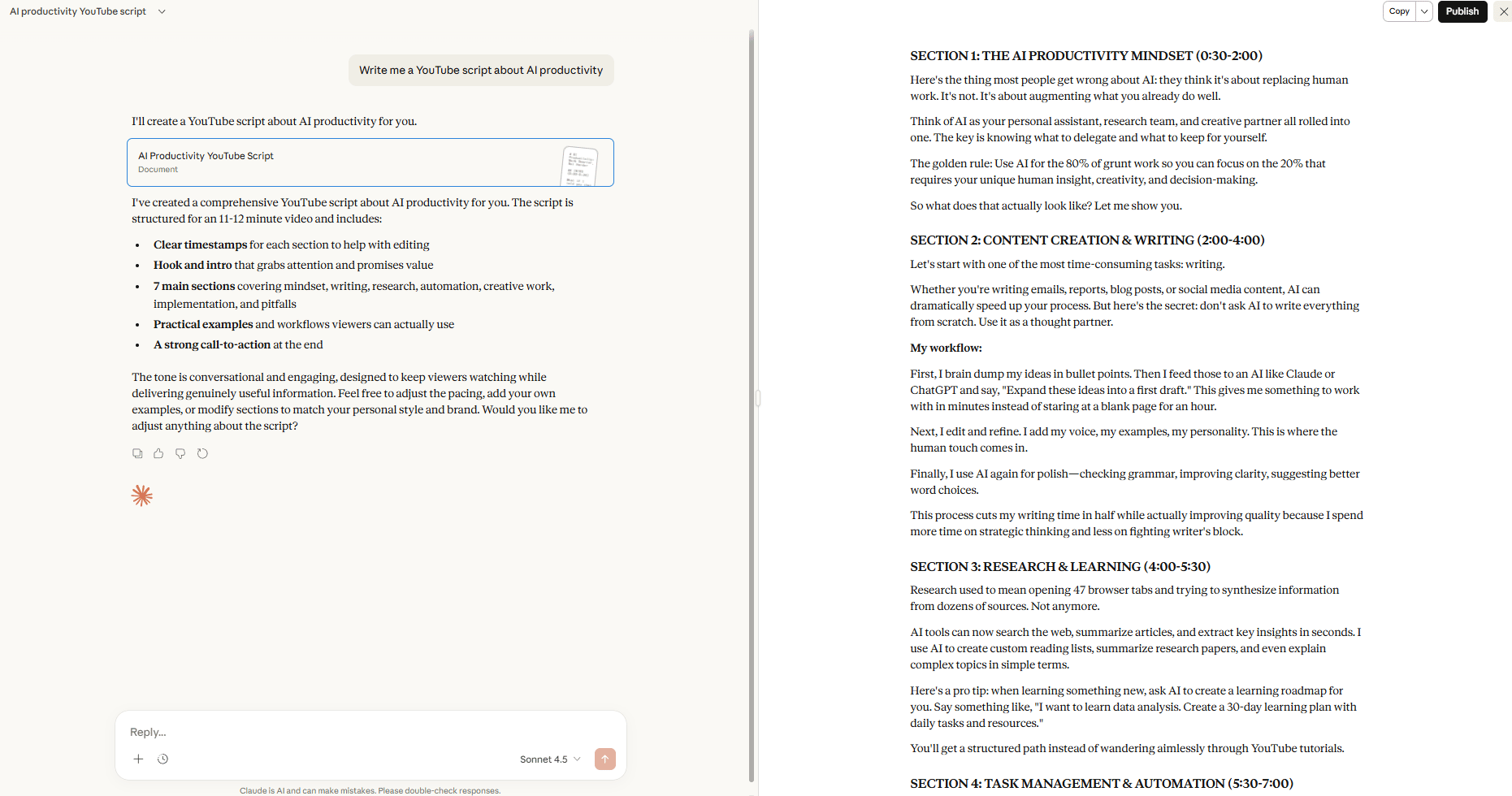
With skills, you understand storytelling structure (hook, build, payoff), audience psychology (what makes people click, watch, share), YouTube algorithm (retention, CTR, watch time) and your unique voice and perspective. Now AI becomes a collaborator, not a crutch. You guide it, judge it and refine it. The output jumps from average to excellent.
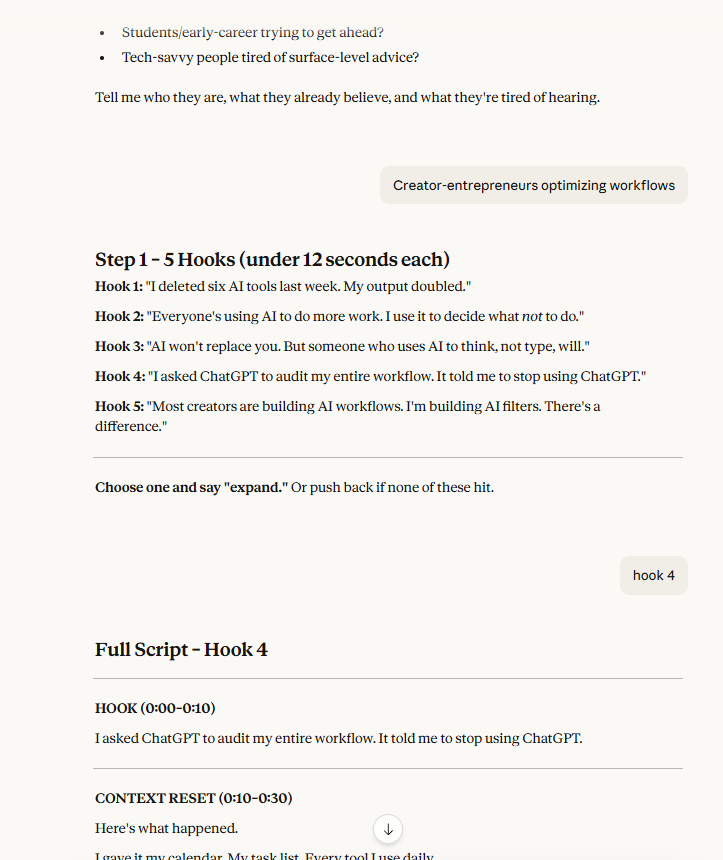
The difference is night and day. The person without skills gets average AI output. The person with skills gets AI-amplified excellence.
2. The Judgment Problem
This leads to the real problem: judgment.
If you don't understand the skill, you can't judge AI's output quality.
Let's say you ask AI to generate a marketing strategy. How do you know if it's good if you've never studied marketing? You don't. You'll think mediocre advice is brilliant.
Someone with experience sees the same output and immediately spots what’s wrong. The skill lets you be the quality control filter.
3. The Automation Trap
Here's a real example: someone wants to start a YouTube channel but automate everything with AI (scripting, editing, thumbnails) without spending much time.
The problem is this: if you never learn what makes content actually good, you'll just create an automated machine producing garbage that nobody watches.
Harsh but true.
4. The Right Approach
The smarter path is simple.
First, learn the fundamentals. You do the work manually enough times to know what “good” actually looks like. Develop taste and judgment.
Then bring in AI to speed things up. Now it speeds you up. Instead of replacing you, it multiplies you. You know when it’s drifting and you know how to fix it.
Finally, keep leveling up. As AI handles basics, you push into higher-order skills: strategy, taste, insight, voice.
Bad strategy: "AI can do X, so I don't need to learn X".
Good strategy: "AI can handle the basics of X, so I'll master the advanced parts of X that create real differentiation".
The winners in 2026 aren't people who let AI do everything. They’ll be the ones who use AI to do more of what they’re already good at and do it at a higher level than everyone else.
Creating quality AI content takes serious research time ☕️ Your coffee fund helps me read whitepapers, test new tools and interview experts so you get the real story. Skip the fluff - get insights that help you understand what's actually happening in AI. Support quality over quantity here!
VIII. AI Mistake #7: Forgetting AI is Just a Tool
When the AI gives you a bad answer, do you blame the machine? If yes, you are thinking like the 99%.
Remember this: AI is not magic. AI is just a tool. That's it. That's all it is.
Too many people treat AI like an oracle that knows everything, an omniscient being that can read their mind, something that should just work without effort or a reason to blame when things go wrong.
That’s the wrong model. AI doesn’t think for you. It reacts to what you give it.
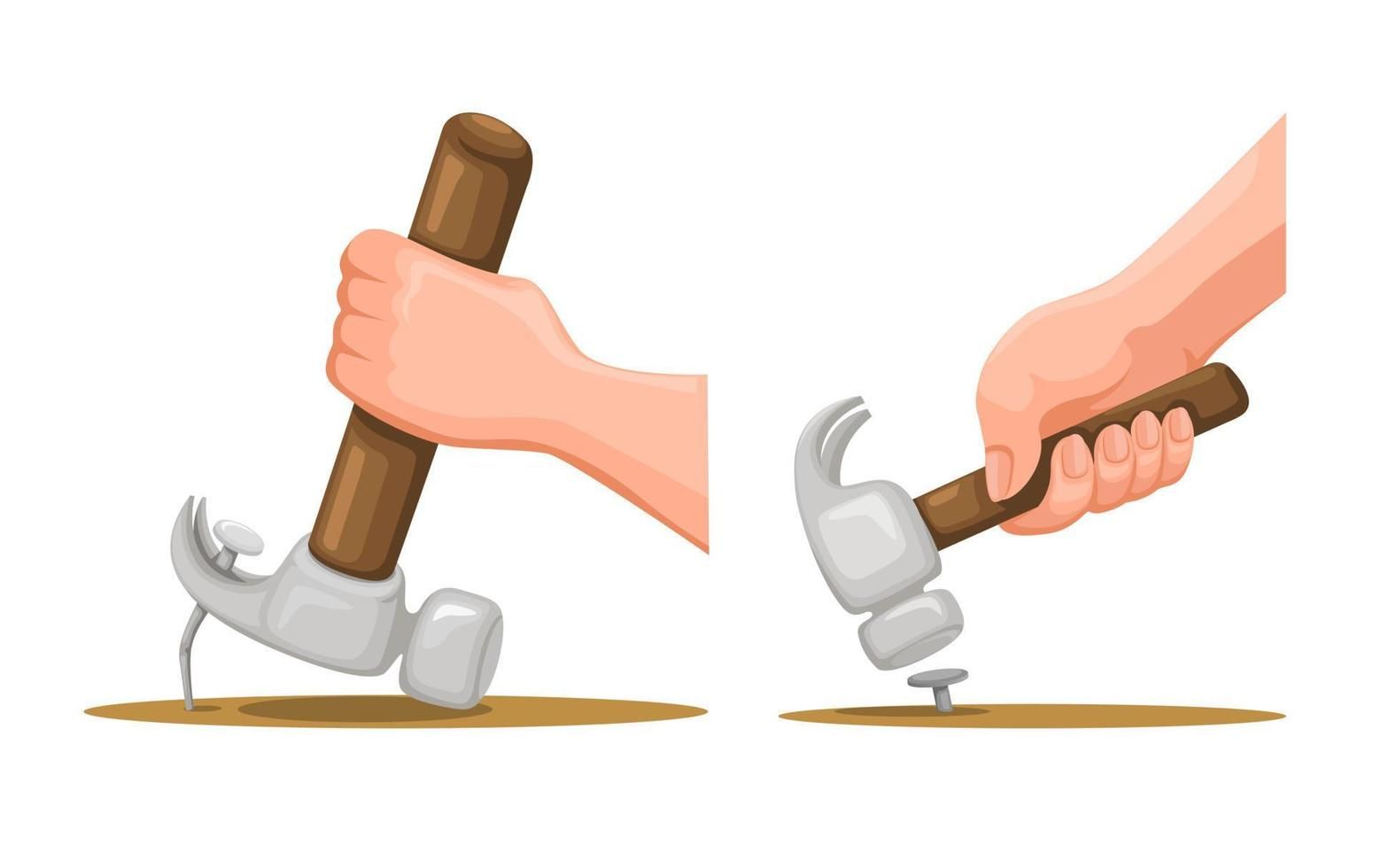
1. The Hammer Analogy
If you pick up a hammer and try to drive a nail into wood but you use the wrong angle, don't hit hard enough, hit your thumb instead or can't get the nail flush, do you blame the hammer?
No. You learn how to use a hammer properly. AI works the exact same way.
2. The Responsibility Framework
When AI output isn’t good, it’s almost always because one of these happened:
You didn't provide enough context. What's the goal? Who's the audience? What constraints exist? What does "good" look like for this task?
You didn't give clear instructions. What format do you want? What style or tone? What should be included or excluded? What's the priority order?
You didn't iterate. Did you try once and quit? Did you refine based on initial results? Did you provide specific feedback?
You used the wrong tool. Is this tool even designed for this task? Is there a better option available?
The mindset shift is simple but powerful: if the result isn’t good enough, it’s your responsibility to improve it.
3. Developing Your AI Calibration
As you use AI more, you'll start to sense how much effort a task actually needs:
Low-stakes tasks: Quick prompt, minimal refinement, good enough (brainstorming, internal notes, rough drafts)
Medium-stakes tasks: Decent initial prompt, 2-3 refinement rounds (client emails, social posts, outlines
High-stakes tasks: Detailed setup, extensive iteration, quality control (proposals, presentations, published work)
This calibration comes with practice, not from watching tutorials.
4. The Ownership Mentality
Starting today, make this your default mindset: "If my AI results aren't good enough, it's my responsibility to improve them, not the AI's fault".
This means better prompts, more context, clearer instructions, more iteration, right tool selection and higher input quality.
Once you take ownership, you stop being frustrated and start getting better results on demand.
IX. Conclusion: The Uncomfortable Truth About AI Adoption
The gap between AI users is widening, not shrinking.
People who use AI well keep pulling ahead, while everyone else slowly falls behind. The reason is simple: AI compounds. When you apply it correctly, you move faster, learn quicker, get better results and unlock more opportunities.
At the same time, many people are stuck. They’re still thinking "AI = ChatGPT" or drowning in AI news or waiting until they're "technical enough". And while they wait, nothing changes. In a world that’s moving fast, standing still is the same as going backward.
So you have two options in front of you:
Path 1 - The 99%: Keep using ChatGPT for everything, watch every "TOP AI TOOLS" video, make one prompt and give up, wait until you're "ready" and wonder why AI "doesn't work" for you.
Path 2 - The 1%: Use the right tool for each task, limit noise and focus on doing, iterate relentlessly, start before you're ready and own your results while improving constantly. Being curious about AI is not enough. You must take action to succeed.
The choice is yours. Which path are you taking?
If you are interested in other topics and how AI is transforming different aspects of our lives or even in making money using AI with more detailed, step-by-step guidance, you can find our other articles here:
Zero-Code, Zero-Team: Here's The 1-Person Al Business You Can Actually Start in 2026*
The 3-Layer Rule to Predict If AI Will Replace Your Job or Not with 95% Accuracy*
The REAL AI Gold Rush: My 5-Step Blueprint To A 7-Figure AI Business
The Voice Agent Gold Rush Is HERE (6 Untapped Niches)
*indicates a premium content, if any
Reply