- AI Fire
- Posts
- 🚨 AI Automation Agencies are Dying: Here’re 11 Models Winning in 2026
🚨 AI Automation Agencies are Dying: Here’re 11 Models Winning in 2026
Most agencies will lose deals by 2026 because “automation” is now cheap. Here’s the pivot to outcomes, audits, and adoption.

Max Anh
December 29, 2025

TL;DR BOX
The AI agency market is shifting from experimental AI automation to ROI-driven transformation partnerships targeting mid-market enterprises. Agencies must pivot from selling tools to delivering measurable outcomes like cost reduction and operational efficiency.
Most AI pilots fail because businesses demand proof of value, not just innovation. This guide predicts a move toward "AI Transformation Partners" who handle everything from software foundations and messy data cleanup to employee training. Success lies in auditing existing systems to find friction and selling comprehensive solutions rather than isolated automations.
Key points
Stat: A staggering 95% of generative AI pilots fail, driving companies to demand concrete ROI before investing.
Mistake: Positioning as a generic "AI automation agency" instead of a niche-specific strategic partner.
Action: Sell paid AI audits ($5k-$15k) to diagnose problems and naturally upsell high-ticket implementation projects.
Critical insight
The real opportunity is focused on simple tasks: fixing data and workflows first. Most companies aren’t AI-ready because their systems are messy.
🛑 The "AI Easy Money" era is dead. How are you surviving? |
Table of Contents
I. Introduction: The "AI Automation Bro" Era Is Over
If you feel like the AI agency space is crowded, that makes sense but what’s crowded is the noise, not the real market.
YouTube and X are full of people selling the same story about no-code tools, quick AI automations and “easy” agency money. But when you step outside that bubble and talk to real businesses with real budgets, something very different shows up.
After months of working with companies, watching deals close and fail and seeing what actually gets approved by decision-makers, one thing became clear: the loud “AI automation bro” era is already ending and most people haven’t noticed yet. Not because AI stopped working but because businesses stopped experimenting.
The mindset inside companies has shifted from “let’s try AI” to “prove this saves us money or time or don’t bother.” And that single shift changes everything.
If you’re still positioning yourself as someone who builds random automations or connects tools together (like a Make.com builder who builds n8n workflows), 2026 will be a very difficult year for you.
You want to know what’s really coming? Here are 11 predictions for 2026 based on what I’ve seen in real deals, so you can pivot before it gets painful.
II. Prediction #1: The ROI Era Has Arrived (No More "Let's Just Try AI")
A year ago, companies were happy to spend money just to see what AI could do and a lot of projects got funded with no clear outcome, no clear owner and no real success metric. That phase is done.
Most companies tried AI, failed quietly and now feel burned. I’ve seen this over and over. Pilots that never shipped. Tools that no one used. Dashboards that looked impressive but changed nothing.
Don’t believe me? An MIT report found that 95% of generative AI pilots at companies are failing. That is not a typo. Ninety-five percent. Companies have blown through their experimental budgets.

Source: Fortune.
So now, they want proof before they open their wallets again. Nobody wants a “cool” or “innovative” tool anymore. They want to know, in plain words, what breaks today, how much it costs them every month and how your solution fixes it.
The "early adopter" phase is done. We are now in the "early and late majority" phase, which means clients are skeptical, risk-averse and demand concrete, measurable ROI before signing anything.
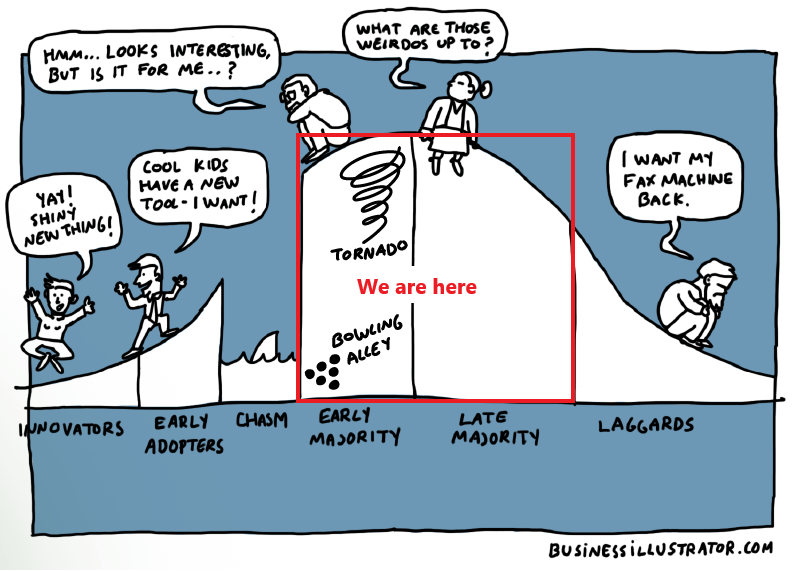
Technology adoption life cycle.
If you can’t explain that clearly, your pitch dies fast. This is why general AI agencies are struggling. Saying “we do AI automation” means nothing anymore.
I’ll give you a real example.
One client came to me asking for “AI support automation.” On the surface, it sounded like a chatbot problem.
But when we audited their system, the real issue wasn’t AI at all; it was broken ticket tagging and messy CRM routing.
We fixed that foundation first. Only then did AI actually reduce support time and costs.
That deal closed because we sold outcomes, not automation.
Here is what you could do to get attention immediately:
Pick a specific area: You need to be "the agency that helps e-commerce teams cut support costs by 30% in 90 days".
Build bulletproof case studies: Generic testimonials won't cut it anymore. You need numbers: "We saved Company X $180k annually by automating their intake process".
Lead with outcomes: Clients don't care about your tech stack. They care about saving money, making money or reducing headaches.
That shift alone will decide who survives.
This is exactly what our AI Transformation Audit delivers: a clear map from messy systems to measurable ROI, before a single line of AI is deployed. This checklist is absolutely free, easy to download, use and importantly, it helps you improve your business a lot.
Once ROI becomes the standard, clients stop buying “automations” and start buying partners who own outcomes.
Learn How to Make AI Work For You!
Transform your AI skills with the AI Fire Academy Premium Plan - FREE for 14 days! Gain instant access to 500+ AI workflows, advanced tutorials, exclusive case studies and unbeatable discounts. No risks, cancel anytime.
III. Prediction #2: "AI Automation Agency" Is Dying. “Transformation Partner” Wins
Companies don’t want ten different vendors solving ten tiny problems.
They want one partner they can trust to guide them through the mess. Most businesses don’t know where AI fits, what to automate first, what not to touch or how to make sure people actually use what gets built.
Real example: CTG Federal made its work easier by replacing many different vendors with just one partner, Shyft Global Services. Instead of managing chaos, they now ship ready-to-use systems from different vendors through a single process, reducing on-site work and costs while staying focused on innovation.

Source: Shyft Global Services.
So when you show up offering to automate one task, you sound small. The agencies that win are the ones who act like long-term partners, not tool installers.
That usually means doing more than people expect at first. You could do something like one of these:
General software development (building the foundation).
Custom AI development (the smart stuff).
Automations (connecting the dots).
Strategic consulting (helping them figure out what to build).
Employee education (making sure it actually gets used).
And more.
If you’re solo, this sounds scary. But it’s also how you go from $3k projects to $30k+ projects.
IV. Prediction #3: AI Audits Become the New "Website" (AKA Your Golden Ticket)
Something interesting keeps showing up in deals I’ve seen: the fastest way into a serious company is not building anything at all. It’s helping them understand what’s broken.
Because businesses are confused. They know AI matters but they don’t know where to start, what’s realistic or what’s a waste of time. Remember when every business needed a website in the early 2000s? AI audits are becoming that same universal entry point.
One example: Liam Ottley teaches an audit model that reportedly closes well and leads into implementation. His AI audits are the highest-converting offer, with an average deal size of $11,400. And that is just the audit. The real money comes next.

These are some things you could do:
Offer the audit: Charge $5k-$15k depending on size, complexity and how messy the ops stack is.
Identify every opportunity: Map their processes and find the friction.
Present a roadmap: Show them exactly what needs to be built.
Sell the implementation: Upsell high-ticket packages ranging from $10k to $100k+.
That alone is valuable to them.
But here’s the real reason audits work so well: once you’ve done the diagnosis, you become the obvious person to build the solution. You’re not selling anymore. You’re continuing the work. That’s how small entry offers quietly turn into large projects.
V. Prediction #4: Education Becomes Mandatory (Or Your AI Gathers Dust)
This one surprises a lot of people. You can build something genuinely useful, something that saves hours every week and still watch it die slowly because no one trusts it or knows how to use it.
You may have heard this classic example of how the “Newton MessagePad” from Apple died just because users distrusted its inconsistent conversion, preferring paper despite the time savings.
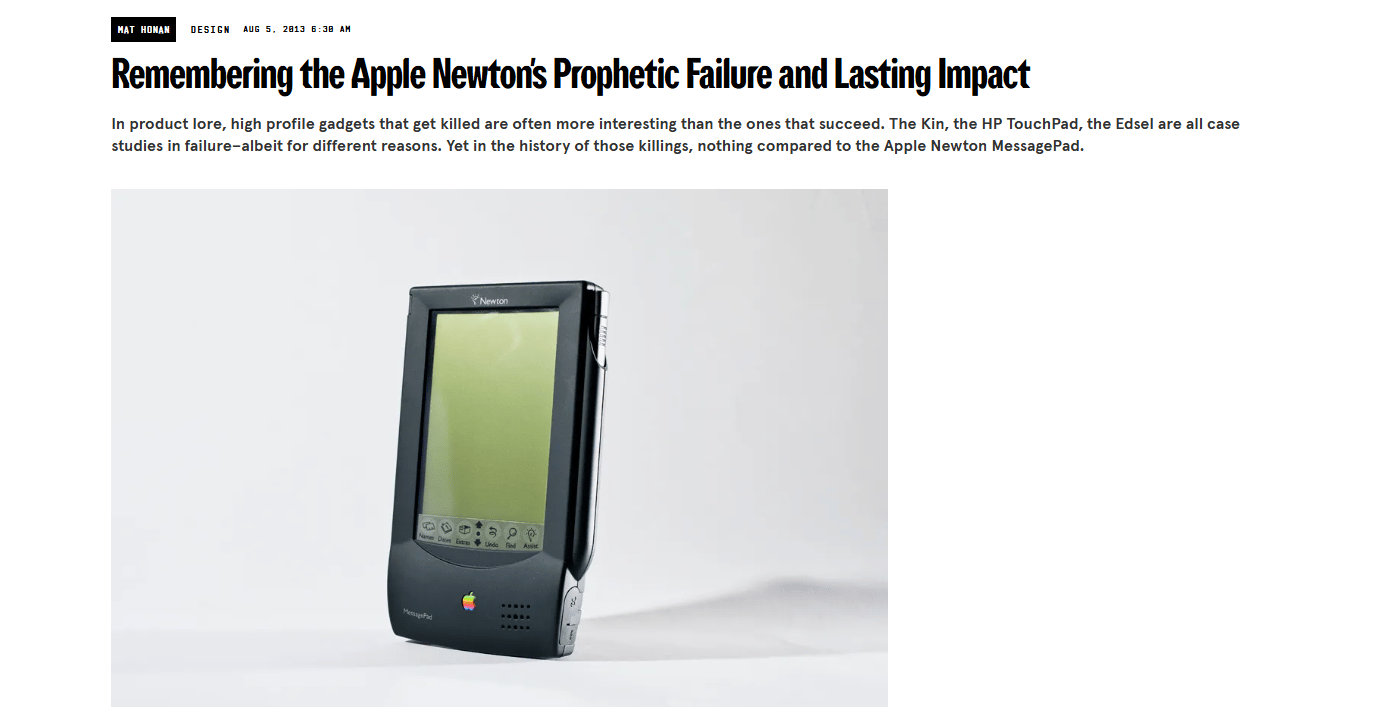
Source: Wired.
I’ve seen great systems sit untouched simply because the team didn’t understand them. In 2026, education stops being optional.
That’s why education has now become a must-have. Training, walkthroughs, examples and simple explanations become part of the product, not an extra. And here’s the part most people miss: education itself becomes a business.
So, you should, no, MUST build education into every project proposal.
$15k-$20k as a dedicated Adoption + Training package (when the client is big enough to justify it).
On-site training sessions with actual users.
Documentation, video tutorials and prompt libraries.
Companies will happily pay to make sure their teams adopt what they paid for. If you don’t offer that, then someone else will.
VI. Prediction #5: 80% of Your Work Will Be General Software Development
This might be uncomfortable to hear but most businesses aren’t ready for advanced AI. Their systems are messy. Their data is scattered. Their workflows are held together by duct tape and Excel sheets.
According to the Cisco report, while 97% of companies say AI is urgent, 92% still don’t have AI-ready data because their ERP systems are stuck in fragmented silos. In simple terms, most businesses want AI but their messy data foundations are holding them back.
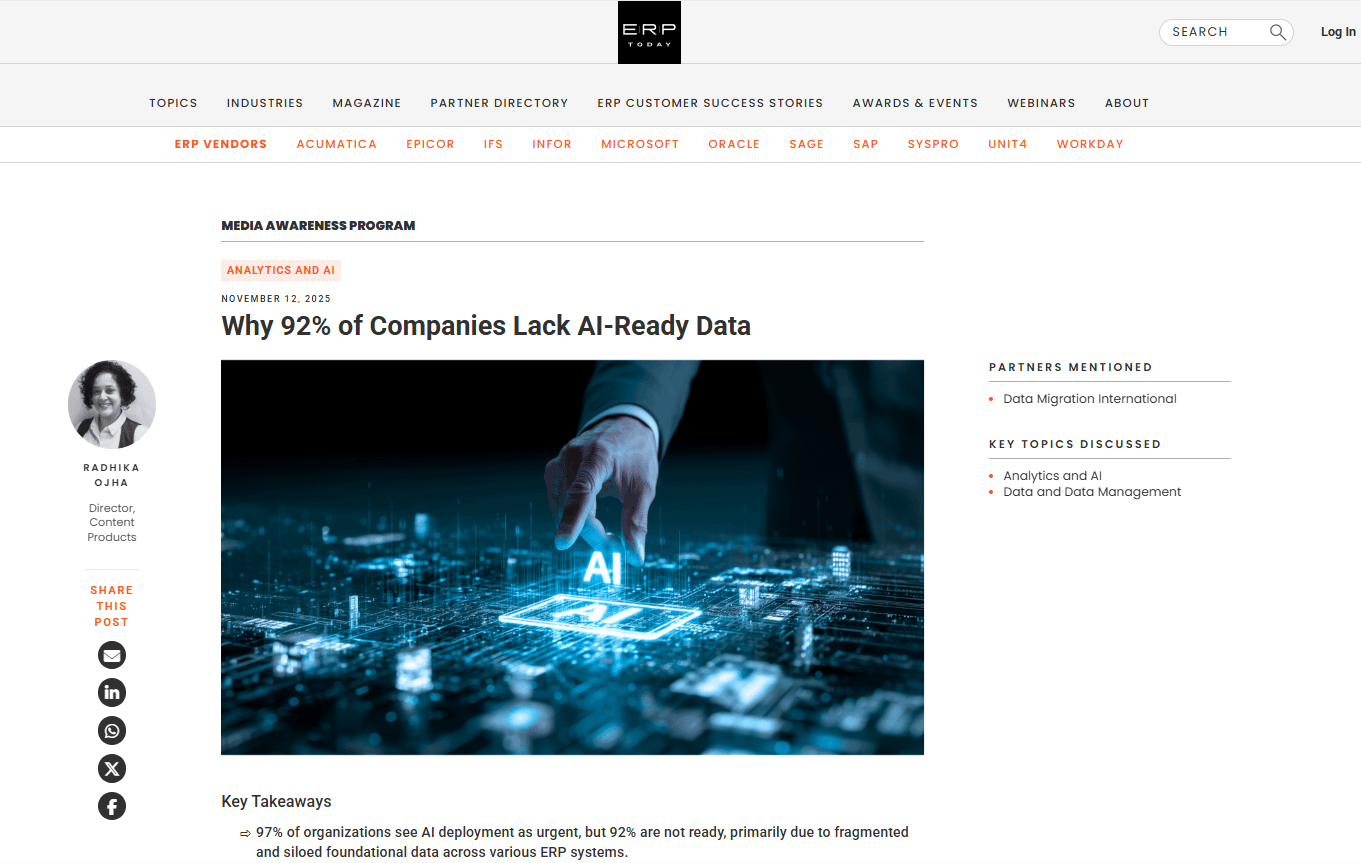
Source: ERP Today.
Before AI does anything useful, someone has to clean that up with things like dashboards, internal tools and simple systems that actually work.
The good news is that building this stuff is faster and cheaper than ever if you know how to use modern tools. You can now build things in days that used to take months. With AI-assisted dev, what used to take months can now take days or weeks so margins are better if you know what you’re doing. You can charge $30k-$50k for a custom dashboard that takes you a week to build with AI-assisted development tools like Cursor or Lovable.
For example, developers using the tool Cursor work 21% to 55% faster. Another tool, Lovable, can build 70% of an app by itself; one user built 30 apps in 30 days instead of months manually.

Source: Blott.
Clients get better tools. You get higher margins. And when the foundation is solid, adding AI becomes easy.
VII. Prediction #6: The Money Is in Testing & Optimization
Building the first version of a system is expected now. The real value comes after, when you test, tweak and improve it based on how people actually use it.
This is why agencies will sell optimization retainers, not just build-and-leave projects.
To prove this shift, I’ll show you 3 real iteration success stories:
KiwiQA ran 18 months of continuous testing on a client app and saw day-one retention jump sharply, with overall retention peaking at nearly 3x. They used real user behavior (cohort analysis and ICE/PIE scoring) to decide what to improve, not gut feelings.
Dropbox started with a simple MVP video to test demand, then refined the product through user feedback, bulk invites and endorsements. That loop helped them scale to over 700 million users.
LG CNS’s Haruzogak tracked user behavior after launch, identified key activation moments and adjusted onboarding flows, which led to a major boost in adoption.
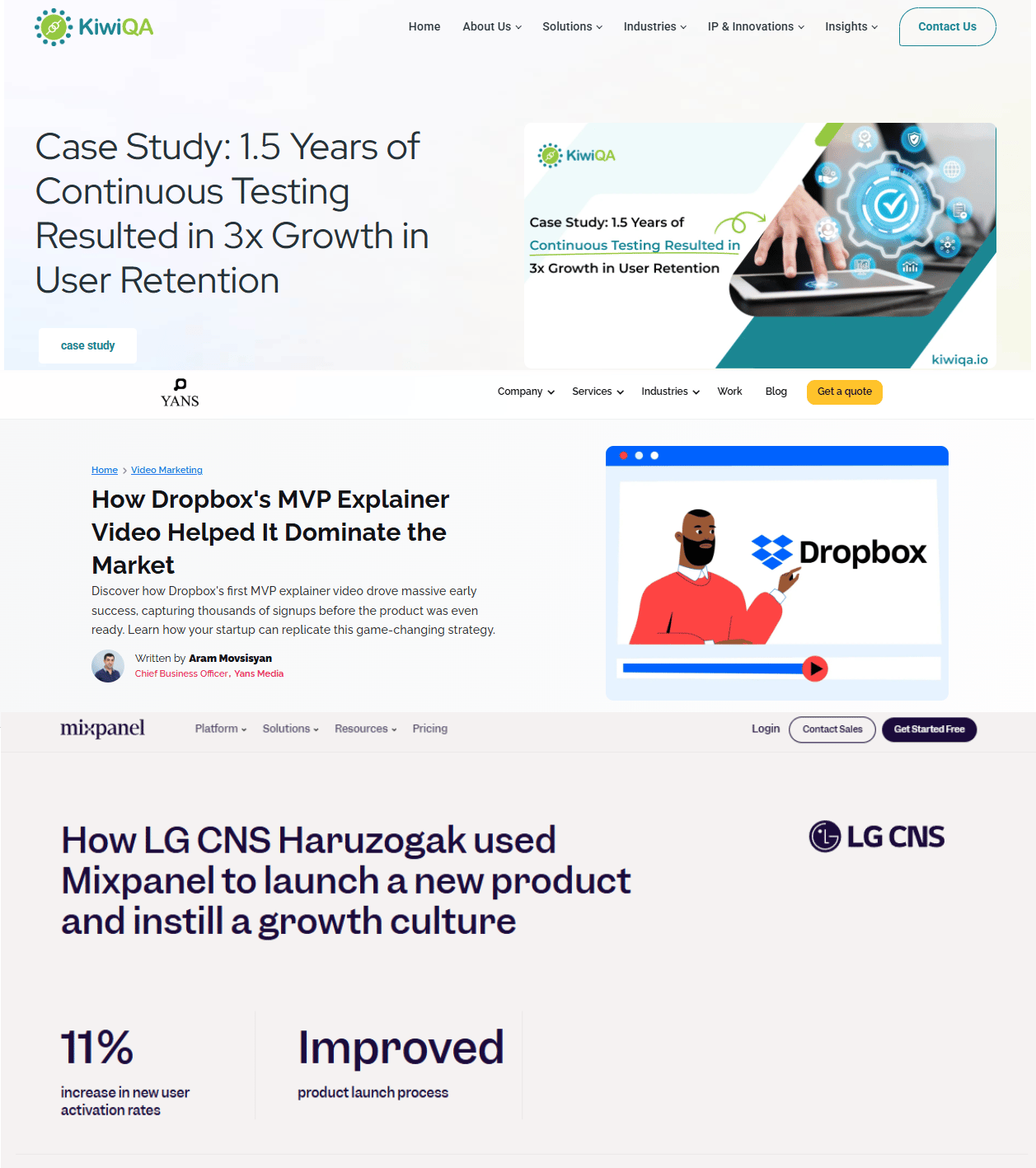
This is where most agencies leave money on the table. They bundle everything into one project, finish it and move on.
The smarter move is to treat version one as the start, then stay involved to improve performance, accuracy and adoption over time. That’s how one-off projects turn into ongoing revenue.
Sell this as a monthly optimization retainer with clear KPIs.
VIII. Prediction #7: The Endgame Is Owning IP (Turn Service Work Into Assets)
After a while, patterns appear. You’ll notice different clients paying you to solve the same problem again and again. That is the shift I want you to know: Smart agencies are using client work as an R&D laboratory to identify software opportunities they can turn into SaaS products.
That’s not a coincidence. That’s a signal. Smart agencies use client work as research. They build once, refine it, then turn it into something reusable. That’s how service work slowly becomes an asset.
Here is the strategy you could apply:
Notice patterns: Are three different clients paying you to solve the same problem?
Productize it: Build it once, sell it many times.
Scale: Move from service margins to SaaS margins.
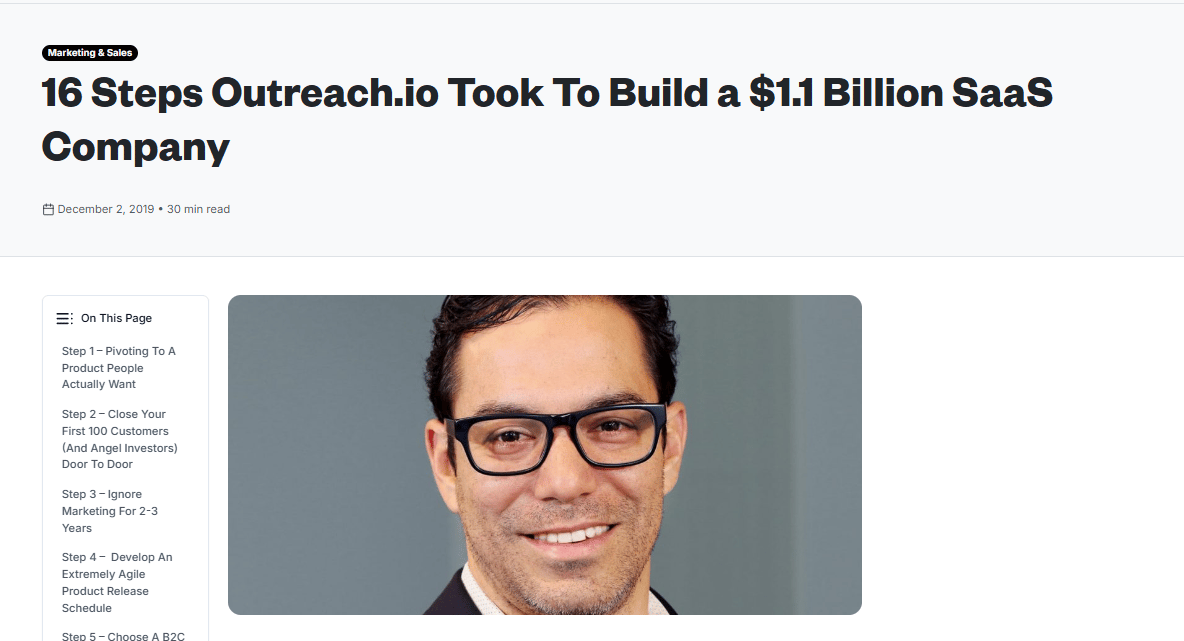
Real case study: GroupTalent, a recruitment agency, noticed sales inefficiencies while working with clients. They built internal software to help their reps work faster and sell better, then spun that tool into Outreach.io, which later grew into a $60M+ revenue business.
Source: GetLatka.
I’m not forcing you to do this overnight. But you need to do it step by step if you want to get there.
Creating quality AI content takes serious research time ☕️ Your coffee fund helps me read whitepapers, test new tools and interview experts so you get the real story. Skip the fluff - get insights that help you understand what's actually happening in AI. Support quality over quantity here!
IX. Prediction #8: The "Partner Race" Begins (Lock Down Mid-Market Now)
Small companies move fast but don’t pay much. Big enterprises pay a lot but move painfully slow. Mid-size companies sit right in the middle.
Why mid-market companies?
They have budgets, they feel pain and they move fast enough.
Too big for freelancers.
Too small for big consulting firms like McKinsey.
Perfect size for agile AI agencies.
In the next few years, every serious AI agency will be trying to lock in long-term relationships with these companies. If you wait too long, the doors close.
X. Prediction #9: Rise of the "Forward Deployed Engineer"
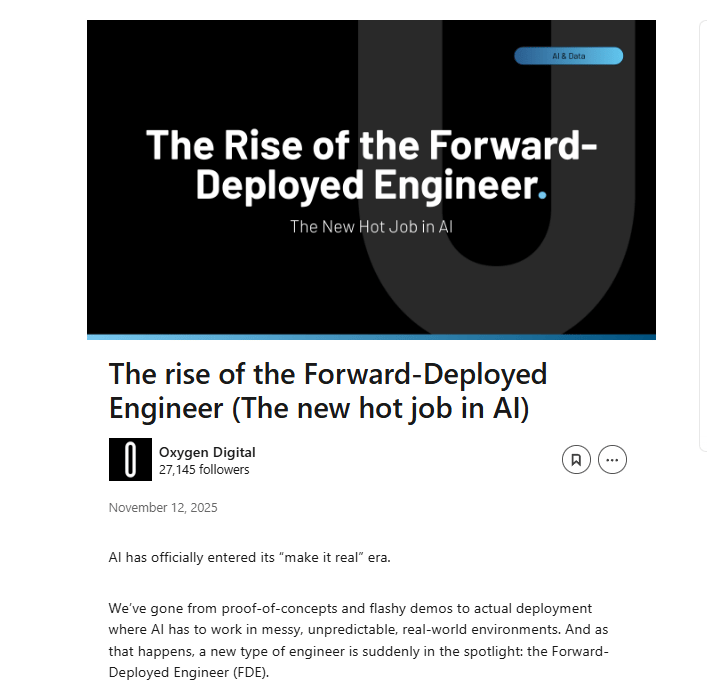
There’s a new role showing up more and more. Someone who understands the business, talks to the team and builds solutions live, adjusting in real time (not a pure consultant or a pure developer). The people who deliver the most value are those who can step into this new hybrid role (half consultant, half developer).
It’s someone who can listen, think and build fast.
For example, if you can do these:
Go on-site to the client's office.
Interview staff to understand problems.
Use "vibe coding" tools (Claude, Cursor) to build working prototypes in front of the client.
Iterate in real-time.
Companies will pay a lot for your time because the value is obvious immediately.
Source: LinkedIn.
XI. Prediction #10: The "AI Executive Assistant" Offer
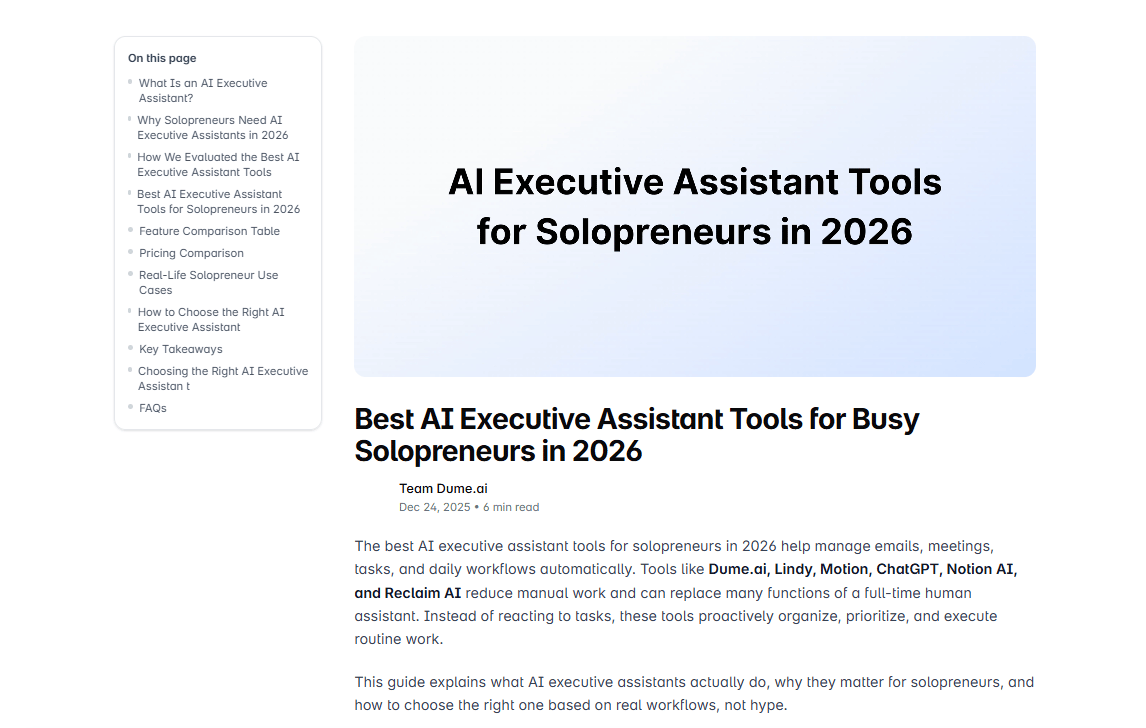
Another shift I’m seeing is demand from leadership, not teams. Executives want a single place where insights come together. They don’t want ten dashboards. They want answers. Systems that pull from across the company and help with planning and decisions.
These aren’t cheap projects. And they’re not short-term. They turn into long relationships if done right.
This isn't a $10k project. This is a $50k-$150k+ annual retainer because you are essentially building a strategic advisor that is always on.
XII. Prediction #11: Google's "Business-in-a-Box" Platform
At some point, big platforms will make building basic systems easier than ever. When that happens, agencies don’t disappear. Their role changes.
My bet: Google (or another giant) will ship “business-in-a-box” workflows that make basic systems stupidly easy.
For example, with the Build Mode in Google AI Studio, anyone can now build an app without knowing how to code. You only need to describe the app using simple text.
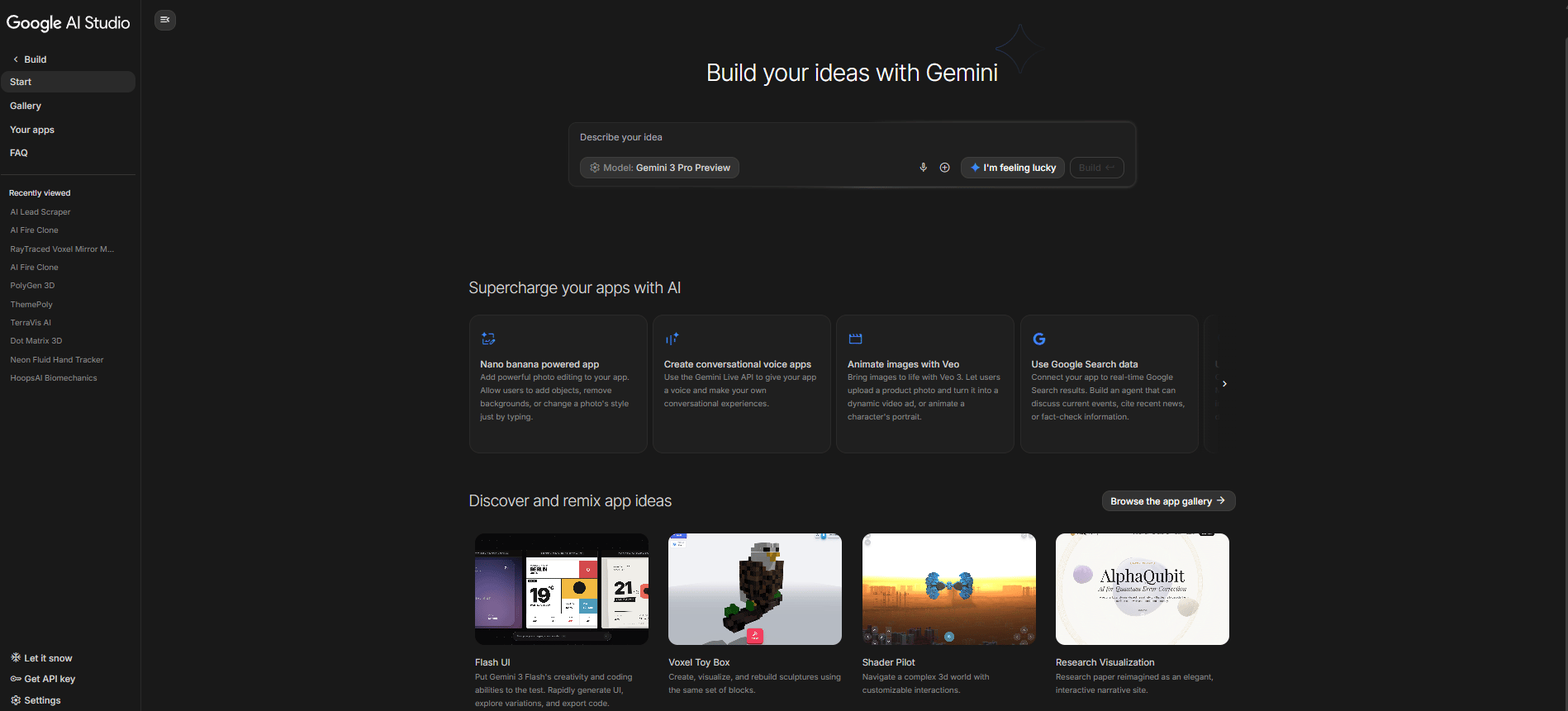
Your job shifts from "building" to "integration and facilitation". Helping companies connect tools, adapt systems and make everything work together becomes the real value. Companies will still need experts to navigate these massive platforms and integrate them with legacy systems.
This is a prediction but the direction is clear: basic build work gets commoditized.
XIII. What Should Your 2026 Positioning Plan Be Right Now?
Pick a niche and a measurable outcome. Build an audit offer that leads to implementation. Add education and iteration as standard line items. Start talking to medium-sized companies now, before your competitors do.
Key takeaways
A focused niche beats a broad “AI agency” label.
Clients care more about results than they do about a list of features.
Use a 90-day plan to reshape your offer and proof.
Build a repeatable audit → roadmap → build → optimize pipeline.
Positioning is not words; it is what you can prove quickly.
Alright, enough predictions. What should you actually do? If I had to position myself today for 2026, I’d do five things and maybe so do you:
Niche Down: Pick one industry and become the undisputed expert.
Expand Beyond Automation: Add software development, consulting and education to your stack. Stop selling automation and start selling outcomes.
Master the Audit: Build a clear roadmap for how $5k audits turn into $50k implementation projects.
Invest in Infrastructure: Build internal systems for rapid iteration and testing so you can move fast.
Go After Mid-Market: Identify 10-20 mid-market companies in your niche and start conversations with them now, not later.
XIV. Conclusion: The Gap Is Widening
The gap between "AI automation freelancer" and "AI transformation partner" is widening fast. Which side you end up on in 2026 depends on the moves you make in the next 90 days.
Most businesses are still using Excel sheets from 2015. The opportunity isn't disappearing; it is just evolving. The agencies that position themselves as transformation partners and deliver measurable ROI through systems + data + AI (in that order) will win.
Everyone else gets pushed into low-margin work.
Your move.
If you are interested in other topics and how AI is transforming different aspects of our lives or even in making money using AI with more detailed, step-by-step guidance, you can find our other articles here:
AI is Changing How Companies Actually Win: 5 Shifts You Can't Ignore if You Wanna Success
Ultimate Guide to Create VIRAL Luxury-Style AI Marketing Campaigns for any Product*
5 AI Habits You Must Build Now to Decide Who Wins & Who Falls Behind in 2026
The Exact 4-Stage Path To $1M With AI: Why Most Will Fail in 2026*
*indicates a premium content, if any
⭐ How would you rate this "How to Make Money with AI" blog post?Help us improve by picking one that best describes your thoughts: |
|
Reply