- AI Fire
- Posts
- 🔄 AI is Changing How Companies Actually Win: 5 Shifts You Can’t Ignore if You Wanna Success
🔄 AI is Changing How Companies Actually Win: 5 Shifts You Can’t Ignore if You Wanna Success
Most businesses are using AI wrong. You don’t need a big team anymore. I’ll show you the 5 shifts I’m seeing and what to automate first.

Max Anh
December 25, 2025

TL;DR BOX
AI is changing how businesses work, quietly but deeply. The real value is moving away from doing the work and toward deciding what to do and how it gets distributed.
Instead of big teams and complex org charts, companies now win by leverage. Instead of product features, they win by data and distribution. These 5 shifts are redefining how companies compete and scale.
In this guide, I’ll show you why headcount-only growth is getting weaker. You can still hire, but hiring isn’t the default lever anymore. It details specific strategies for building proprietary data loops and automating back-office functions to gain an advantage that actually lasts.
Key points
Stat: A single "AI Ops" role can recover 400-800 hours of capacity weekly in a 20-person company.
Mistake: Assuming competitive advantage still lies in development capability when AI allows anyone to build software instantly.
Action: Audit your time for two weeks to identify the 20% of repetitive execution tasks to automate first.
Critical insight
When features become easy to copy using AI coding tools, your only defensible moat is proprietary data that improves your product automatically through customer usage loops.
🚀 Which "shift" is your biggest opportunity right now? |
Table of Contents
I. Introduction: The Restructuring of Value
Most business owners talk about AI like it’s a faster email writer or a nicer spreadsheet helper, and if that’s how you see it, you’re missing the whole point because AI isn’t just speeding up work, it’s changing what work is worth doing in the first place.
Over the past few months, I’ve created real AI workflows, watched teams rebuild how they operate, and sat in conversations where people quietly realized they don’t need more hires, they need more leverage, and the same five shifts keep showing up again and again, especially in small teams.
These aren’t predictions on a slide; they’re happening right now in real companies. The question isn't whether these shifts will affect your business. It is whether you will adapt in time to capitalize on them.
The Context That Changes Everything
Before we go into the five shifts, you need to understand why this moment is different. This moment is different because AI doesn’t just improve your workflow like mobile or cloud did. AI changes what’s possible.

You can now build software in plain language, and when anyone can build almost anything. A kid can now design, launch and make money from a full app using voice commands and tools like Lovable. No coding, no degree, no apprenticeship.
This creates a new paradox: if anyone can build almost anything, what actually stays valuable?
The real value moves somewhere else, and if you don’t notice where it moves, you’ll keep investing in the wrong things.
Once you see that, you stop thinking in headcount and departments, and you start thinking in leverage, and that’s the first shift.
Learn How to Make AI Work For You!
Transform your AI skills with the AI Fire Academy Premium Plan - FREE for 14 days! Gain instant access to 500+ AI workflows, advanced tutorials, exclusive case studies and unbeatable discounts. No risks, cancel anytime.
II. Shift 1: From Org Charts to Leverage Charts (The Death of "Throw Bodies at Problems")
1. The Old Model: Departments, Levels and Staff Numbers
If your default answer to growth is “hire another person,” you’re about to feel pressure, because “throw more people at it” is one of the most expensive habits in business.
The old model was simple. You had departments like sales, marketing, finance and operations, each staffed with multiple people organized hierarchically.
And when things got messy or slow, you added headcount to patch the gap. Sales team underperforming? Hire three more sales reps. Marketing not generating enough leads? Expand the marketing department.
This model made sense when human labor was the primary input. But that world is ending.

2. The New Model: One Owner, Infinite Leverage
The new model flips this entirely. Instead of a department being “a bunch of people doing tasks,” it becomes “one owner who runs a system.”
Finance doesn’t need six people moving invoices around all day. You need one sharp finance lead who sets rules, watches the numbers, and lets the system handle the routine stuff.
Marketing doesn’t need a full team making content all week. You need one marketer with taste who knows what to push, what to ignore, and how to steer the machine.
This isn’t about “killing jobs.” It’s about killing the boring parts of jobs that waste time and energy, and keeping the parts that actually create value like strategy, judgment, relationships, and taste.
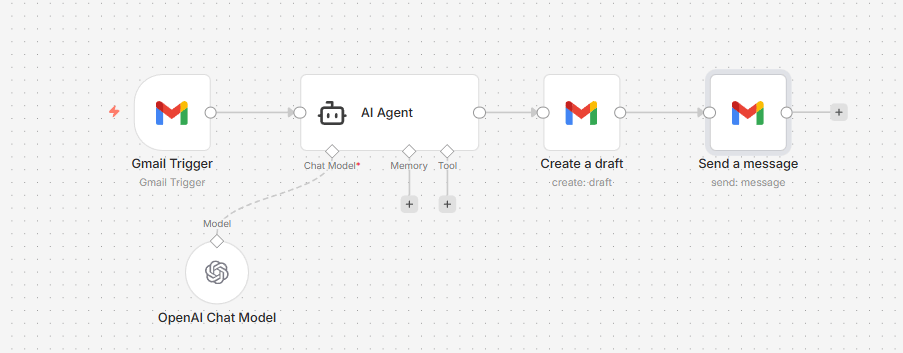
Let me take a simple example: You’re tiring of checking emails, writing drafts, sending them and waiting for the response. If you are still in the old model, you are definitely hiring new staff to do that and that costs a lot of money, time to train,… But with a new mindset, you create a simple workflow in n8n that could do all of that with a little bit of money.
3. Tactical Application 1: The One-Person Sales Machine
A typical B2B sales setup is bloated. You have people doing outreach, people qualifying, people booking, people following up, and a closer at the end. It need 10-14 people to generate $3-5M in annual revenue.
Now imagine you only keep one elite closer, and you surround that closer with a system that does the repetitive parts all day without getting tired.
AI agents run outbound prospecting end-to-end. They research each prospect, write personalized emails, and filter inbound leads before you ever see them.
Your calendar stays optimized automatically. The AI reshuffles meetings so you spend more time talking to high-value prospects and less time on low-impact calls.
After every conversation, follow-ups write themselves. The AI sends emails that reference exactly what was discussed, so nothing feels generic or forgotten.
And during live calls, AI feeds you real-time help. Competitive context, product details, and talking points show up when you need them, not after the call is over.
That’s not “nice to have.” That’s how one closer can perform like a whole team.

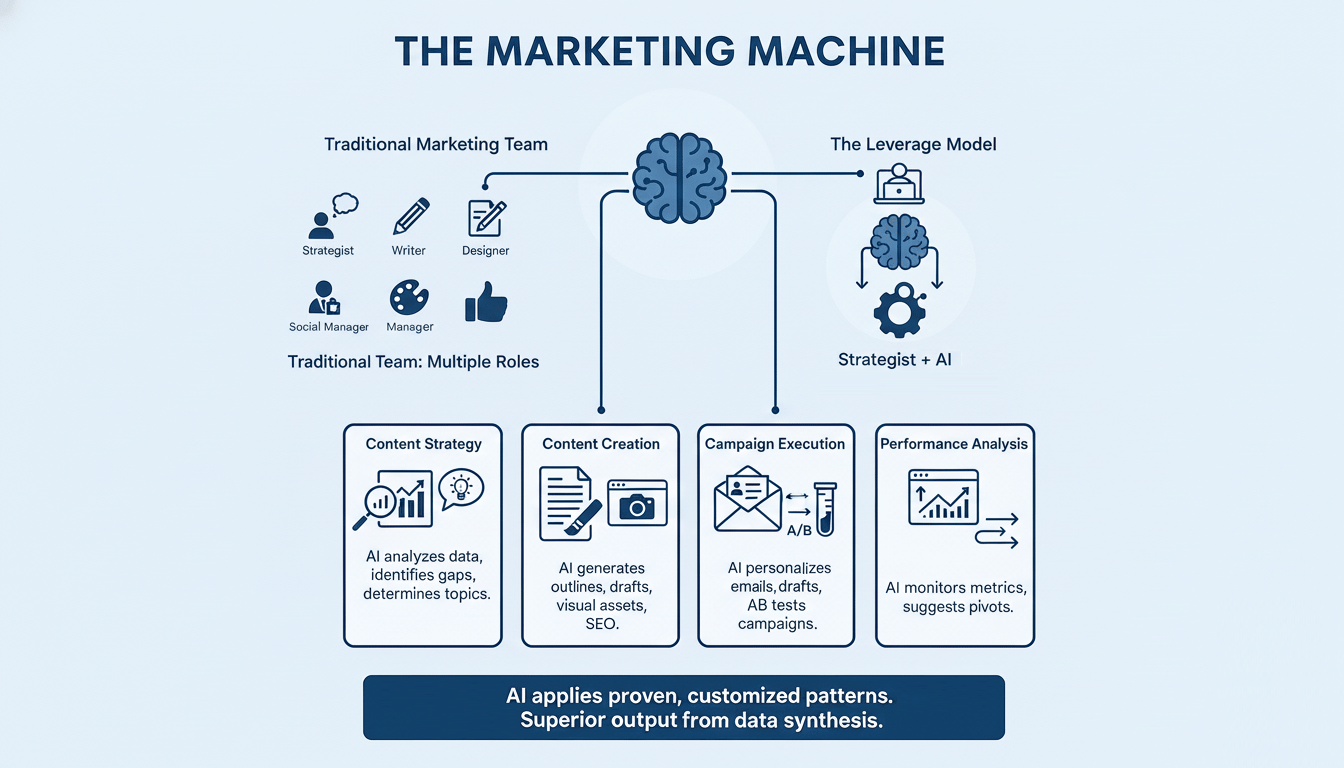
4. Tactical Application 2: The Marketing Machine
Most teams waste hours doing things that feel productive but don’t move revenue, like rewriting captions, resizing visuals, summarizing reports, and posting content that isn’t connected to a real customer need.
When you shift to leverage, your marketing becomes a loop.
Content Strategy: AI analyzes customer data to identify content gaps and determine what topics drive conversions.
Content Creation: AI generates detailed outlines, writes first drafts, creates visual assets and optimizes for SEO.
Campaign Execution: AI personalizes email campaigns based on recipient behavior and A/B tests variations automatically.
Performance Analysis: AI monitors what is working across channels in real-time and suggests strategic pivots based on data
The system makes volume cheap. You still need taste, good inputs, and sharp decisions. Because if your inputs are bad, you don’t get “good marketing faster,” you get junk faster.
Traditional marketing teams include strategists, writers, designers and social media managers. The leverage model: One strategic marketer directing AI systems.
5. The Future-Level Hack: The AI Ops Role
This is the role a lot of small teams will hire before they hire more staff.
Not “IT” or “automation guy.” One person whose job is to find repetitive work, remove it, and train the team to run with leverage.
I’ve seen small teams (20-person team) unlock what feels like multiple extra full-time roles just by having one person who takes leverage seriously and keeps improving the system every week.
Job Description: Identify repetitive work, build AI solutions to eliminate it, train team members to become directors and measure time saved.
Value: One AI Ops person might create 20-40 hours of recovered time per week per employee. At a 20-person company, that is 400-800 hours of recovered capacity weekly. That is like hiring 5-10 additional full-time employees without the payroll cost.
If you want a simple mindset shift that changes how you operate, stop asking:
“Who should I hire next?”
Start asking:
“What should I build so we stop needing to hire for this?”

To make this real, I documented the weekly AI Ops checklist I use to recover hours without adding tools or headcount.
III. Shift 2: From Doer to Director (The Skill That Actually Matters Now)
This is the shift most people resist. Because it feels like cheating or it feels like you’re “not working” if you are not the one doing the task.
But in an AI-enabled business, doing is not a rare skill anymore. Directing is.
1. Why AI Doesn't Blow People's Minds (Yet)
A lot of people try AI once, get disappointed, and then say it’s overrated.
But what they actually did was ask ChatGPT for a blog post, get a generic blog post, and then blame the tool. That’s like hiring a smart assistant, giving them one vague sentence, and getting mad when they guess wrong.
That’s not how it works. AI behaves more like a team member.
If you give a team member a vague instruction, you get vague output.
If you give them context, examples, and clear standards, you get high-quality work.
So the new skill is not “prompt tricks.”
The new skill is being able to direct a system toward an outcome.
2. The Old vs. New Time Allocation
In the old world, most of your time went to execution: you did the work, wrote the thing, built the slide, made the spreadsheet, followed up,…
But in the new world, most of your time goes to: deciding what matters, setting standards, giving context, reviewing output, iterating the system, making judgment calls,…
Category | Old Allocation | New Allocation | Why It Matters |
|---|---|---|---|
Time Split | 90% Execution (doing the tasks), 10% Direction (planning) | 80-90% Direction (strategy, configuration, refinement), 10-20% Execution (coordination, relationships) | Humans now focus on strategy, taste and judgment, not repetitive tasks. |
Human Role | Mostly task-doing | Mostly decision-making & system design | Better choices → better outputs. |
Execution Quality | Declines with fatigue and repetition | Stays high because AI handles the repetitive work | AI eliminates low-value work that drags performance. |
Output | Slower, inconsistent | Faster, more consistent and often superior | Quality improves when humans spend time on what truly matters. |
3. The Director Mindset: What Changes
You spend less time typing and more time thinking. This is why the “director” analogy works so well. A director does not act every role in the movie. They set vision, guide specialists, judge quality, and make the final call.
That becomes your job, even if you are a solo founder. You are designing your job, then put it together with AI systems that eliminate your tasks.
4. What This Means for Jobs
Here’s the blunt truth:
If your work is mostly repeating predictable steps, AI will take a large part of it.
If your work is mostly judgment, taste, strategy, relationships, and decision-making, you become more valuable.
Don’t you believe it? Here is a report that shows customer service reps face 80% automation risk by 2025; data clerks see 7.5M roles eliminated by 2027 as AI handles scheduling, spreadsheets, and inquiries 13.8% faster per hour.
So the “safe path” is not your title. The safe path is your task mix. And you can adapt even if you are not technical, because directing is learned through practice, not credentials.
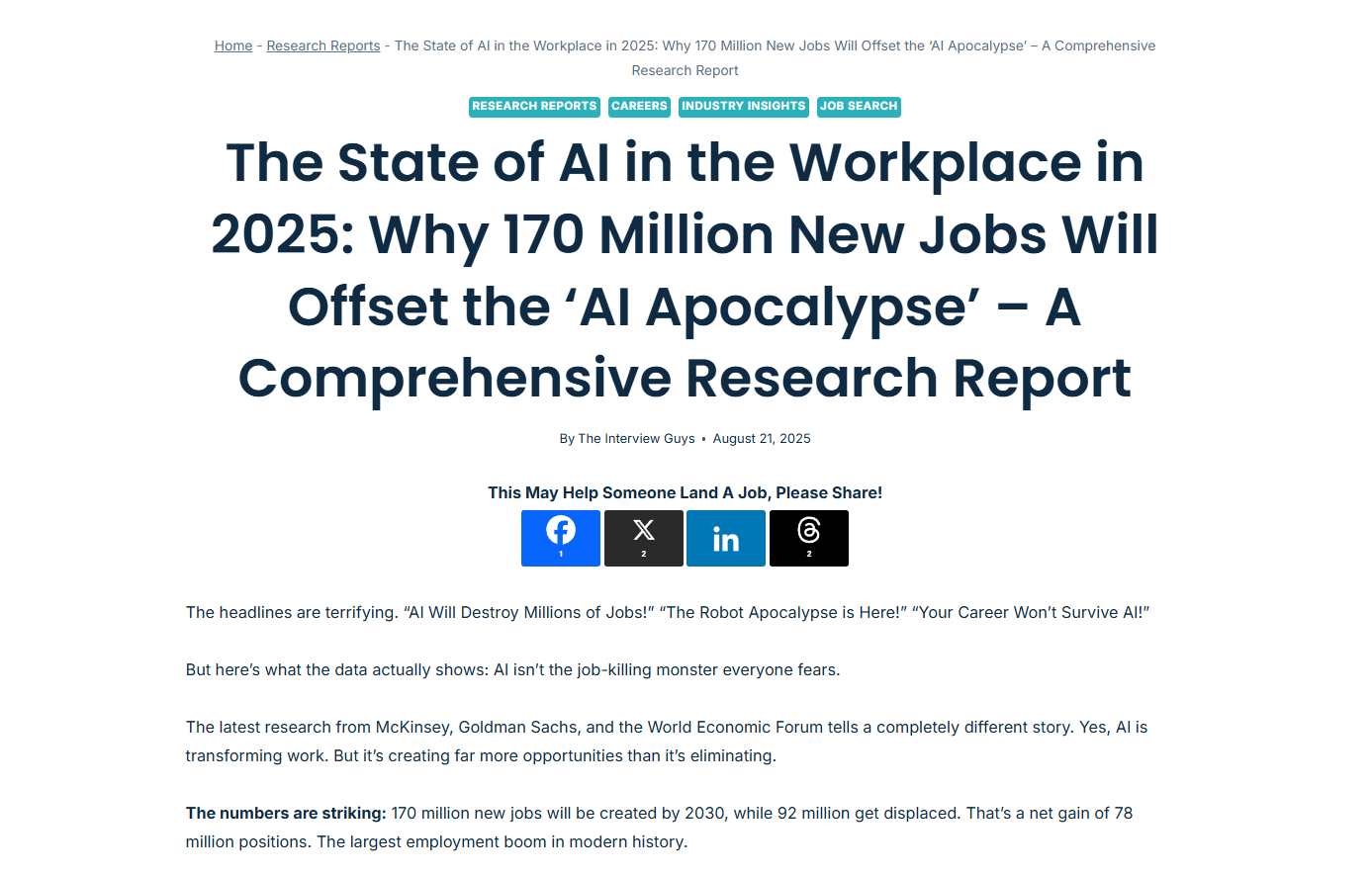
Source: The Interview Guys.
5. How to Adapt: Developing the Director Skill
You do not build this skill by reading about it. You build it by changing how you work. You can start with three simple habits:
Step | Focus | What To Do |
|---|---|---|
1. Audit Your Time | Understand your baseline | - Track your time for two weeks. - Calculate your Execution vs Direction ratio. |
2. Identify Opportunities | Spot high-leverage automation targets | - Find the 20% of execution tasks consuming 80% of your time. - Ask: Is this pattern-based? |
3. Learn to Direct AI | Build the skill that flips your ratio | - Pick your top 2-3 tasks. - Learn to direct AI well. - Write clear system prompts. - Provide examples. - Iterate repeatedly. |
4. Expand Systematically | Gradual shift to AI-powered leverage | - After automating 2-3 tasks, expand. - Aim to move from 80% execution → 80% direction over 12-18 months. |
IV. Shift 3: From Feature Defenses to Data Defenses (Why Your Competitive Advantage Just Changed)
1. The Old Competitive Dynamics: The Feature Race
For years, software competition was simple. You shipped a new feature. You won for a few months. Then competitors copied it. Your advantage was just speed. That world is gone.
Pushpay didn’t win by shipping more features. They cut churn by 20% by changing pricing and being proactive with customers while competitors were busy copying each other’s features. That’s the pattern now. In SaaS, UIs and algorithms get cloned fast, switching costs stay low, and feature-based differentiation disappears almost overnight.
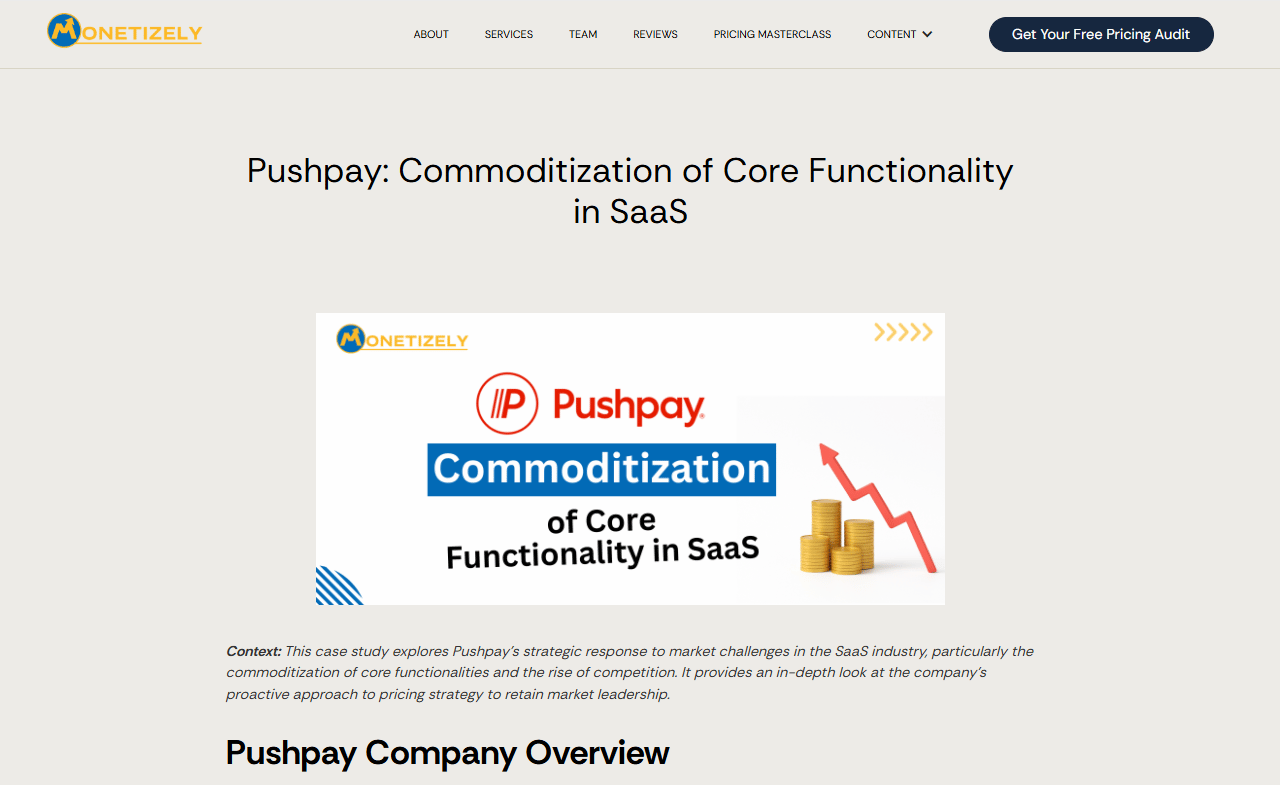
Source: Monetizely.
2. The New Reality: AI Builds Features Instantly
Today, AI can build features fast. Really fast. With tools like Lovable, Cursor or GitHub Copilot, a small team can ship in days what used to take a full engineering organization.
If you release a feature, assume others will copy it within weeks. Competing on features is suicidal because the cost of feature development has dropped close to zero.
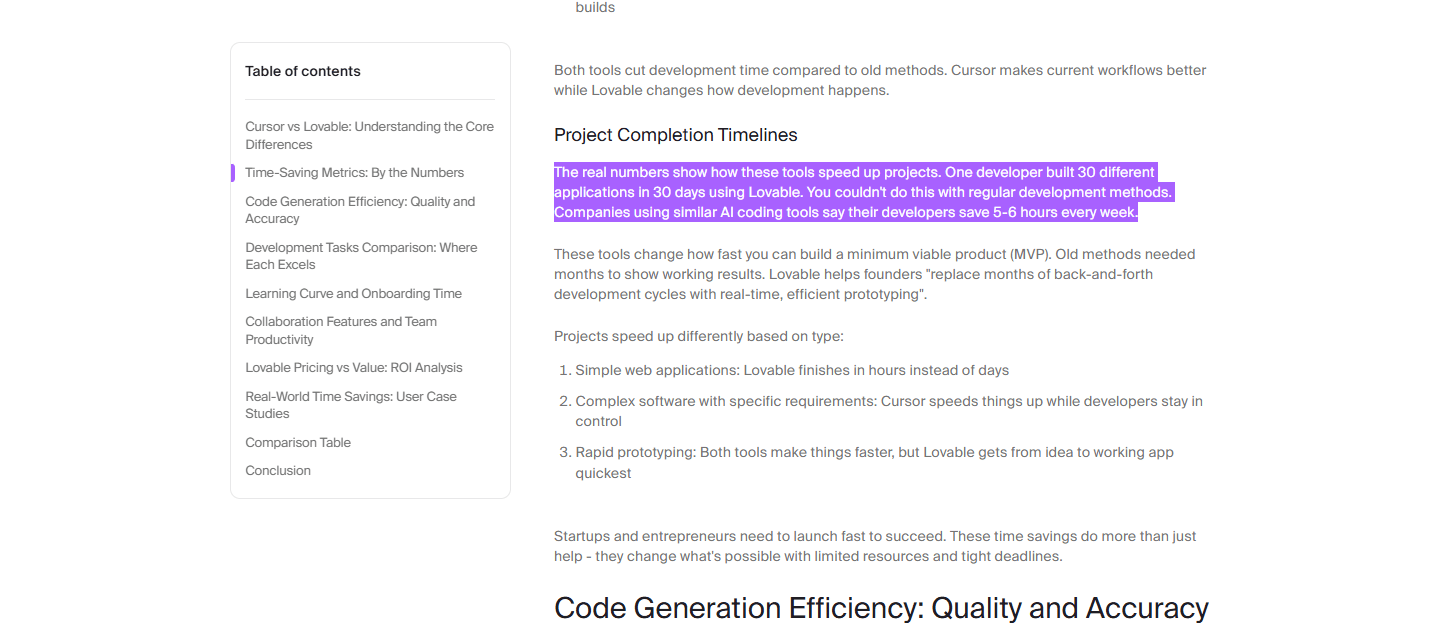
Real-World Examples: Grupo Boticário gained 94% developer productivity with Copilot, shipping faster than rivals; one founder used Lovable for 30-day app marathons, impossible pre-AI.
Source: Blott.
3. The New Moat: Proprietary Data and Learning Loops
If features are easy to get, what protects your business? Data, I’m not talking about: public data, generic benchmarks,… I want you specifically to know that:
Private Customer Data: Preferences, behaviors, outcomes, feedback.
Private Industry Data: Unique insights, methodologies and processes.
Learning Loops: Systems that continuously improve based on customer interactions.
This is why ChatGPT gets better the more you use it. OpenAI collects your history and preferences. Your experience is personalized based on your data and competitors can't replicate that. Your business needs the same dynamic.
4. Building Your Data Moat: The Three-Step Framework
Here’s how to build it, step by step.
Step 1: Clean Your Data (Garbage In, Garbage Out).
If your customer records are messy, AI will give messy output. You need to remove duplicates, fix missing fields and make sure basics are correct.
Step 2: AI Analysis and Correlation Discovery.
Once the data is clean, AI can spot things you won’t.
For example, it could spot correlations across thousands of records that you would never notice manually, like what type of customer churns, what message converts, and what onboarding step predicts retention.
This creates a competitive advantage: the more customers you onboard, the better your AI gets at personalization.
Step 3: AI-Suggested Next Steps (Closing the Loop).
Don’t stop at dashboards. Let AI suggest what to do next. The loop looks like this: data comes in → AI finds trends → AI suggests actions → you approve → AI executes → results feed back into the system.
That loop compounds over time.
Here’s the hard truth: when everyone has the same features, the company with the best data wins. If you’re still racing on features, you’re already behind. Start building your data moat now.
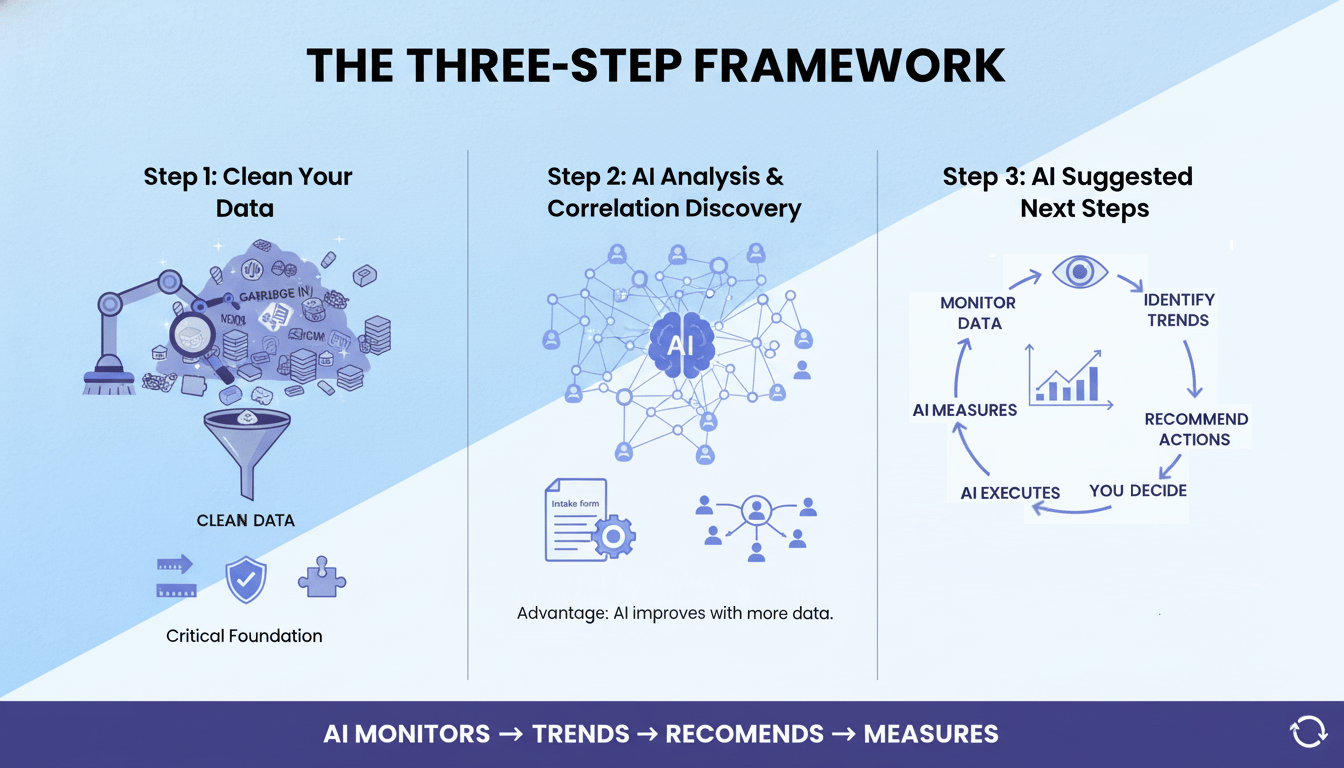
The 3-Step Framework
Creating quality AI content takes serious research time ☕️ Your coffee fund helps me read whitepapers, test new tools and interview experts so you get the real story. Skip the fluff - get insights that help you understand what's actually happening in AI. Support quality over quantity here!
V. Shift 4: The Autonomous Back Office (Why You're Still Paying Humans for Robot Work)
1. The Old Model: Full-Time Positions for Routine Functions
For decades, companies hired full-time staff for finance, HR, and legal. The logic was simple: this work needed judgment, context, and careful handling. So you paid people to sit in the back office and process the same requests every day.
Here’s the uncomfortable truth: most of that work follows rules: an invoice comes in, someone checks it, someone approves it, someone files it,… This happens over and over again.
This is exactly the kind of work AI is good at.
2. The Emerging Reality: 98% Automation, 2% Human Oversight
When you look closely, back-office work is rarely strategic. It’s policy-driven execution. If X happens, do Y. If it breaks a rule, escalate.
AI can handle the bulk of this on its own. Humans step in only when something looks unusual. Examples you’ll recognize:
Finance: AI tracks cash flow, reads invoices, checks approval rules, pays vendors, and creates reports.
HR: AI runs recruiting pipelines, answers common employee questions, and processes documents.
Legal: AI reviews standard contracts, flags risky clauses, and handles repeat questions.
What used to take days now finishes in minutes.

3. The Practical Implementation: Finance as an Example
Think about how invoices work today.
Traditional: Invoice arrives → Manual entry → Waiting for approval → Manual review → Payment → Manual reconciliation.
AI-Enabled: Invoice arrives → AI extracts data → AI checks policy → If within policy, AI processes immediately → AI reconciles automatically.
You don’t lose control; you just stop doing busywork. Tools like Tipalti already do this. You connect your systems, define your rules once, and let the system run.

4. The Implementation Pattern
To make this work, you only need three things:
Clear rules. Write down what’s allowed, what’s not, and when a human should step in.
Connected data. Give AI access to your accounting tools, CRM, inboxes, and docs.
Human review for exceptions. When something looks unusual, AI escalates with full context.
Here’s the principle that changes how you build companies: patterns belong to machines, exceptions belong to people. Automate the 98% that repeats. Save humans for the 2% that truly matter.
VI. Shift 5: From Development Advantage to Distribution Advantage (Why Code Is Worthless)
1. The Old Competitive Advantage: Best Development Team Wins
For a long time, the winners were the teams with the best engineers. If you had smarter developers, better architecture, and more R&D money, you would win. The strategy revolved around shipping features faster than everyone else.
But now, that world is gone.
2. The New Reality: 12-Year-Olds Are Building Apps
Today, AI tools like Lovable, Cursor, and Bolt let almost anyone build real apps by typing plain English. You don’t need a big team. You don’t even need years of coding experience. Building the product is no longer the hard part.
This changes everything.

3. What Actually Matters: Distribution
If anyone can build anything, then the real advantage moves somewhere else: distribution.
It comes down to one question: can you get in front of the right people and earn their trust?
Distribution usually shows up in three ways:
Owned audiences: email lists, YouTube subscribers, communities. This is gold because you control it.
Paid reach: ads. Useful, but expensive and easy for others to copy.
Partnerships: working with people who already have the audience you want
4. The Three-Step Distribution Playbook
If you want this to be practical, here’s the clean path:
Principle | What It Means | Why It Matters |
|---|---|---|
Build Distribution Into the Business Model | - Start with the question: How will we reach customers? - Pick one primary channel (organic, paid, partnerships). - Grow one owned channel every week. | - Distribution beats product quality. - A great product without reach dies. - Committing to one channel accelerates early traction. |
Attach Your Brand to a Clear Problem | - Make it instantly obvious: Who is this for? What problem does it solve? What result will I get? - Focus on outcomes, not features. | - People buy clarity. - A sharp problem definition makes your offer memorable and increases conversion. |
Pre-Sell Before You Build | - Sell the product before it exists. - Validate demand, collect commitments and use revenue to fund development. | - Reduces risk. - Confirms real demand. - Prevents wasting months building something no one wants. |
5. The Distribution Shortcut
If you don’t have distribution yet, borrow it. Partner with creators or experts who already speak to your audience. Build something useful for their people. They promote it. You split the upside.
This is how you go from zero to revenue fast.
The big takeaway: when building is easy, reach is everything. Your edge isn’t the code. It’s your ability to put that code in front of people who care.
VII. Conclusion: The Future Belongs to Directors
We are moving into a world where the hard part is no longer building.
The hard part is directing systems, setting standards, building learning loops, and reaching people.
If you understand these five shifts early, you can build a company that outputs like a 50-person team with a fraction of the cost.
If you ignore them, you’ll keep hiring to fix problems that should be solved by systems, and you’ll watch faster companies run past you.
The choice is yours. The shifts are happening already. Will you lead them or be disrupted by a superior AI system?
These are your first steps, if you want to make this real this week:
Look at your business and ask: where are we still doing robot work with humans?
Pick one function to turn into leverage first, usually sales, marketing, or operations.
Build one small system that removes a weekly time sink, then expand from there.
Every week you delay, someone else is building leverage you will have to compete against later. You don’t need to move fast forever. But you do need to start.
If you are interested in other topics and how AI is transforming different aspects of our lives or even in making money using AI with more detailed, step-by-step guidance, you can find our other articles here:
Want Extra Income? Try AI Automation on Make.com — It’s Easier Than You Think!
How To Scrape Google Maps For $30k/Month Business Ideas*
*indicates a premium content, if any
What do you think about the AI Report series? |
Reply