- AI Fire
- Posts
- 🤚 The No-Code Way to Build What Customers Already Asked For
🤚 The No-Code Way to Build What Customers Already Asked For
A simple framework to validate demand first, then build a working app with AI with no coding required. This is how I test ideas fast before wasting months building the wrong thing

Max Anh
January 08, 2026

TL;DR BOX
Most startups fail because they build solutions for problems that aren't painful enough to pay for. To succeed in 2026, you must stop guessing and start acting as a "Problem Detective". By using a simple 20-minute workflow (Validation → AI Analysis → Vibe Coding), you can prove demand while doing no coding at all.
The secret is asking the "Golden Question" to strangers with money (using tools like PickFu) to identify "Painkillers" rather than "Vitamins". Once validated, use ChatGPT to mine raw feedback for patterns and Mocha to "vibe code" a working prototype instantly. This approach massively improves your odds because you’re building what people already said they would pay for, not guessing in the dark.
Key points
Fact: "Vibe coding" tools like Mocha can generate full-stack apps with built-in databases and hosting from a single natural language prompt.
Mistake: Asking friends and family for feedback; they will lie to protect your feelings. Only trust data from targeted, paid demographics.
Action: Run a poll asking, "What ONE feature would you pay for right now?" to force users to identify their highest-priority headache.
Critical insight
The biggest risk in 2026 isn't a buggy product; it's Market Irrelevance. By testing 10 ideas in the time it used to take to build one, you collapse the cost of failure and increase your "surface area" for luck.
💸 Tired of building products nobody buys? |
Table of Contents
I. Introduction: The Build It and They Will Come Trap
Most entrepreneurs spend months (sometimes years) building products they think people want, launch with fanfare and then... nothing happens. What’s left is just a graveyard of features nobody asked for and a bank account with much less money left.
The problem is quite simple: They are guessing instead of asking.
In practice, you can go from zero to a working, validated prototype in about 20 minutes by doing one thing most founders skip: asking first.
The workflow is easy to remember: Validation → AI Analysis → Vibe Coding.
If you are tired of building products that don't sell, this is the framework you need to launch with no coding. Let me break down exactly how you can stop guessing and start building what people are already begging to buy.
*Quick note: this post is about mindset and strategy, not a deep technical setup. The goal is to help you stop guessing whether your product idea is real. And if you already have a product, this will help you check whether it’s actually strong. Part 2 also covers how to market it correctly.
II. Why Do Most Founders Fail?
Let's start with the uncomfortable truth that most founders don't want to hear. The "build it and they will come" mindset sounds nice but in reality, it’s what kills most first products.
You waste 6 months of your life and thousands of dollars building something that gets 3 sales (two from your mom, one from your friend who felt bad).
1. The Traditional Broken Process
The old way of building software is broken. People usually start with the solution and think, "I want to build a better calendar app". Then they spend months building it before ever talking to a customer. Did they ever stop for a second and think, “Who asked?”
And of course, the result is a graveyard of half-finished products, depleted savings and serious doubts about entrepreneurship.
2. The Pain Before Product Framework
The upgraded way to work is the "Pain Before Product" framework:
First, you find a painful problem.
You treat your business like a pharmacy but you don't want to sell "vitamins", things that are nice to have but easy to skip.
You want to sell "painkillers", solutions to problems that are so annoying that people will pay a premium to make them stop right now.
That solution is what your customer really wants. So, you need to stop being an artist hoping someone likes your work and start being a detective, finding problems people will pay to solve.

I’ve used this exact flow to kill bad ideas early and double down on the ones people actually paid attention to. It sounds hard but don’t worry, just follow me and we will get it right.
III. What Tools Do You Actually Need?
You need one tool for validation, one for analysis and one for building. Everything else is optional. The mindset is the most important part; you can change the tools if you want.
Key takeaways
Validation: fast feedback from buyers.
Analysis: extract patterns + objections.
Building: generate a usable demo quickly.
Keep the stack lean.
More tools won’t fix a guessing habit.
You don’t need a massive stack. All you need is the right tools for three jobs: validation, building and analysis.
Stage | Goal | Best Tools | When to Use Them |
|---|---|---|---|
Validation | Fast, honest feedback | PickFu | When you want speed + precision from a specific audience |
Reddit polls | Use these for free, honest opinions from real people (slower) | ||
Google Forms + ads | When you want control over questions and traffic | ||
Twitter / LinkedIn polls | Best for B2B ideas and quick signal checks | ||
Building | Prototype fast (no coding at all) | Mocha | Quick prototyping with vibe coding |
Cursor | AI inside your code editor | ||
Bolt | Spin up full-stack apps fast | ||
Replit | Code + host in one place | ||
v0.dev | Ready-made UI components with minimal thinking | ||
Analysis | Think clearly | ChatGPT | Most analysis, structuring, prompt cleanup |
Claude | Long or complex context | ||
Perplexity | Market research with sources, fast |
You could test all of these tools or you could use the tools I recommend (PickFu, Mocha and ChatGPT). The core idea is the mindset, not the tool. Save this list in case you want to try something different.
Before moving on, pause and run the 15-minute Quick Start. This alone will filter out weak ideas and surface the ones actually worth testing. If the pain isn’t clear here, building faster won’t save it.
Learn How to Make AI Work For You!
Transform your AI skills with the AI Fire Academy Premium Plan - FREE for 14 days! Gain instant access to 500+ AI workflows, advanced tutorials, exclusive case studies and unbeatable discounts. No risks, cancel anytime.
IV. Stage 1: Market Validation (The Right Way)
The first mistake most people make is asking their friends or family for feedback.
Your mom will lie to you because she loves you.
Your friends will lie to you because they don't want to hurt your feelings.
You need the truth from people who do not know you: strangers who are willing to pay.
1. Why PickFu is the Right Tool for Validation?
PickFu is a platform that lets you poll specific demographics (like 100 small business owners in the U.S.) and get responses in hours.
You can target the exact people who would buy your product, instead of random strangers.

2. The Golden Question
If you want to explore PickFu, this video shows you step by step how to create a poll and start getting feedback in minutes.
After creating a new poll in PickFu, you need to ask the right question.
The way you phrase your validation question is everything. Do not ask, "Would you use this?" Everyone says yes to free stuff. Instead, use this specific template:
"What ONE website feature does your business need the most right now that you would be willing to pay for?""ONE feature": This forces people to choose their biggest problem.
“need the most": This identifies urgency and separates needs from nice-to-haves.
"Right now": This confirms the problem is current, not a "maybe later" issue.
"Willing to pay for": This is the ultimate filter. Interest is cheap; commitment is expensive.
And make sure you include clear options you genuinely want feedback on. These options weren't random. Each one must solve real business problems, be built quickly, have clear monetization paths and apply across multiple industries.
For example, I chose these options to test: Appointment Booking System, Contact Forms, Customer Testimonials Display, AI Chatbot and Pricing Calculator.

Then you customize the audience you want to reach. It could be: small business owners, audiobook listeners, 18-year-olds, AI tool users,…

After that, you click on “Preview and pay,” then confirm your poll.
3. Common Mistakes
Polling the wrong people: Do not poll "everyone". If you are building a tool for plumbers, only poll people in the trades.
Vague options: Make sure each option solves a specific, technical problem.
If the feature doesn't solve a painful problem right now, it is not worth building. Now that you know what actually hurts, the next step is understanding why.
V. Stage 2: Analyzing the Data (Let AI Do the Heavy Lifting)
After getting the results, you need to know that raw poll numbers only tell half the story. What you actually need is the insights.
1. The Example Result
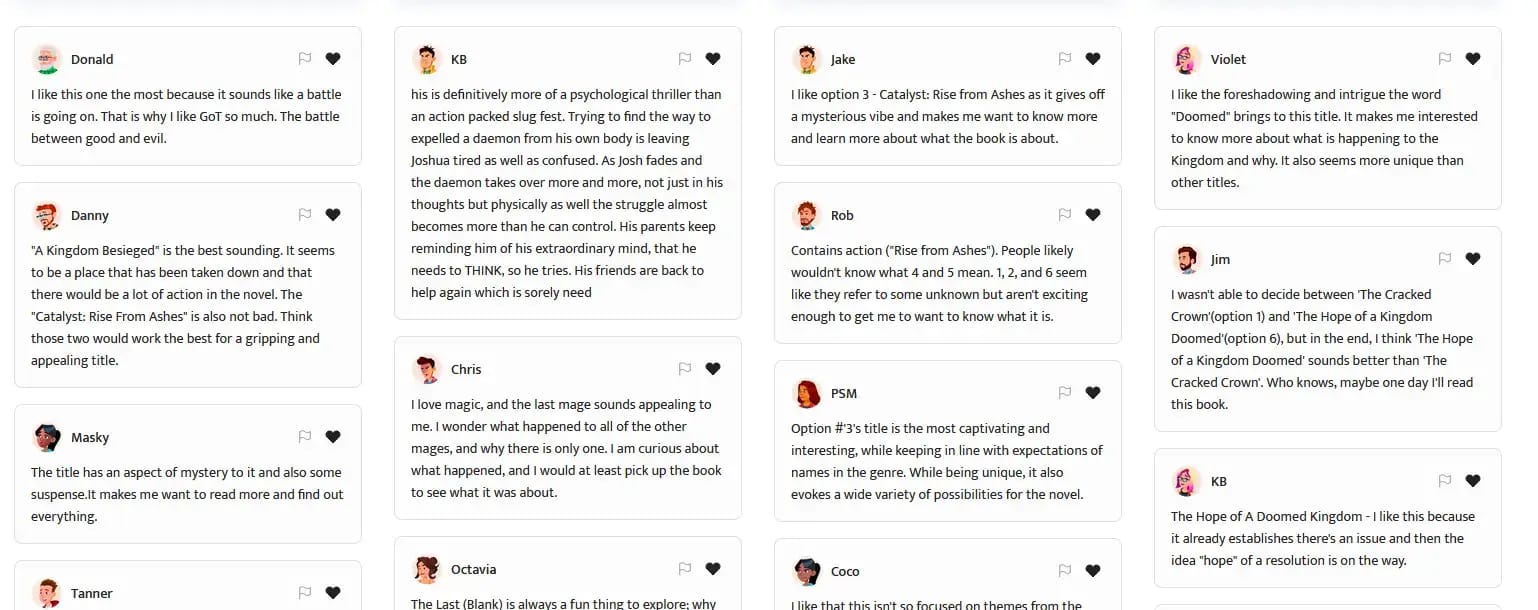
Let’s take “Appointment Booking” and “AI Chatbot” to be the winners. Usually, most people just stop right after knowing the winner. They look at the percentages and ignore the comments. Stop doing that; you need to analyze the written feedback.
2. Using ChatGPT to Analyze Written Feedback
You can feed all the written responses from your poll into ChatGPT to find patterns. You aren't just looking for what they want; you are looking for their "Why". That’s why this feedback is the real gold.
Here is the analysis prompt for ChatGPT:
I ran a poll asking 100 small business owners what website feature they need most and would pay for.

Here are the results and written feedback. Analyze this data and tell me:
1. Which option is the strongest 'painkiller' (most urgent need).
2. What objections or concerns people have about each option.
3. Which features people expect for free vs. willing to pay premium.
4. Any patterns in the responses that reveal deeper insights.

[Insert all the feedback] 
3. ChatGPT's Analysis (The Insights That Matter)
After feeding all of the feedback, ChatGPT will help you spot hidden hurdles.
For example, here is the analysis from my survey:
On Appointment Booking: Even people who ranked it second or third admitted they struggle with calendar management. The need applies to almost every service-based business. People are willing to pay because they can see exactly how much time they will save.
On Contact Forms: Popular but expected to be free. Most business owners think this should be included, not sold separately. The perceived value remains low and these work better bundled with other features
On AI Chatbots: Business owners think these tools are hard and expensive to make. This perception creates a willingness to pay premium prices. Urgency varies wildly and some see it as critical, others as optional.
On Pricing Calculators: Highly valuable for specific industries like contractors, freelancers and service providers. They deliver immediate ROI by increasing conversion rates. The opportunity is underrated, with lower competition than booking systems.
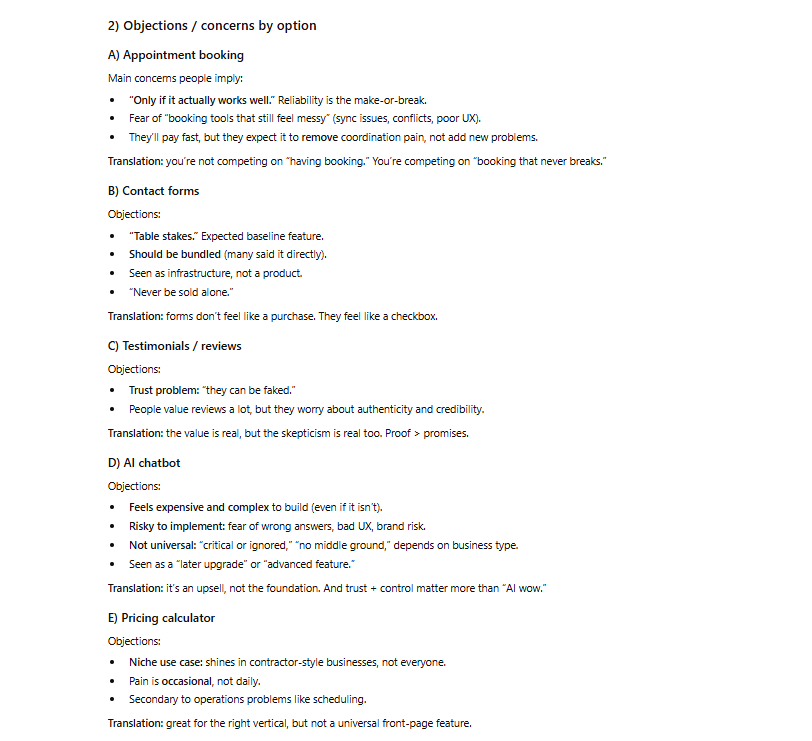
So, based on this demo analysis, you can then decide to build a booking tool (your primary product) that includes a mini-calculator as a premium "pro" feature.
The Lesson Here: Don't just look at what won. You have to understand why it won and what that reveals about pricing, positioning and product strategy.
VI. Stage 3: Building with AI (From Idea to Working Product in 18 Minutes)
This is where it gets wild. A few years ago, building this would have required a development team costing $5,000-$10,000, 2-4 weeks of development time.
Today, it only takes 18 minutes with AI, with no coding required.
1. Why Should You Use Mocha as Your Vibe Coding App?
Mocha is a vibe coding app that lets you build software using natural language with no coding required. If you describe it in plain English, Mocha will write the code for you. Then you just preview, iterate and export working code if it’s good for you.
It is essentially ChatGPT for full-stack software development.

In case you ask, “Why not Lovable, Bolt, Rork or other apps?” Unlike Lovable or Bolt, which require you to connect external accounts like Supabase for databases or Netlify for hosting, Mocha includes its own database, user authentication (Google Sign-In) and hosting out of the box; perfect for a no-coding workflow.
In short, I would like to recommend a new app to you (hope you like it).
2. Step 1: Refining the Prompt with ChatGPT
You might be worried that Mocha will misunderstand your words and give you the wrong result. Don’t worry, you could use ChatGPT to write the perfect prompt for Mocha.
I don’t write prompts from scratch anymore. I let ChatGPT clean them up like this:
I’m using a vibe coding tool to create a reusable widget. Below is my rough prompt. Rewrite it to be significantly clearer, more detailed and more aligned with how a vibe coding platform like getmocha.com interprets instructions. The goal is to give the app strong context so it can generate better structure, logic and UI decisions.

I want to build a plug-and-play booking widget that small businesses can easily embed on their websites. The widget should allow potential customers to schedule appointments such as consultations, quotes, calls or services (e.g. dog grooming, local services, professional sessions).

This widget needs to be flexible across industries, so it must support easy customization of branding elements like name, colors, fonts and copy. Swapping themes or industry-specific wording should be frictionless, allowing me to reuse the same core widget while tailoring it for different verticals and marketing campaigns.

If any part of this request lacks enough clarity to produce a high-quality result, ask me targeted follow-up questions to refine the prompt before generating the final version.
The first iteration took 5 minutes. It produced a landing page explaining the widget, a generic booking interface and basic styling. It worked but looked too generic.

Now, use this second prompt using insights from the ChatGPT analysis:
Upgrade this to a super widget based on this analysis:

[Insert the analysis] 
The second iteration took a minute. It created a tool with many features buttons to turn parts on and off and a professional design.
Better but still not specific enough to sell.
3. Step 2: Niche-ing Down (The Game-Changer)
Instead of building for all small businesses, the decision became focusing on one specific industry and nailing it.
This works because specific industries are easier to market to, clear use cases require less explanation, tight communities enable word-of-mouth growth and recurring appointments create high lifetime value customers.
I chose dog grooming because of the answers I saw in the survey. You see, the survey responses are definitely gold. So make sure you read it carefully. And it’s much cheaper to find 100 dog groomers on a Facebook group than it is to find "100 small business owners" across the entire internet.
Here is the prompt I used:
Now, from that, create an appointment booking widget specifically for dog grooming businesses. Include services:
- Basic Bath & Brush ($35, 45 minutes)
- Full Groom ($75, 90 minutes)
- Nail Trim Only ($15, 15 minutes)
- Teeth Cleaning Add-On (+$20)
- De-Shedding Treatment (+$25).

Add intake form fields for pet name, breed, size, age and special instructions. Use fun, pet-friendly aesthetic with paw print icons.
4. Step 3: Let Mocha Cook the Final Prototype
Your last step is to go to Mocha and paste your final prompt into it.
In 18 minutes total, Mocha built a fully functional booking widget with:
Service selection dropdown with pricing.
Calendar view showing available slots.
Detailed intake form (pet-specific).
Mobile-responsive design.
Professional branding.

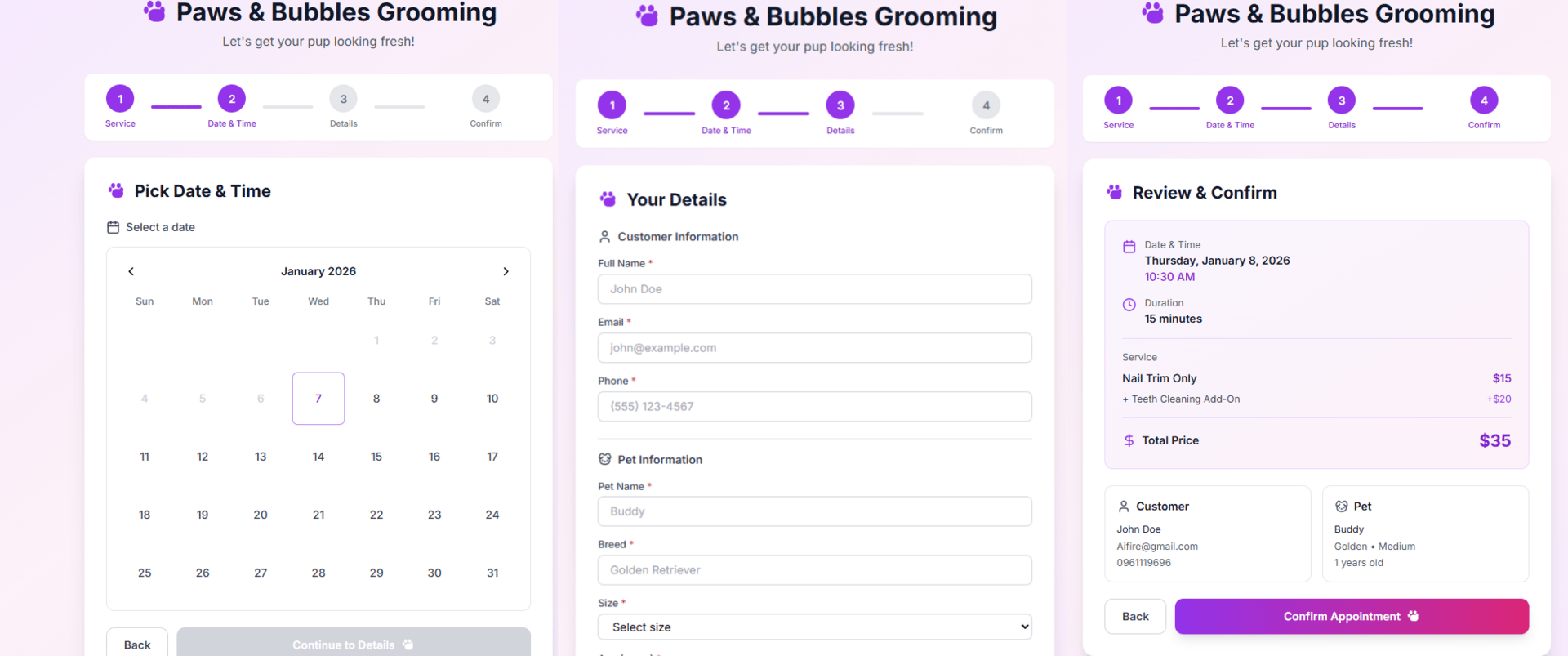
You could take this to a dog grooming business tomorrow and say: "Here's a working tool that lets your customers book appointments online without calling. Want to try it for 30 days free?"
VII. The Ready, Fire, Aim Advantage
Picture the old startup story again with me: You spend months researching, interviewing users, running surveys, hiring developers, planning features in endless docs and then you launch… and realise no one actually wants it.
This isn’t bad execution. It’s just a slow system.
That’s why this new approach is great. Instead of 7 months to get the win rate lower than 10%, you just need around 4 hours (3 hours to run validation poll and 1 hour to build the app with no coding required) and the win rate is definitely higher because you built what they asked for.

I call this The Compounding Advantage. Because you can build with no coding, you can test 10 ideas in the time it used to take to test one. You want math. Let me do it for you:
Traditional building is risky and costs $20,000. You will likely lose most of that money.
This new approach has a much higher hit rate and costs below $200; your expected return is positive from day one.
Creating quality AI content takes serious research time ☕️ Your coffee fund helps me read whitepapers, test new tools and interview experts so you get the real story. Skip the fluff - get insights that help you understand what's actually happening in AI. Support quality over quantity here!
VIII. What Are the Top Mistakes to Avoid?
Asking the wrong question, polling the wrong people, building too much, ignoring comments and trying to help everyone. Each mistake puts you back into guessing. The fix is simple: tighten the loop.
Key takeaways
Pay-intent question only
Buyer-quality audience only
MVP only (prove the core)
Comments drive roadmap
Niche first, expand later
The biggest risk isn’t bugs. It’s building the wrong thing perfectly.
Mistake 1: Asking the Wrong Question
Asking “Would you use this?” feels safe but it lies to you.
People say yes to things they’ll never touch. The only question that matters is “Would you pay for this?” Money is the filter for real demand.
Mistake 2: Polling the Wrong People
Feedback from friends and family is useless. Because they want to be nice and don’t want to hurt your feelings.
What you need is feedback from the exact people who would buy and who already spend money on similar solutions.
Mistake 3: Building Too Much
Adding features before showing anyone feels productive but it’s risky.
Just build the smallest version that proves your idea, then show it immediately. Every extra hour without feedback increases the chance you’re building the wrong thing.
Mistake 4: Ignoring Written Feedback
Numbers show what people like but written comments explain the reason why. That’s why I always highlight that feedback is the gold mine. If you skip the comments, you miss the words you’ll later use in your marketing, pricing and positioning.
Mistake 5: Trying to Help Everyone
“This works for all small businesses” usually means it works for none. This is why Walmart failed in Germany. They tried serving "everyone" with U.S.-style big-box stores, ignoring local tastes; they ignored German preference for small shops, baggers and no smiling service.
Choose one specific group of people and solve one clear problem for them. A tight niche converts better, markets more easily and gives you room to expand later.

Source: ebitans.
IX. Final Thoughts: The Risk You Should Actually Fear
Many business owners worry about the wrong things, like bugs or design. That nonsense, they should fear building something nobody wants.
In 2026, the biggest risk is launching too late. Because everybody can easily build apps with no coding. While you are perfecting your MVP, someone else is running validation polls, building with AI in 20 minutes and getting real customers.
This approach isn't just faster. It's fundamentally less risky because you validate before you build.
The question is: Will you keep guessing or will you start asking?
You can validate the right problem and build the right product in record time. But none of that matters if you present it to people who don’t value it or can’t afford it. So here’s Part 2 to help you fix that.
If you are interested in other topics and how AI is transforming different aspects of our lives or even in making money using AI with more detailed, step-by-step guidance, you can find our other articles here:
Overall, how would you rate the AI Startups Series? |
Reply