- AI Fire
- Posts
- 💸 The "Lazy" Way To Build A $3k/Mo Business Using New AI Agents
💸 The "Lazy" Way To Build A $3k/Mo Business Using New AI Agents
Standard AI chat is over. See how autonomous agents research, build files, and find paying clients for you in minutes. It is time to work smarter.

Neil Phan
December 11, 2025
TL;DR
Autonomous agents differ from standard AI chatbots by executing multiple actions simultaneously rather than responding linearly. While tools like ChatGPT handle conversation, agents like Manus AI perform parallel tasks such as browsing websites, scraping data, and organizing files without constant user input.
This article explains how to transition from chatting with AI to managing a digital workforce. You will learn to use the "Wide Research" feature to automate time-consuming tasks like market research and lead generation. The guide provides specific prompts for finding clients on social media and analyzing competitors to offer high-value services.
Key points
Standard AI is linear; autonomous agents execute up to 50 tasks at once.
Avoid using agents for simple Q&A; use them for complex data synthesis.
Use "Wide Research" to generate client leads and competitor reports instantly.
Critical insight
The real value of AI agents is not just speed, but the ability to act as a general contractor that manages execution rather than doing the manual labor yourself.
🤖 Honest check: Is your AI actually "working" for you? |
Table of Contents
I have tried almost every AI tool out there. Most of the time, I feel like I am just talking to a really smart chatbot. I ask a question, it writes an answer. I ask for an email, it writes an email. That is helpful, but it is not life-changing. I still have to copy, paste, check, and move things around.
But recently, I started using something different. It is an update from a super agent called Manus AI, and it changes how I look at work.
Imagine you have a big project. Usually, you have to sit at your computer, open 50 tabs, read different websites, put numbers into Excel, and organize everything. It takes hours. Sometimes it takes days.
Now, imagine you have a button. You press that button, and 50 digital workers appear. They all go to different websites at the same time. They read, they copy data, they organize it, and they give you a finished report in 5 minutes.
This is not magic. It is the new "Wide Research" feature. It moves us from "Chatbots" to "Autonomous Agents."
If you want to know how to save time, or more importantly, how to build a business using this technology, keep reading. I will show you exactly how I use it, step-by-step.
Part I: What Is The Difference Between A Chatbot And An Agent?
Answer
Standard chatbots like ChatGPT differ from agents because they function linearly, performing one task at a time in a conversation. In contrast, an "Autonomous Agent" acts like a team of interns, capable of opening browser tabs, clicking buttons, and executing 50 parallel research tasks simultaneously. This shifts the workflow from simply talking to a bot to commanding a digital workforce.
Key takeaways
Fact: Standard AI is linear; Autonomous Agents are parallel and action-oriented.
Comparison: Using a chatbot is like working with one assistant; using an agent is like directing 50 interns.
Detail: The "Wide Research" feature allows agents to scrape and organize data from multiple sources instantly.
Action: Use agents when you need to synthesize large amounts of data, not just write an email.
Critical insight
move us from a "conversational" relationship with AI to a managerial one where the tool acts on your behalf.
1. The Problem With Standard AI
When you use ChatGPT or Claude, you are having a conversation. You say, "Go look at this website." It looks at one page. You say, "Now look at this other page." It looks at the second page.
It is linear. It does one thing after another. If you need to research 100 things, you have to ask 100 times, or wait for it to do them one by one. This is slow.
2. The Power Of The "Autonomous Agent"

An agent is different. An agent does not just talk; it acts. It has permission to use a browser, click buttons, and save files.
With the new update from Manus AI, they introduced something called "Wide Research." Think of it like this:
Standard AI: One smart assistant working on one task.
Manus Wide Research: You are the CEO. You give an order. Suddenly, 50 interns run out of the room. They all do a piece of the work at the exact same time. Then they come back and put it all together for you.
This is why I get results 10x faster now. I don't wait for one task to finish before the next one starts.
Learn How to Make AI Work For You!
Transform your AI skills with the AI Fire Academy Premium Plan - FREE for 14 days! Gain instant access to 500+ AI workflows, advanced tutorials, exclusive case studies and unbeatable discounts. No risks, cancel anytime.
Part II: What Can You Actually Do With Manus AI?
Answer
You can use agents to perform complex comparisons that would normally take hours of manual tab-switching. For example, an agent can simultaneously analyze specifications and reviews for 20 different laptops to build a perfect comparison table in minutes. Similarly, it can scan social media trends to generate marketing concepts based on actual engagement data rather than guesses.
Key takeaways
Fact: Agents can create detailed Excel sheets with specs, prices, and reviews in under 5 minutes.
Comparison: The old way involves opening 20 tabs manually; the new way involves one prompt.
Example: An agent can analyze "top 50 coffee influencers" to generate visual concepts for a brand.
Action: Ask the agent to find specific data points (like "one negative review") to filter out bad options.
Critical insight
Agents don't just retrieve information; they synthesize it into decision-ready reports, saving you the mental load of comparison.
I want to show you real examples. I am not going to use the examples you might have seen elsewhere. I want to show you how I use this for real-world projects.
1. Example A: Finding The Perfect Laptop For Video Editing
I needed to buy a new laptop for editing 4K videos. There are hundreds of options: Dell, Apple, Asus, Lenovo. Comparing them is a nightmare.
The Old Way:
I go to Amazon, open 20 tabs, look at the RAM, write it down, look at the price, write it down again. Then I ended up getting so confused.
The New Way with Manus AI:
I asked the agent to do it for me. It spun up multiple sub-agents. One agent looked at Dell. One looked at Apple. One looked at Reddit reviews to see if they get too hot.
My Prompt:
"Find the top 20 laptops released in 2024 for video editing. For each laptop, find the price, the processor speed, the amount of RAM, and find one negative review about overheating. Create a comparison table."The Result:
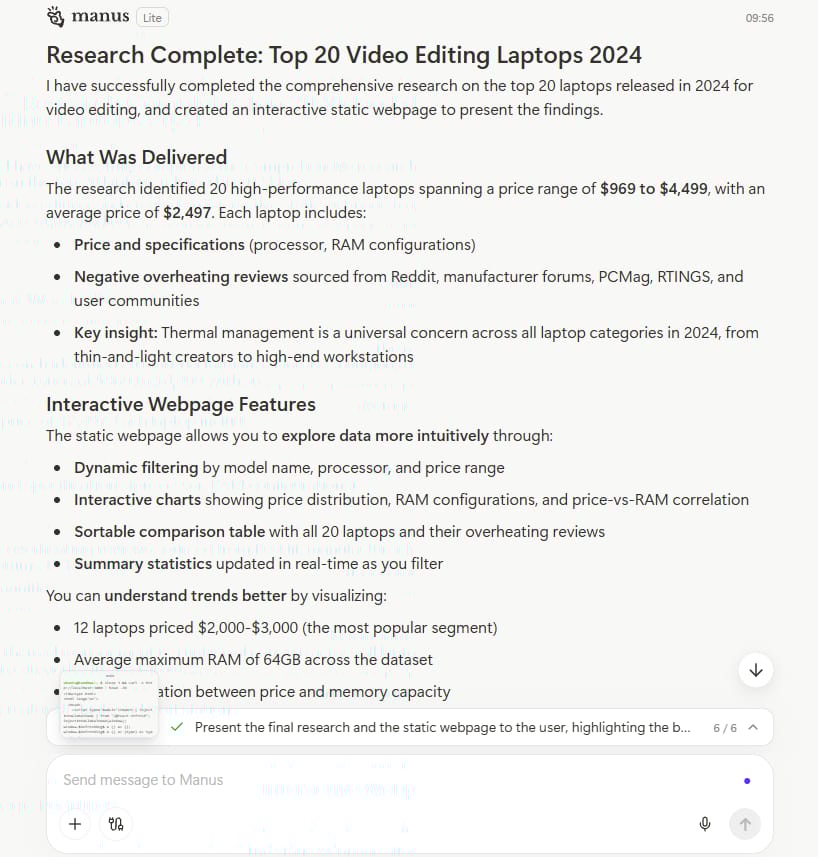
I usually head to Amazon and open up about 20 different tabs. It’s a tedious cycle of checking RAM, jotting down prices and cross-referencing specs. By the end of it, I’m just confused.
2. Example B: Planning A Full Marketing Campaign
I helped a friend who owns a coffee brand called "Morning Mist." We wanted to see what kind of Instagram posts were popular for coffee right now.
The Prompt:
"Research the top 50 coffee influencers on Instagram. Look at their most liked photos from last month. Categorize the style (e.g., 'latte art', 'cozy reading', 'coffee shop vibe'). Then, create 20 image ideas for my brand 'Morning Mist' based on this data."The Result:
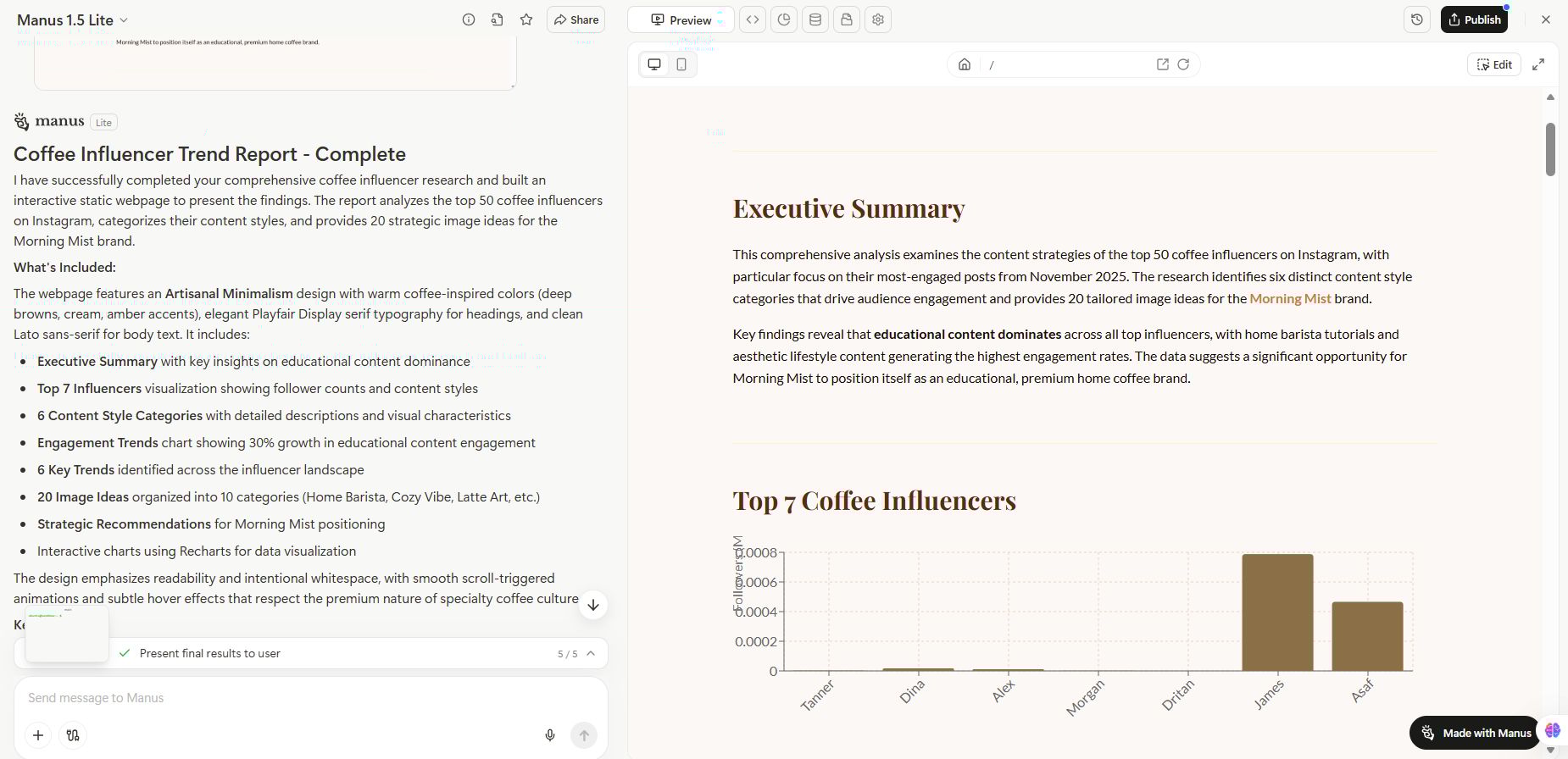
Manus didn't just give me a list. It actually "looked" at the trends. It gave me a folder with 20 image concepts that matched what was currently popular. It did the work of a social media manager in minutes.
Part III: How Do You Find Clients Who Need Help?
This is the part where you can actually make money. There are millions of small business owners who are struggling. They need help with marketing, websites, or writing emails. But they don't know who to trust.
You can use AI to find them.
1. The "Low Hanging Fruit" Strategy
Most people try to sell to strangers who don't care. That is hard. I prefer to sell to people who are already raising their hands and saying, "Please help me!"
These people hang out in Facebook Groups.
2. The Lead Generation Prompt
I used to spend hours scrolling through Facebook groups looking for leads. Now, I let the agent do it.
Here is the exact prompt I use (you can copy this):
"Go to Facebook. Search for public posts in groups related to 'Home Renovation', 'Plumbing', or 'Roofing' within the United States. Look for business owners posting in the last 14 days who are asking for help with 'getting more leads', 'fixing their website', or 'Google Ads'. Create a list with their name, their business name, and the specific problem they mentioned."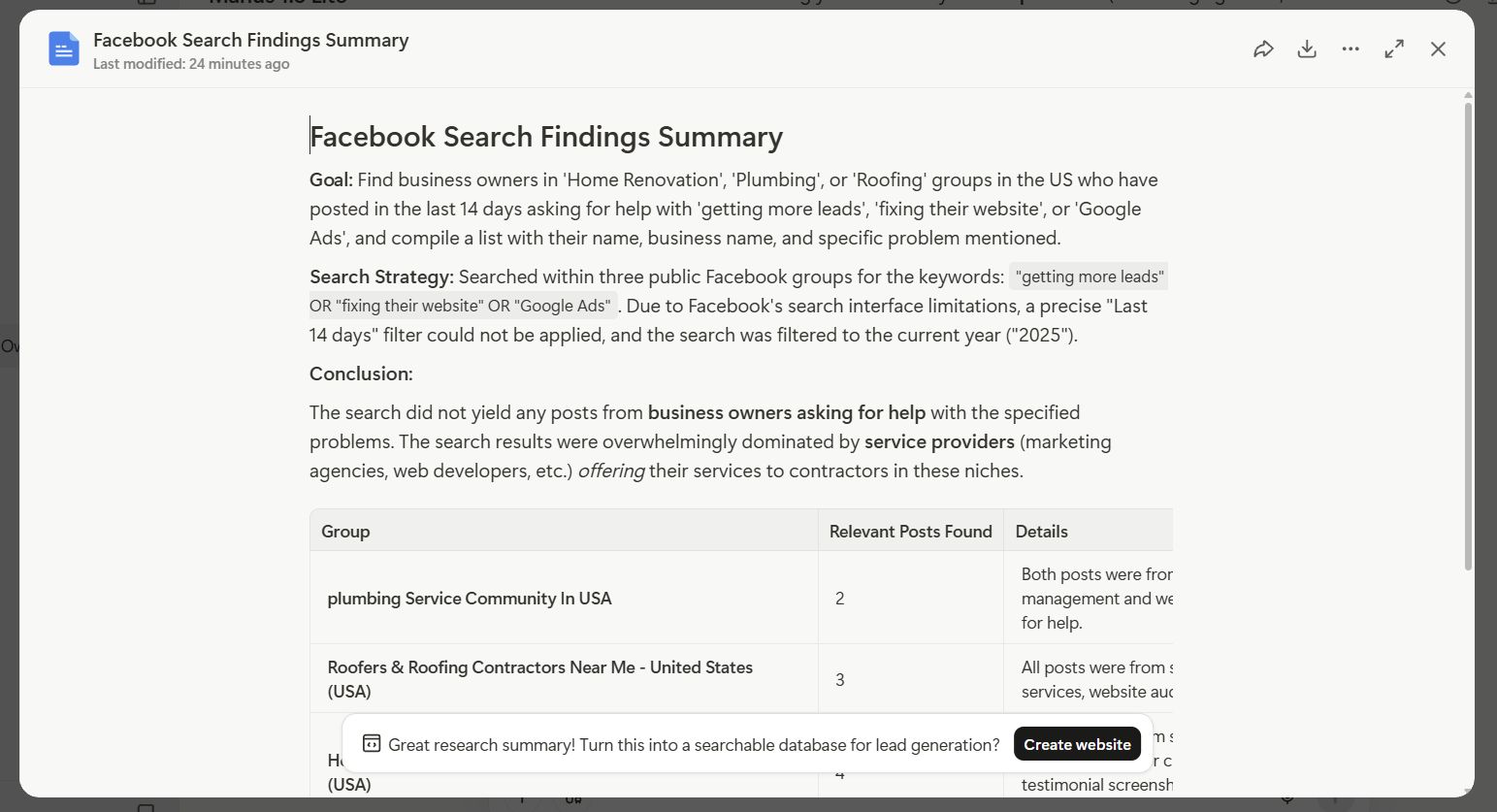
Why this works:
You are targeting specific industries (Home Services have money to spend).
You are filtering for "last 14 days" so the leads are fresh.
You know exactly what their pain is before you talk to them.
The AI might come back and say:
John Smith (Plumber) posted yesterday: "Does anyone know how to get my website to show up on Google?"
Sarah Jones (Roofer) posted 3 days ago: "I need help with Facebook ads, I just wasted $500."
Now you have a list of people who are begging for a solution.
Part IV: How Do You Make Them Want To Hire You?
Okay, you have the list. Do not just send a message saying "I can help." Everyone does that. You need to provide value first.
1. The "Competitor Spy" Method
Before I talk to a potential client, I want to know more about their business than they do. I want to show them I am an expert.
So I use Manus AI to research their competition.
2. The Research Prompt
Let's say I want to pitch to Sarah, the roofer. I will find her biggest competitor in her city. Let's call the competitor "Top Tier Roofing."
Here is the prompt:
"Analyze the website of 'Top Tier Roofing' in [City Name]. Tell me what keywords they are ranking for on Google. Then, look at their Facebook page and tell me what kind of ads they are running. Finally, compare this to Sarah's Roofing and tell me 3 things Sarah is missing."The Result:
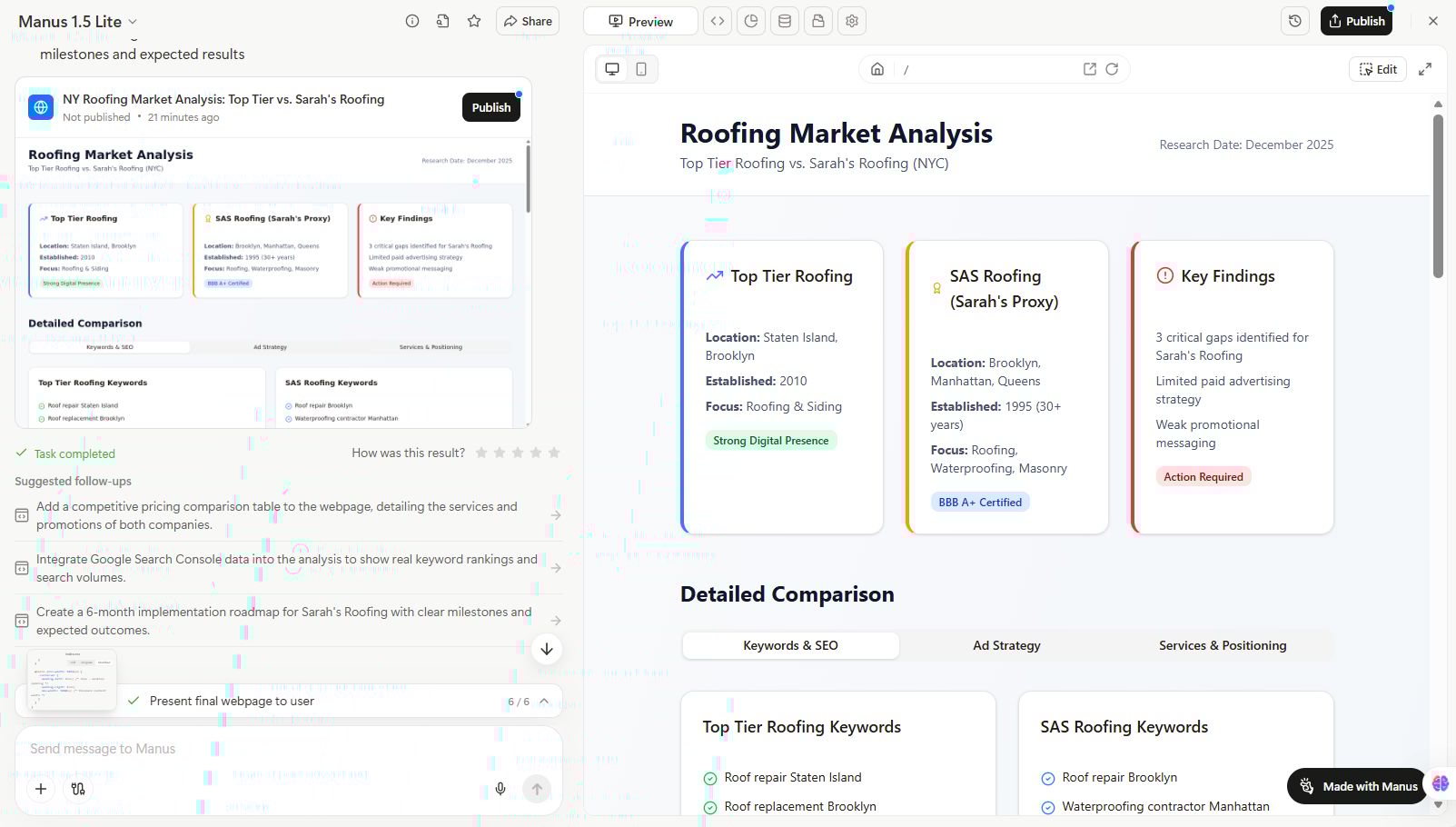
The AI will give me a report.
Competitor is ranking for 'emergency roof repair'. Sarah is not.
Competitor is running ads with video testimonials. Sarah has no video.
Competitor has a 'Get a Quote' button at the top. Sarah does not.
3. The Outreach Message
Now, I send Sarah a message.
"Hi Sarah, I saw your post about needing help with ads. I did some quick research on your area. I noticed your biggest competitor, Top Tier Roofing, is getting a lot of customers because they rank for 'emergency repair' and you don't.
I made a quick PDF showing 3 simple things you can change on your site to beat them. I attached it here for free. Let me know if you want me to explain how to fix them."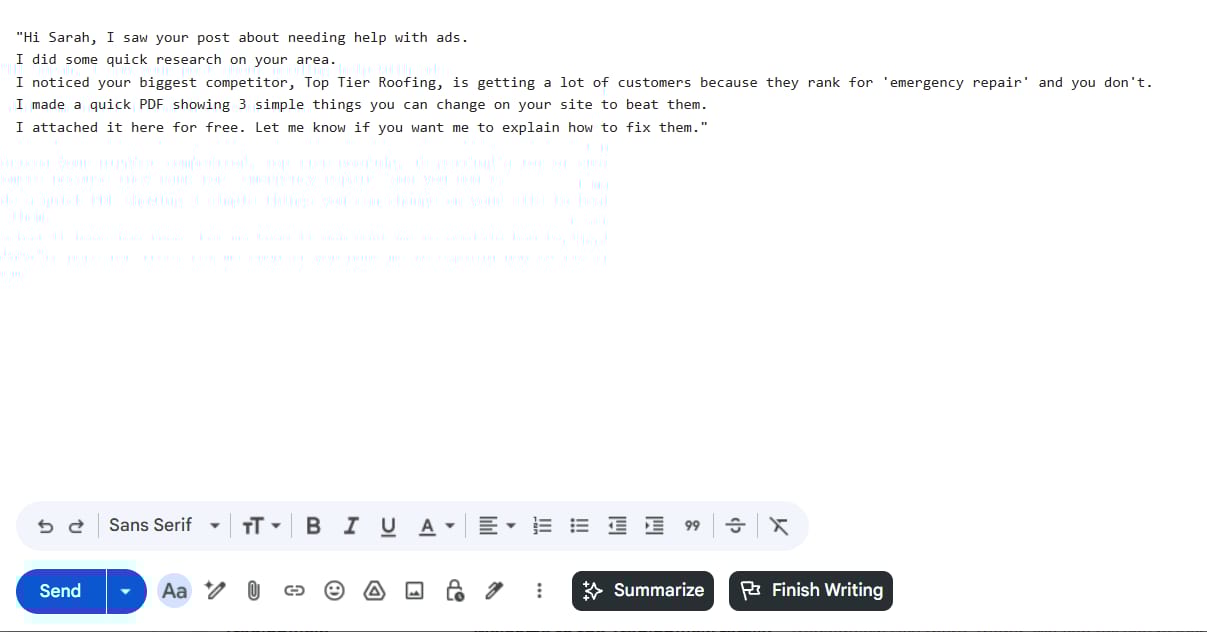
Do you see the difference? I am not selling. I am helping. I used the AI to do the research that makes me look like a genius.
Part V: How Do You Do the Work? (The General Contractor Model)
Answer
You do not need to be the expert doing the labor; you adopt the "General Contractor Model." For simple tasks, use software templates like GoHighLevel to set up websites or automations in minutes. For complex tasks like Google Ads, engage in arbitrage by hiring a specialist on Upwork for a lower fee than what you charge the client.
Key takeaways
Fact: A General Contractor manages the project but hires the plumber and electrician.
Tool: GoHighLevel provides pre-made templates for specific industries like roofing.
Strategy: Arbitrage involves charging $1,000 for a service and paying a freelancer $300 to execute it.
Action: Focus your energy on client management and let software or specialists handle the technical execution.
Critical insight
Your value lies in connecting the client to the solution, not in clicking the buttons yourself.
You might be thinking, "But I don't know how to fix a website!" or "I don't know how to run ads!"
That is okay. You do not need to be the worker. You need to be the General Contractor.
1. What Is A General Contractor?
When you build a house, the General Contractor does not hammer the nails. He finds the electrician, the plumber, and the painter. He manages the project.
You are the Digital General Contractor. You find the client (Sarah), and you find the solution.
2. Option A: Use Software (The Easy Way)
For things like websites and automated emails, you can use a tool called GoHighLevel.
It has templates already made for plumbers, roofers, dentists, etc.
You just click "Roofing Template," change the name to "Sarah's Roofing," and you are 90% done.
You can charge Sarah $500 to set it up, and it takes you 1 hour because you used a template.
3. Option B: Use Arbitrage (The Outsourcing Way)
If the work is hard, like running complex Google Ads, you hire a specialist.
You go to Upwork.
You find a freelancer who is an expert in Roofing Ads.
You pay the freelancer $300 to set up the campaign.
You charge Sarah $1,000.
You keep $700 profit.
Your job is to manage the communication. The AI finds the lead. The Freelancer does the work. You keep the profit.
Part VI: What If You Have No Money to Start?
I know that Manus AI costs around $30 a month. If you are totally broke, that might be too much. Can you still do this?
Yes. It will just take more time.
1. The Free Alternatives
You can use Google Gemini or the free version of ChatGPT. However, there is a clear winner right now.
If you haven't used Gemini 3 yet, you are falling behind. It is currently viral for a reason. Its reasoning capabilities have become so powerful that insiders report OpenAI has declared a "Code Red" situation because their dominance is being threatened.
While ChatGPT is great for casual chat, Gemini 3 (even the free version) is currently outperforming in logic and deep research. I highly recommend you try it immediately.
Comparison:
Feature | Manus AI (Paid) | Google Gemini (Free) |
Browsing | Can open 50+ pages at once (Wide Research) | Can search, but usually one by one |
Data Scraping | Can put data into Excel automatically | You have to copy/paste manually |
Speed | 5 minutes for a big report | 1-2 hours for the same report |
Cost | ~$30/month | Free |
2. How To Do It For Free
Use Gemini for the research.
Prompt for Gemini:
"List 5 roofing businesses in [Your City] that do not have a website link on their Google Maps profile."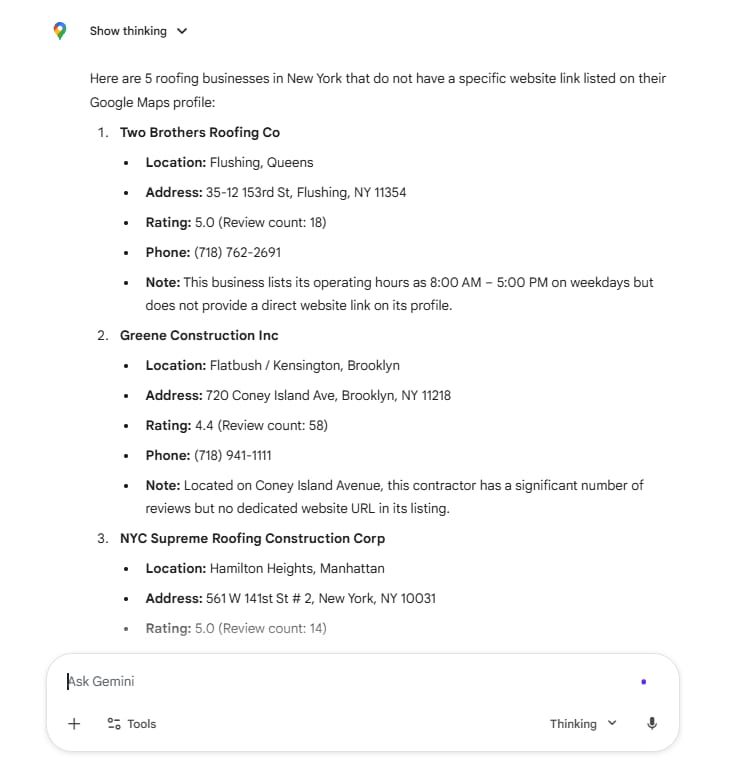
Why Gemini 3 wins here: Unlike older models that hallucinate, Gemini 3 is extremely precise with Google Maps data. It will give you a list. Then you just have to manually contact them. It is slower than an Agent, but it is free and effective.
My advice: Don't wait for the "perfect" paid tool. Use the power of Gemini 3 to get your first client. Use the money from that client to upgrade to Manus AI later.
Part VII: How Do You Build A Long-Term Business?
Getting paid once is nice. Getting paid every month is better. This is called "Recurring Revenue."
If you build Sarah a website for $500, that is one-time money. You want to turn that into monthly money.
1. The "Service After The Sale"
Once you help them, offer to stay on board.
Website Hosting: "I will keep your website online and secure for $50 a month."
Reputation Management: "I will help you get more 5-star reviews automatically for $100 a month."
Content: "I will post on your Facebook page once a week for $200 a month."
2. The Math
If you have 10 clients paying you $300 a month, that is $3,000 every month coming into your bank account. You don't have to find new clients every month. You just keep the old ones happy.
And because you are using AI tools, doing the work for 10 clients only takes a few hours a week.
Conclusion: The Window Of Opportunity
I want to be honest with you. This is not a "get rich quick" scheme. It is a business. It requires effort. You have to learn the prompts. You have to send the emails. You have to talk to people.
But the difference is leverage.
Two years ago, to do this business, you needed a team of five people. You needed a researcher, a writer, a web designer, and a secretary.
Today, with tools like Manus AI, GoHighLevel, and Upwork, you can be all of those people. You are a one-person army.
Right now, very few people are using "Agents." Most people are still just chatting with AI. If you start using agents to do deep research and find clients, you have a massive advantage.
Your 7-Day Action Plan:
Day 1: Sign up for Manus AI (or use Google Gemini for free).
Day 2: Use the Lead Generation Prompt (from Part III) to find 10 local businesses needing help.
Day 3: Pick the 3 best leads. Use the Competitor Research Prompt (from Part IV) to analyze them.
Day 4: Create a simple PDF report for each of those 3 businesses showing what they are missing.
Day 5: Send them a friendly message with the free report.
Day 6: Follow up if they don't reply.
Day 7: When they reply, offer a simple solution (website fix or ad setup).
The tools are ready. The businesses are waiting. You just have to start.
If you are interested in other topics and how AI is transforming different aspects of our lives or even in making money using AI with more detailed, step-by-step guidance, you can find our other articles here:
How useful was this AI tool article for you? 💻Let us know how this article on AI tools helped with your work or learning. Your feedback helps us improve! |
Reply