- AI Fire
- Posts
- 🤖 Google's Gemini or ChatGPT: The Clear Best AI to Boost Your Marketing Traffic & Sales in 2026
🤖 Google's Gemini or ChatGPT: The Clear Best AI to Boost Your Marketing Traffic & Sales in 2026
Most teams are picking AI tools wrong. Here’s how to avoid platform lock-in and build a stack that survives the next 12 months.

Max Anh
January 13, 2026
TL;DR BOX
The AI platform war in 2026 is no longer about copy quality; it's a battle for your marketing stack. Google Gemini uses a massive $224 billion data moat (Search, Ads, YouTube) to offer ecosystem-integrated insights, while OpenAI's ChatGPT remains the leader in persuasive storytelling and human-centric personality.
Marketing teams are increasingly moving toward a Multi-Model AI Strategy, using Gemini for live data detective work and search strategy and ChatGPT for creative execution and client communication. The biggest risk is Platform Lock-in, where technical dependencies make switching providers too expensive as free tiers shrink and ecosystem "taxes" rise. To win, teams must build for portability, focusing on prompt engineering principles rather than tool-specific hacks.
Key points
Fact: Google processes roughly 13.6 billion searches daily, giving Gemini a live "pulse" of human curiosity that ChatGPT’s training-only data cannot match.
Mistake: Assuming you can easily switch platforms later. Saved templates and integrations create "technical concrete" that makes migration painful without a clear AI strategy.
Action: Audit your high-stakes marketing prompts across Gemini, ChatGPT and Claude to see which "biological advantage" fits your specific stage of production.
Critical insight
The winning AI strategy is to stop being a "User" of one tool and become an "Orchestrator" of multiple models. Gemini for the data, ChatGPT for the voice and portability for the long-term hedge.
⚔️ Choosing a side in the AI Platform War? |
Table of Contents
I. Introduction
So you thought picking between Gemini and ChatGPT was about finding the tool with better output quality? Maybe you figured you'd test both for a week, see which one writes cleaner copy and move on. That was never the decision.
Here’s the part nobody at your team meeting is talking about: this isn't a chatbot beauty contest, it's a full-blown platform war. And the AI strategy you are making right now (or avoiding, let's be honest) will determine your marketing costs, operational speed and competitive survival for the next half-decade.
Yeah, no pressure. You could think of it like choosing between iOS and Android in 2010. Once you build your house on their land, moving becomes nearly impossible. This is why a cohesive AI strategy is your most valuable asset in 2026.
Grab your coffee and let's get into why this matters way more than you think. Before we talk lock-in, you need to see how this war even started.
II. The Platform War Nobody Realises They Are In
The tech giants are not fighting to see who can write the funniest poem. They are fighting for total control over your marketing stack. When you go all-in on one platform without a diversified AI strategy, you are building technical dependencies that become concrete over time.
Every automation you build in Zapier or n8n becomes a part of your system that is hard to change later if you ever switch tools.
If your entire team learns "the ChatGPT way", you cannot just flip a switch and move to Google (Gemini) tomorrow. The migration costs (in time and re-training) become a barrier that keeps you stuck, even if a better tool launches elsewhere.
That’s why most marketers are getting this catastrophically wrong. They are only treating AI tools like they are choosing between Microsoft Word and Google Docs.
Now that you see how lock-in happens, let’s break down why Google has the advantage that makes this even harder.
Learn How to Make AI Work For You!
Transform your AI skills with the AI Fire Academy Premium Plan - FREE for 14 days! Gain instant access to 500+ AI workflows, advanced tutorials, exclusive case studies and unbeatable discounts. No risks, cancel anytime.
III. Why Google Has an Unfair Advantage
Google has advantages baked into its whole ecosystem and OpenAI can’t easily copy that. They control search behaviour, distribution and even their own AI hardware. That’s why Gemini often ends up cheaper and easier to plug into real workflows.
Key takeaways
Google has decades of search-intent signals.
Gemini can be embedded into tools people already use.
TPU hardware gives Google more cost control.
This matters most for research and ecosystem tasks.
The biggest advantage is distribution, not model talent.
Google isn’t competing the same way OpenAI is; they’re running a different playbook. They have structural advantages that are almost impossible to replicate.
1. A Data Moat That Is Impossible to Copy
Google has been collecting search queries since the late 1990s. We are talking about decades of search queries.
According to NP Digital reports, Google processes over 13.7 billion searches a day, which is 5 trillion searches per year or 158,500 searches every single second.

When you use Gemini, you're tapping into decades of behavioural data that updates in real time. OpenAI has impressive training data but it doesn't have a direct line to the world’s current pulse.
ChatGPT works based on what it was trained on. Gemini pulls from what people are searching right now.
With that massive amount of data, Google can improve its AI every single day. That’s why tools like Nano Banana can look more human and realistic than ChatGPT Images-1.5, even though ChatGPT has gone through many updates.
2. Distribution Is Everywhere
Google doesn't need you to adopt Gemini as a new tool. They just need to turn it on in the tools you're already using every day.
YouTube: Over 2.7 billion monthly active users watch 1 billion hours of video daily.
Google Ads: A $224 billion advertising ecosystem.
Workspace: Gemini is being baked directly into Docs, Sheets and Gmail.
Did you know that almost all Google tools already have AI built into them? Yes, even Google Docs, Sheets, YouTube, and their long documentation pages.
That’s why YouTube knows exactly what you want to watch and can recommend content you’re likely to enjoy.
ChatGPT is a website, an app and some API integrations you have to manually connect. Gemini is already sitting inside your existing workflow. You don’t ‘adopt’ Gemini, it just shows up in the tools you already use.
3. Custom Hardware (The TPU Factor)
OpenAI rents compute from Microsoft and chips from NVIDIA. That's just the reality, not a criticism. They're paying for access to someone else's infrastructure.
Google, however, builds its own Tensor Processing Units (TPUs) made specifically for AI. They own the hardware and control the costs. They can scale without negotiating with a cloud provider.
Have you seen Facebook’s deal? Meta's in talks to purchase Google's TPUs and this is a response to Nvidia chip. Meta is trying to buy it instead of NVIDIA, which caused Google’s stock to spike toward a trillion-dollar market cap.

Source: The Wall Street Journal.
According to Bloomberg, Google's TPU infrastructure can perform better than GPUs for some AI work. It means Google has strategic control of the entire AI stack.

Source: Bloomberg.
It’s like renting a car vs owning the entire factory that makes them. Both can win but one has home-field advantage.
Once you understand how different their business models are, the pricing strategy suddenly makes sense.
IV. The Pricing Strategy That Changes How You Build Products
The truth is: the pricing can be fake. So that is why you need to understand the "Microsoft Strategy". In the 90s, Microsoft gave away Internet Explorer for free to crush the competition. Google is doing the same thing with Gemini.
The Microsoft strategy is simple: they give away products to generate leads, while the money comes from somewhere else.
Now, you need to understand where that money comes from.
1. Ecosystem defence vs. Standalone profit
Google doesn't need Gemini to be profitable. Google is one of the most profitable companies today, with over $116 billion in annual profit. They only need it to protect their $224 billion advertising empire.
They can run Gemini at cost or even at a loss because every query you run in Gemini keeps you using Google Search. Every document you create in Google Docs with Gemini's help keeps you in Workspace. Every ad campaign you optimise with Gemini keeps you in Google Ads.
According to Google's Q3 2025 earnings, Google's cloud revenue hit $11.4 billion in a single quarter, up 35% year-over-year. Google Ads revenue was $65.85 billion for the quarter. Do you think they care about charging $20 a month for Gemini when they're making billions keeping you in their ecosystem?

Source: Yahoo Finance and CNBC.
OpenAI needs ChatGPT to actually make money. Google needs Gemini to keep you in their ecosystem, where they make money everywhere else.
But this does not mean ChatGPT will lose.
2. Why OpenAI's Pricing Has to Actually Work
ChatGPT needs to cover real costs. Microsoft's Azure infrastructure isn't cheap. R&D for GPT-5 isn't cheap. Compute costs scale with usage. They are a business, not a charity.
They have to pay massive bills to Microsoft for server space and spend billions on research. This means their pricing will always have to be higher than a subsidised Google product.

ChatGPT pricing
Over time, Google can likely offer more compute and more features for less money (or even free) just to keep you in their walled garden. On the other hand, this forces OpenAI to constantly innovate just to stay relevant.
But cheaper doesn't automatically mean better for your use case. Which brings us to the workflow that actually works.
V. How These Two Tools Work Together in a Real Campaign
Use Gemini when you need search-aware research, SEO thinking or analysis tied to Google’s ecosystem. Use ChatGPT when you need persuasive writing, a consistent voice or human-sounding communication. Then loop back based on performance data.
Key takeaways
Gemini fits research, SEO gaps and analytics patterns
ChatGPT fits landing pages, emails and brand voice
A practical flow is Research → Write → Optimise
Pick by task outcome, not brand habit
Pick the tool that fits the task, not the one you’re most comfortable with.
The most successful marketing teams do not pick a side. They realise that forcing one AI to do everything is like using a hammer to perform surgery.
You need a "Multi-Model AI strategy" where you use each tool for its specific biological advantage. This is what's working in practice right now.
1. When to Use Gemini
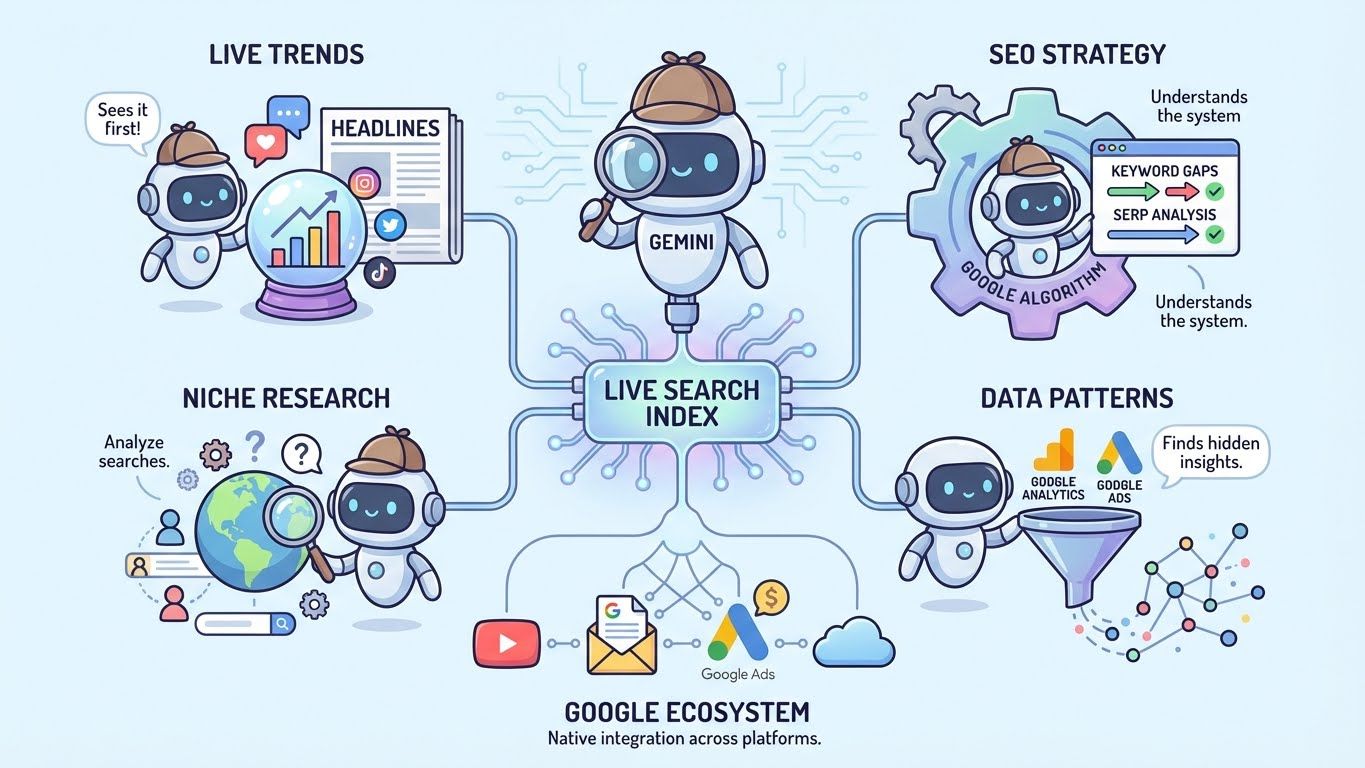
Gemini is the ultimate detective. Because it is plugged into the live search index, it sees trends before they become headlines.
Research & Data Analysis: Use it to analyze what people are searching for in your niche right now.
SEO Strategy: It understands the Google algorithm better than any human because it is the algorithm. Use it for keyword gaps and SERP analysis.
Data Analysis: Feed it your Google Analytics or Ads data. It understands that ecosystem perfectly and can find patterns that external tools miss.
Ecosystem-native insights: It understands the architecture of the $224 billion Google Ads platform better than anyone else. (e.g., If you're optimizing for YouTube, Gemini has access to video performance data. If you're using Workspace, Gemini is already baked in).
2. When to Use ChatGPT
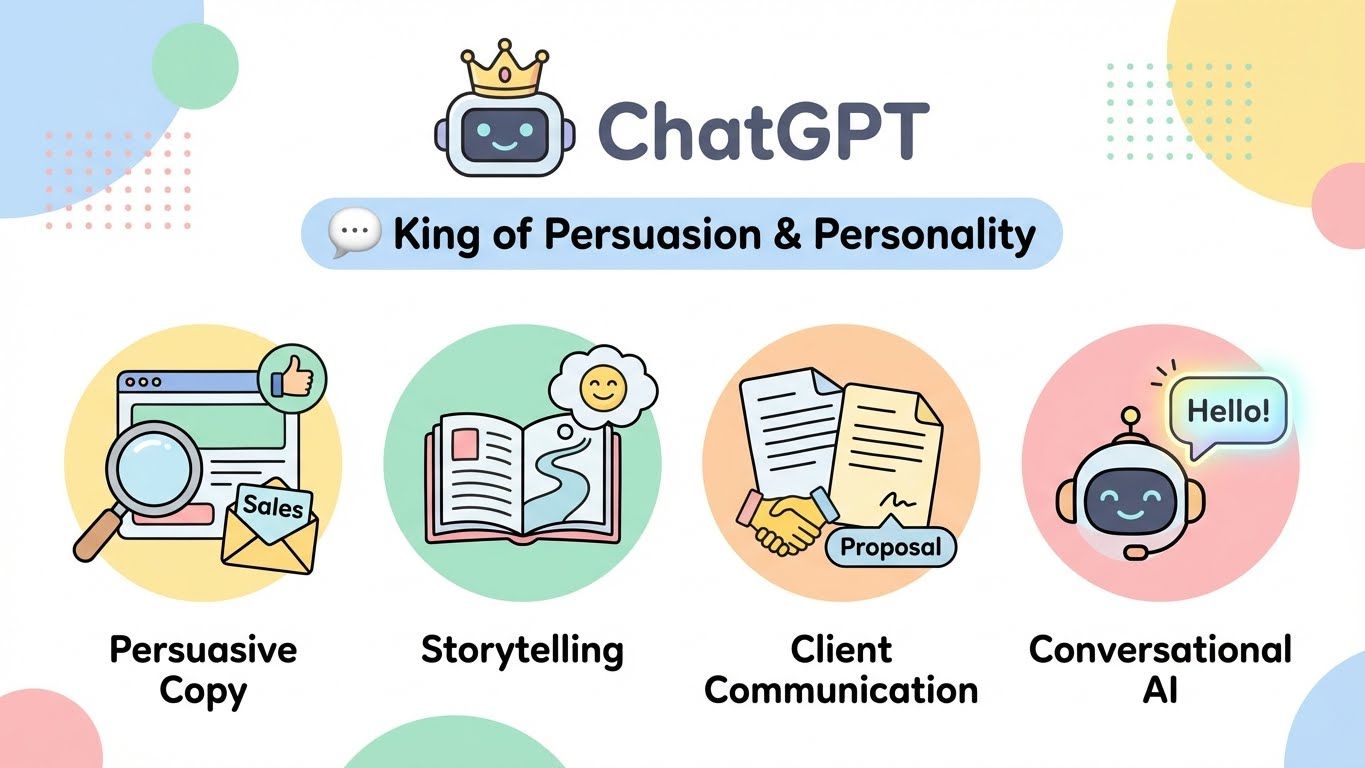
ChatGPT is still the king of persuasion and personality. It understands human emotion and tone better than its competitors.
Persuasive Copy: Use it for landing pages, sales emails and high-stakes social posts.
Storytelling: It is better at maintaining a consistent brand voice and creating narratives that don't sound like a corporate brochure.
Client Communication: When you need a proposal or a pitch deck to sound "human", this is your tool.
Conversational AI: For chatbots that need to maintain context and personality.
3. How This Actually Works in Practice
Let's say you're launching a new product campaign. Here's how smart teams are structuring the workflow right now.
Phase 1: Research and Strategy (Gemini)
You use Gemini to look at search trends, keyword intent, competitor positioning and past ad performance. From that data, you get a clear direction on what to say and who to say it to.
Phase 2: Creative Execution (ChatGPT)
Next, you go to ChatGPT to turn those insights into headlines, emails, landing pages, social posts and video scripts. This is where ideas become messages people actually respond to.
Phase 3: Optimisation (Back to Gemini)
Then you go back to Gemini to read real performance data (Google Analytics), see what’s ranking, what’s converting and where money is being wasted. You improve your plan based on facts, not guesses.
This is just one of the three practical workflows you can start using right now. Check out other workflows where I already include go-to prompts.

Each AI handles what it was built to do. You get better results faster without forcing one tool to be good at everything.
Creating quality AI content takes serious research time ☕️ Your coffee fund helps me read whitepapers, test new tools and interview experts so you get the real story. Skip the fluff - get insights that help you understand what's actually happening in AI. Support quality over quantity here!
VI. The 12-Month Window: Why the Clock Is Ticking
The next 12 months will decide the next five years of your career. Right now, these platforms are offering generous free tiers and making integration "easy" because they want to hook you.
Right now, companies are giving away free tools to get you hooked. This will not last forever.
Here’s why the timing matters more than the tool you pick.
1. The Lock-In Tax Reality
In a year or two, free tiers will shrink and pricing will "normalise" (increase). You’re already locked in and rebuilding hundreds of workflows isn’t realistic. Migration becomes so expensive that you accept worse and worse terms.
Next come the feature gates. The things you actually need sit behind higher plans, custom contracts or enterprise upgrades. Even getting your own data out turns into a fight.
Over time, innovation slows. Better tools appear, competitors move faster and you can’t follow. The cost of switching is too high, so you stay put and pay more for less.
If your entire marketing stack depends on one tool, you’ll be stuck writing checks for price increases you can’t negotiate. That’s the real lock-in tax.
2. Building for Portability
Smart teams are carefully checking their current systems. They sit down and map which workflows depend on a single AI platform. They ask uncomfortable questions:
What breaks if prices change?
How hard would it be to move?
What happens if this tool disappears tomorrow?
From there, they build for portability. They use "abstraction layers", meaning they build workflows that can swap AI providers without needing a complete rewrite.
They also train their teams on "Prompt Engineering Fundamentals" rather than just "how to use ChatGPT"
When building workflows, flexibility is baked in right from the start. Research might happen in one model, writing in another and optimization back in the first. Nothing is locked. Everything can move.
Finally, they keep watching the landscape. Prices, performance and new competitors are reviewed regularly. Costs are measured per task, not per subscription. Decisions stay grounded in reality, not habit.
That’s how teams stay fast without getting trapped.
VII. Conclusion: Stop Fighting the Wrong War
The wrong question is: "Which AI is better?" The right question is: "How do I build an AI strategy that wins regardless of which platform is the GOAT?"
Google and OpenAI are going to keep evolving. Your job is to stay flexible enough to pivot when the landscape shifts. The marketers who figure this out in the next 12 months will have a massive competitive advantage. People who do not plan now will have to explain to their bosses why they cannot switch to a cheaper tool.
If you want to stay ahead, try this: Try running your most important task through Gemini, ChatGPT and Claude today to see the difference. Compare the results and you will see exactly why a one-model strategy is a recipe for mediocrity.
If you are interested in other topics and how AI is transforming different aspects of our lives or even in making money using AI with more detailed, step-by-step guidance, you can find our other articles here:
How would you rate this article on AI Tools?Your opinion matters! Let us know how we did so we can continue improving our content and help you get the most out of AI tools. |
Reply