- AI Fire
- Posts
- 🚨 Code Red: ChatGPT Ads Are About to Replace Google Keywords
🚨 Code Red: ChatGPT Ads Are About to Replace Google Keywords
Sam Altman hit “Code Red.” Here’s why ads are shifting from clicks to conversations and how I’d test cheap intent before it gets expensive in 2026

Max Anh
December 17, 2025
TL;DR BOX
Ads are shifting from tracking clicks to tracking you (your tone, stress and intent inside AI chats). That lets platforms predict behavior and adjust prices in real time.
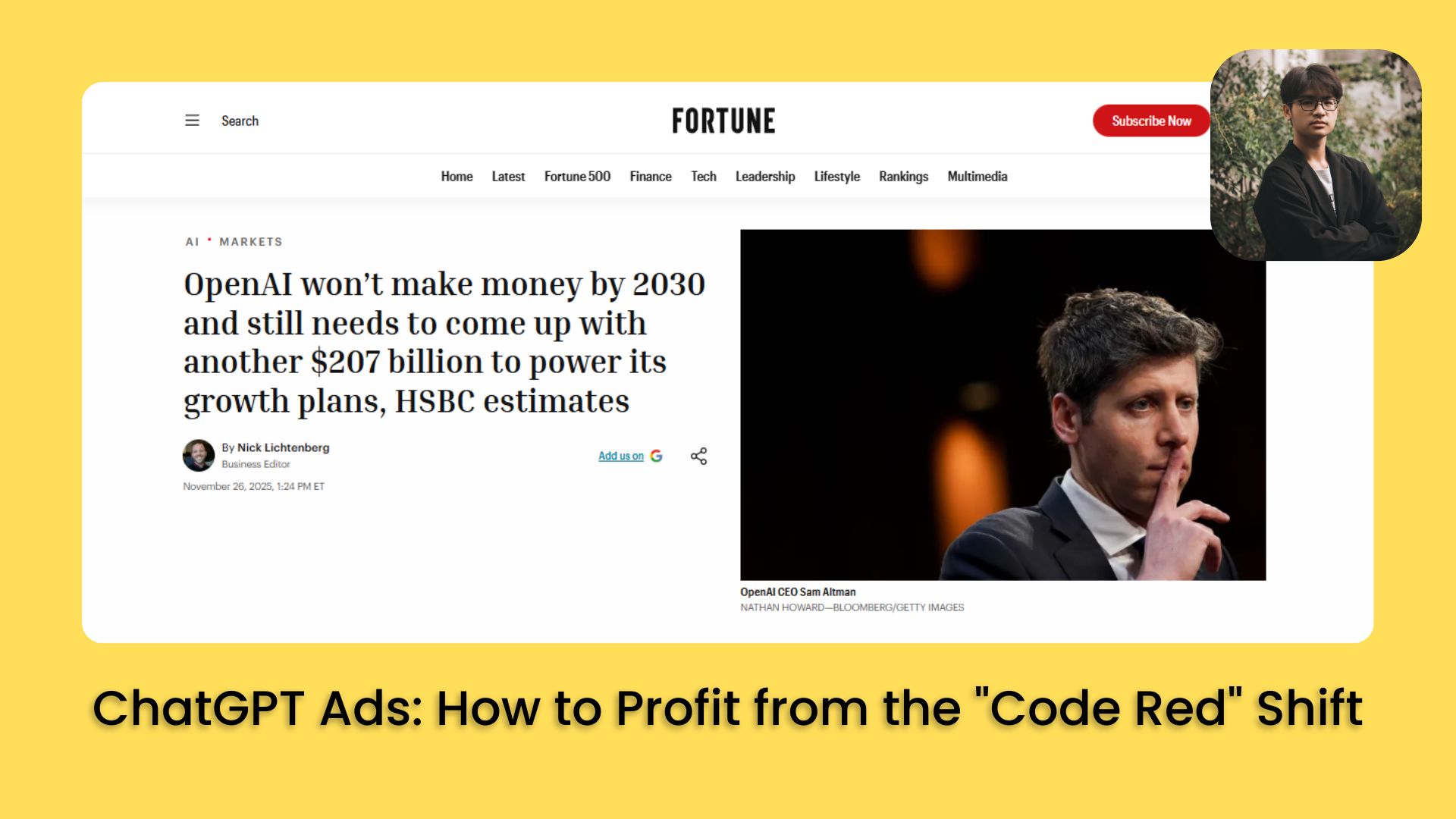
"Code Red" signals OpenAI’s urgent pivot to ad-based monetization to cover massive costs and push revenue past subscriptions, directly competing with Google’s established infrastructure. The new model for ChatGPT ads targets "private" questions (intimate questions users ask AI) offering deeper intent data than traditional search keywords. Marketers can take advantage of this window by spotting emotional triggers and building specific tools that actually help.
Key points
Stat: Marketers have an estimated 12-month window to exploit low-cost traffic before AI ad competition saturates the market.
Mistake: Targeting broad keywords; success now lies in "intent jacking" confessional phrases like "I can't afford my mortgage".
Action: Launch micro-niche AI tools using no-code platforms to own specific problem niches and capture direct leads.
Critical insight
AI advertising enables "surveillance pricing", where algorithms analyze a user's distress level to dynamically maximize the price they are willing to pay.
🚨 "Code Red" for Ads: Are you terrified or excited? |
Table of Contents
I. Introduction: The Internet Just Crossed a Terrifying Threshold
Something big just changed on the internet and almost no one is talking about the right thing.
People are arguing about ChatGPT ads and Google’s AI tools. That’s a signal. The real shift is this: traditional ads are dying and AI is taking their place. Not banner ads. Not tracking cookies. AI that predicts what you’ll buy before you even think about it.
This is why Sam Altman called it “Code Red.” Not because Google has better AI but because Google already knows how to turn human behavior into money at scale.
It’s unsettling. It’s powerful. And if ChatGPT ads show up inside that moment, the “keyword era” is basically over.
Let me show you exactly what Sam Altman isn't telling you about the coming AI ad revolution and how to position yourself before this becomes normal.
II. Why Did Sam Altman Call This “Code Red”?
ChatGPT has massive usage but most users don’t pay. Only 3-5% are on a paid plan, while everyone else still costs money to serve. Subscriptions help, but they don’t scale well enough on their own. Ads do. They’re how Google, Meta, and TikTok turned attention into profit.
At this size, ads aren’t a choice. They’re a necessity. That’s why the pressure to introduce ChatGPT ads isn’t optional. It’s survival.
Key takeaways:
ChatGPT growth is huge but revenue pressure is real.
Subscriptions don’t automatically solve profitability.
Ads are the fastest path to scale monetization.
“Code Red” is about business model risk, not model quality.
This isn’t an “ads feature.” It’s a strategic pivot.
1. Why Sam Altman Is Actually Panicking
OpenAI has hit a problem that few people noticed. ChatGPT grew incredibly fast and now has hundreds of millions of users. But even with all that attention, turning it into a steady income is still a big challenge.
That $20/month subscription you are paying for? Not profitable. The $200/month premium tier? Still bleeding cash.
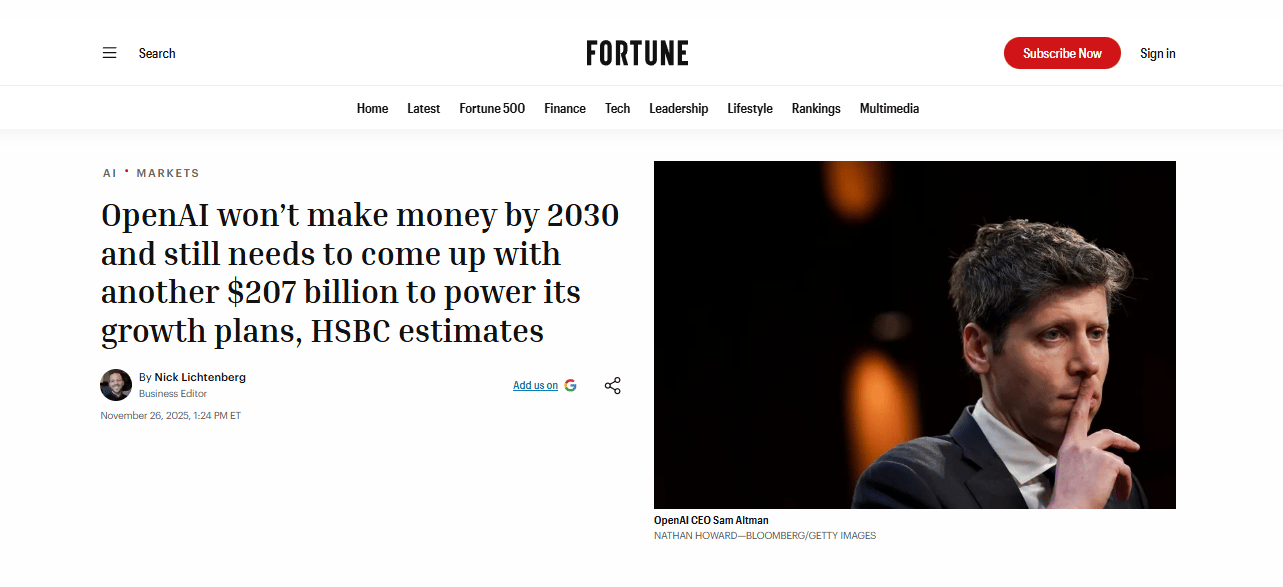
Source: Fortune.
Meanwhile, Google, which has had billions of users for two decades and a 20-year head start on ad infrastructure, just weaponized Gemini across its entire ecosystem. Not a soft launch. Not a pilot program. Full integration across Search, YouTube, Gmail, Android and every touchpoint where 4+ billion people spend their digital lives.
The result? Sam Altman triggered Code Red at OpenAI headquarters.
2. The Real Threat (It's Not What You Think)
Here is what the headlines are missing: Google isn’t winning because Gemini benchmarks slightly better than GPT-5 on some tests. Google is winning because it solved the monetization riddle that OpenAI is still struggling with.
Google already has:
The Ad Infrastructure: 20+ years of advertising systems, bidding platforms, conversion tracking and payment processing baked into every product.
The Behavioral Data: Decades of search history, location data, Gmail scanning, YouTube watch patterns, Chrome browsing habits and Android usage.
The Distribution Monopoly: Billions of daily active users across Search, Maps, YouTube and Gmail.
OpenAI depends heavily on its partnership with Microsoft but that support only reacts to pressure. Google took a different path by building Gemini directly into tools people already use every day. Now OpenAI is pushing ChatGPT ads fast, not to get ahead but to stay alive.
Learn How to Make AI Work For You!
Transform your AI skills with the AI Fire Academy Premium Plan - FREE for 14 days! Gain instant access to 500+ AI workflows, advanced tutorials, exclusive case studies and unbeatable discounts. No risks, cancel anytime.
III. What’s The Real Threat From Google?
Google doesn’t win because Gemini is slightly better on benchmarks. Google wins because it already owns the full ad stack: demand, supply, tracking, billing and distribution. They can place AI-driven ads inside Search, YouTube, Gmail android and Chrome at global scale.
Key takeaways:
Google already has 20+ years of ad infrastructure.
Google has deep behavioral data across products.
Google has built-in distribution across billions of users.
OpenAI is building monetization while Google is deploying it.
OpenAI is competing with a machine that’s already been printing money for decades.
To understand where we are headed (and where the opportunity is) with ChatGPT ads, you need to see how we got here.
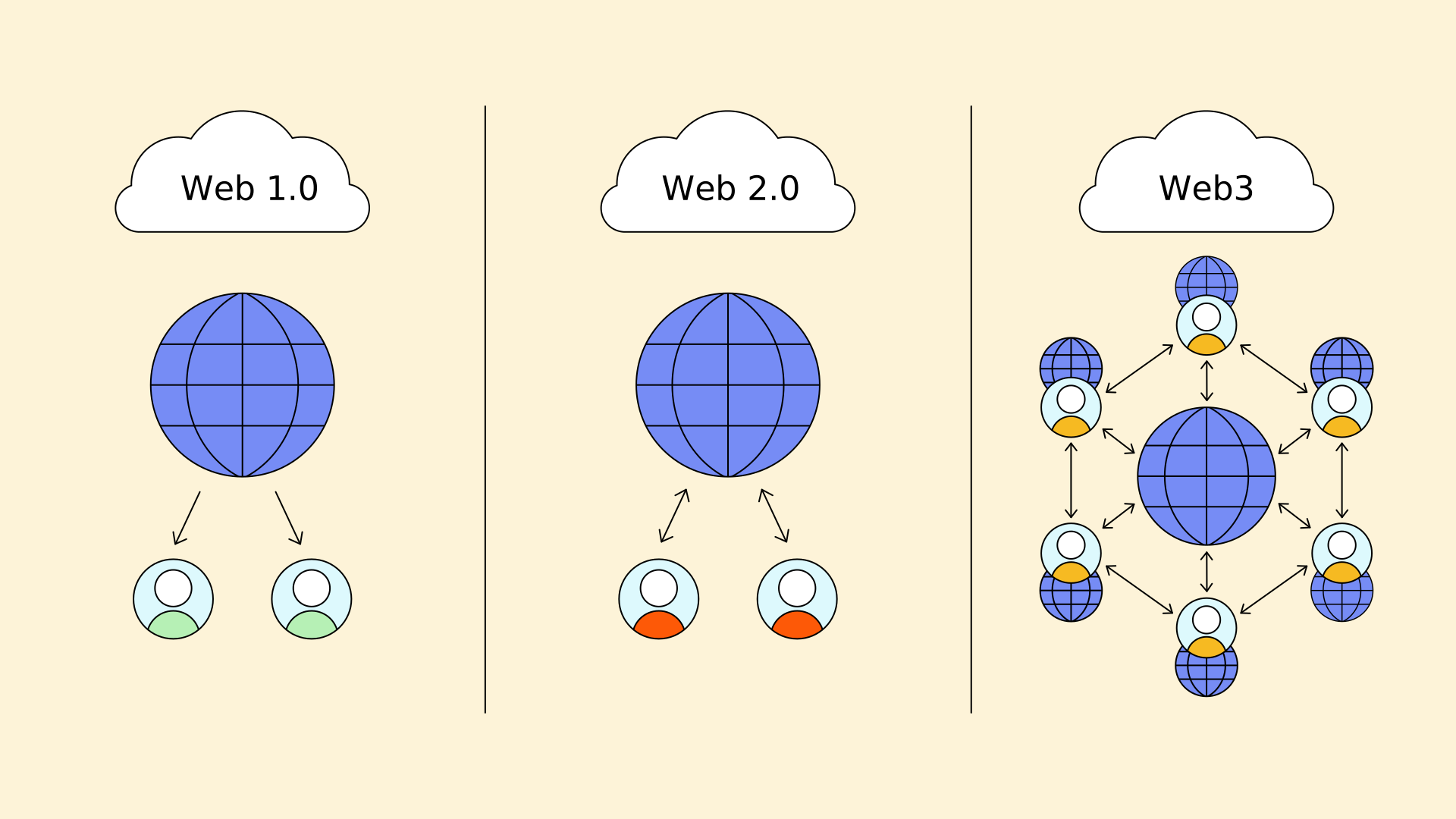
1. Web 1.0: The Billboard Era
Remember the first banner ads? AT&T's crude "You Will" campaign from 1994? Back then, ads were digital billboards. The website knew maybe your geographic region. That was it. You showed up, they showed you an ad, you clicked or you didn't. Simple. Dumb. One-size-fits-all.

Then came cookies and tracking pixels. They quietly changed advertising and made modern affiliate marketing possible
It felt like magic at first. In reality, it was just your online activity leaving signals behind. This is how retargeting was born: ads that follow people based on what they click and view.
Now things get creepy. Facebook's Cambridge Analytica era proved something chilling: within 300 likes, AI can predict your personality better than your spouse.
Why? Because you tell AI things you would never tell your partner.
You search Google: "How many drinks make you an alcoholic?" (You would never ask your spouse that until you’re ready to admit it.)
You search: "How much does divorce cost?" (You aren't telling your significant other you are researching this.)
You search: "Signs of depression" or "bankruptcy options".
AI doesn't just track where you click; it tracks how you think. Personality types. Thought patterns. Vulnerabilities. Triggers. It can literally model your psychology with frightening precision.
4. Web 4.0: The Algorithm Is You
This is where ChatGPT ads take us.
Traditional Advertising: Reactive Search. You type "best running shoes", Google shows shoe ads.
AI Advertising: Predictive and Personalized. You tell ChatGPT: "My knees hurt from running". AI responds: "Given your knee issues, running history and weight, here are the exact shoes with orthopedic support you need and here is a 15% discount because the algorithm knows you are price-sensitive based on your income discussions last month".
There is no "bucket". The AI is literally building a custom algorithm that mirrors you. OpenAI remembers every conversation you have ever had. It knows your problems, emotional state, financial situation and vulnerabilities.
The ad targeting mechanism isn't an external algorithm trying to figure you out anymore. It is a mathematical reflection of your own psychology.
IV. How Did Advertising Evolve From Clicks To Psychology?
Ads started as dumb billboards. Then the cookies made them follow you. Then “super memory” systems made them predict you. The shift now is that AI doesn’t just track actions. It models intent, stress, urgency and preferences from what people say in private.
Key takeaways:
Web 1.0: broad, generic banner ads.
Web 2.0: cookies + retargeting based on clicks.
Web 3.0: AI predicts personality from behavior signals.
AI chat logs reveal more than search keywords ever did.
When people “confess” to AI, they hand over the best targeting data on earth.
Let me paint the dystopian picture that is already being built behind the scenes.
1. The Gemini-Powered YouTube Algorithm
Google has hinted that Gemini is now powering the YouTube algorithm. This is new. Algorithms used to be rules-based systems (if X, then Y). Now they are AI-driven, adaptive and learning in real-time from every single interaction.
The goal? Keep you on the platform as long as possible by exploiting what the AI has learned about your specific psychology. If the AI detects that you are easily influenced by political outrage, it feeds you that. If you are lonely, it drowns you in relationship content.
2. Surveillance Pricing: "What Can You Afford?"
Here is where it gets truly scary. One of the most controversial applications of AI is dynamic pricing based on perceived ability to pay.
Real example: When a student wanted to attend art school, the admissions officer asked: "How much equity do you have in your house?." It means: "We are going to charge you whatever we think you can afford".
AI Scale: Imagine AI knowing you typed: "I can't afford my mortgage this month". Imagine prices adjusting in real-time based on how desperate the AI calculates you are.
The future isn't just ads selling things. The future is ads that change prices based on how desperate, vulnerable or wealthy the AI knows you are.
3. Election Interference 2.0
Remember 2016? Cambridge Analytica almost broke democracy using micro-targeted political ads. That was humans doing it.
Now imagine AI doing it at 1,000x scale with 1,000x more precision. AI that knows your political leanings, triggers, fears, biases and crafts personalized propaganda designed specifically to manipulate you. Thought control isn’t science fiction. It’s being built right now.

Fake Cambridge Analytica ad hits Facebook.
V. What Do ChatGPT Ads Look Like In “Web 4.0”?
In classic ads, you search for a keyword and get results. In AI ads, the system builds a profile from your conversations and makes product recommendations that feel like help, not marketing. It can personalize the offer, the framing and even the discount based on what it knows about you.
Key takeaways:
Targeting shifts from keywords to conversations.
Intent becomes richer than any search query.
Recommendations can adapt to your exact situation.
The ad engine starts to mirror the user.
The algorithm stops guessing who you are. It starts reflecting who you are.
Alright, now the useful part: how I’d play this without becoming gross. Let's talk about making money. While I won't be handing over my deepest secrets to ChatGPT, I will be exploiting the gap this creates.
Whenever a massive shift happens in digital advertising, there is a temporary arbitrage window where early movers can buy traffic for pennies and flip it for dollars.
1. Opportunity A: The "Penny Click Arbitrage"
When a new ad platform launches, the big players are slow. Walmart just introduced a shopping AI tool in 2024 and they have billions of dollars and entire teams dedicated to this. If Walmart can't move fast, you can.
Let me take one of my friends as an example. In his Google AdWords account, he runs a campaign where he buys clicks for 5 cents and flips them into $5, $10 or $25+ payouts through affiliate offers. The same opportunity is coming with ChatGPT ads.
Traffic will be cheap because advertisers don't understand the platform yet.
Competition will be low because enterprise companies move slowly.
Intent will be crystal clear because people are having conversations, not typing single keywords.

Walmart shopping AI tool
2. Opportunity B: "Intent Jacking" on Steroids
Traditional search is linear: Someone types "mortgage calculator" → You show them refinance offers. But what about confessional keywords? Searches that reveal intent without being direct buyer keywords.
"How do I know if I'm going to default on my credit card?" (Intent: Credit repair or debt consolidation).
"Signs my spouse is cheating" (Intent: Divorce lawyer or private investigator).
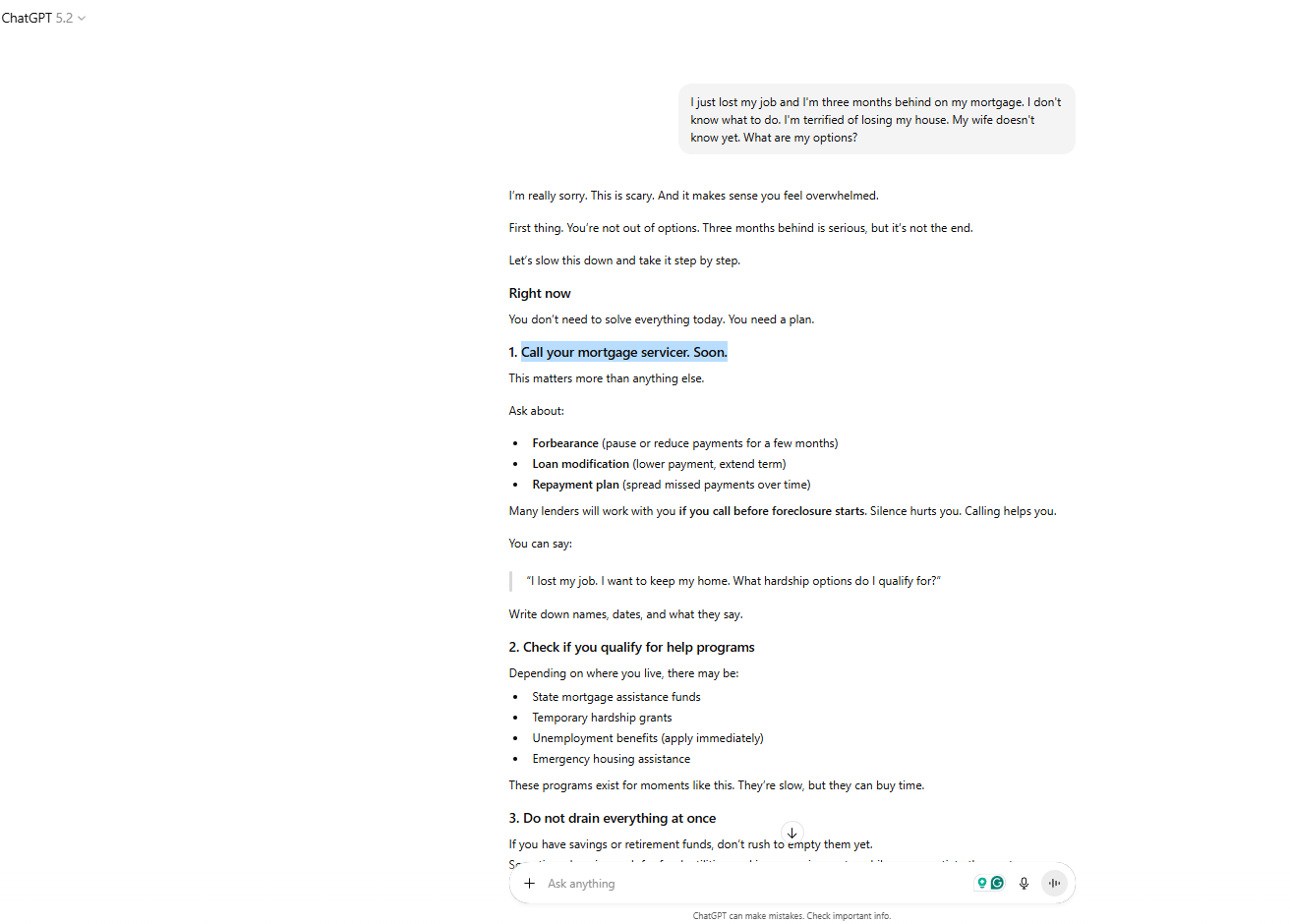
With AI conversations, intent jacking is on steroids. Instead of typing "behind on mortgage" into Google, someone has a conversation with ChatGPT: "I just lost my job and I'm three months behind on my mortgage. I don't know what to do. I'm terrified of losing my house. My wife doesn't know yet. What are my options?"
The AI now knows: Job loss (desperation), Three months behind (urgency), Fear of foreclosure (acute problem), Hiding it from spouse (emotional stress). If you are an affiliate marketer with offers for loan modification or debt relief services, this is a goldmine. The AI processes intent through conversation, not keyword strings. It is infinitely clearer, richer and more targetable.
Creating quality AI content takes serious research time ☕️ Your coffee fund helps me read whitepapers, test new tools and interview experts so you get the real story. Skip the fluff - get insights that help you understand what's actually happening in AI. Support quality over quantity here!
3. Opportunity C: Micro-Niche AI Tools
Here is a strategy almost nobody sees coming: building super-micro-niche AI tools that solve hyper-specific problems.
Examples: A free AI tool that analyzes mortgage scenarios and recommends refinance options and a free AI chatbot that helps people script difficult conversations (monetized with therapy offers).
Why does this work? Because ChatGPT is a general tool. People want specific solutions. If you build a tool that is perfectly tailored to one micro-problem, you own that niche. You become the go-to resource.

An app I built to analyze mortgage scenarios and recommend refinance options.
If you want to create your own app without paying a single cent, I think Google AI Studio is a great starter pack.
VI. The Trigger Word Method: Your Secret Weapon
One of my most powerful strategies is what I call the Trigger Word Method, identifying the exact words and phrases that reveal buyer intent, emotional state and readiness to act. In the age of AI, this method becomes 10x more powerful because AI conversations are full of trigger words.
Examples of Trigger Words:
Financial Stress: "behind on", "can't afford", "maxed out", "collections", "foreclosure", "bankruptcy".
Health Concerns: "constant pain", "can't sleep", "doctor said", "getting worse", "worried about".
Relationship Problems: "fighting all the time", "thinking about divorce", "doesn't listen", "lonely", "affair".
Career Frustration: "hate my job", "underpaid", "toxic boss", "thinking about quitting", "burned out".

When someone uses these trigger words in a ChatGPT conversation, the AI knows their emotional state and urgency level. If you can position your offer to appear when these trigger words are detected, you aren't interrupting; you are solving.
VII. The Dark Side You Need to Understand
Before you dive into AI advertising, you need to understand the ethical and practical dangers:
1. Privacy Is Dead
If you are using ChatGPT like a personal therapist, confessing your deepest fears and financial struggles, you are handing that data to a giant corporation with a questionable track record.
OpenAI had a data leak where user chats were exposed. Treat AI like a tool, not a confidant. Keep your usage business-focused.
2. AI Unemployment Is Real
We are already seeing job losses attributed to AI automation. Content writers, customer service reps, data entry workers and entire categories of jobs are vanishing. If you are building a business in this era, consider building something that helps people navigate this transition. Education, retraining, mental health support; these are gaps that will only grow.
3. Monopoly = People Get Left Behind
Whenever power consolidates into the hands of a few (OpenAI, Google, Meta), people get squeezed out. The "algorithm overlords" aren't just controlling feeds; they are controlling lives.
Your opportunity as a marketer is to be the bridge. Help people who fall through those cracks. Build businesses that serve the underserved.
VIII. Your Action Plan: What to Do Right Now
If you’re a marketer, here are the 5 steps to capitalize on the ChatGPT ad opportunity before the window closes:
Step | Focus | What You Do | Why It Matters |
|---|---|---|---|
Step 1 | Test ChatGPT Search Behavior | Experiment with ChatGPT search. Track which queries trigger product suggestions and solution-style answers. Document patterns. | Free early market research before ads exist. Huge edge later. |
Step 2 | Build intent database | Create a spreadsheet with Trigger Track, which prompts trigger recommendationsWords, Pain Points, Affiliate Offers, AI Queries. | Becomes your targeting blueprint when ads launch. |
Step 3 | Build micro-niche AI tools | Use no-code tools (Bubble, Voiceflow) to launch simple, free tools. Monetize via affiliates or leads. Launch fast. Iterate. | Lets you capture intent directly, not just traffic. |
Step 4 | Prepare affiliate stack | Join affiliate programs in Finance, Health, Legal, Career, Relationships. Build relationships with managers. | Ensures you’re ready to monetize high-intent AI conversations. |
Step 5 | Master confessional marketing | Create content targeting private, emotional AI searches (“What nobody tells you about…”). | Builds trust, authority and primes users for conversion. |
IX. The 12-Month Window (Why You Must Move NOW)
Here is the reality: You have a 12-month window (maybe less) to capitalize on this opportunity. Why? Because early adopters get:
Cheap Traffic (before advertisers flood the platform).
Low Competition (before the big players figure it out).
Arbitrage Profits (before the market reaches balance).
By the end of 2026, this window will be closed. The giants will have caught up. Ad costs will skyrocket. The "easy money" phase will be over. If you want to win, you start testing NOW.
X. How Do You Profit Without Becoming The Villain?
AI ads will make manipulation easier. That’s exactly why ethics becomes a competitive advantage. If you recommend real solutions, avoid scams and protect user trust, you last longer and scale cleaner.
Key takeaways:
Don’t exploit desperation with shady offers.
In sensitive niches, only promote legitimate services.
Build long-term trust, not one-time conversions.
Use the power to help, not to squeeze.
The best operators will make money and keep a reputation they can live with.
I have been in this business for 25 years. I ran early Google Ads when clicks were $0.05 and learned the same pattern: early platforms are cheap because everyone’s confused. I have seen the sleaze. I have seen marketers exploit every vulnerability. Don't be that marketer.
The AI ad era will create huge power for manipulation. The technology is morally neutral but how you use it isn't.
Build businesses that genuinely help people.
If you target debt, promote legitimate debt relief, not scams.
If you target health issues, recommend real solutions, not snake oil.
You can make money and sleep well at night. Ethical businesses last longer, scale bigger and build reputations that pay dividends for decades.
XI. Final Thoughts: The Algorithm Is You
AI ads aren’t just another channel. They change who decides what gets shown.
The system doesn’t guess anymore. It listens, learns and reacts to you in real time.
That makes most people uncomfortable. And it should.
Because from now on, there are only two roles: the person being analyzed… or the person using that analysis to win attention cheaply.
This shift is already happening. Not next year. Not later.
The only real question is whether you’ll notice it in time or realize it after the prices go up.
If you are interested in other topics and how AI is transforming different aspects of our lives or even in making money using AI with more detailed, step-by-step guidance, you can find our other articles here:
The AI Crash Is Here? Why You Are Safe & How To Profit In 2026!
Your "AI Automation" Agency Is About To Die (Unless You Pivot)
*indicates a premium content, if any
What do you think about the AI Report series? |
Reply