- AI Fire
- Posts
- Screenless AI Arrived 💍


In partnership with


AI just moved off your screen… and onto your finger. OpenAI shipped quietly. China is sprinting. And agents are no longer “tools” - they’re acting like teammates. Most people still think this is about chatbots. It isn’t…!?
What's on FIRE 🔥
LEARNING PARTNER AIRCAMPUS

AI is no longer just about answering questions — today’s AI Agents can run complex workflows, make decisions, and hand tasks to humans at the right time.
In this live 3-hour Masterclass, you’ll learn:
🤖 Learn to Build your own AI Agent from scratch using Relevance AI, n8n and Google Opal platforms step-by-step.
🧠 Deep-dive inside the workflows of fully functional AI Agents and see how they reply to emails, schedule meetings, post online, and connect 40+ tools to work in sync.
🧩 Explore 4+ breakthrough AI tools that are redefining how people build, automate, and scale their daily work.
⚙️ And by the end, you’ll understand exactly how these agents think, act, and collaborate to save you hours every week.
✅ Perfect for founders, professionals, and creators who want to use AI not just as a tool, but as a team member.
🎟️ Seats are limited — reserve your spot now!
AI INSIGHTS

Good ideas disappear fast. For the creator, it happens 5 - 10 times a day.
Pebble Index 01 is a tiny smart ring built to catch them.
How it works: Press the button → whisper your thought → it’s saved. As a note, reminder, or task on your phone.
Why it stands out:
Always on your finger. No screen.
Records only when pressed. No always-listening.
No subscription. No internet needed.
Battery lasts years. No charging.
Works with iPhone and Android.
Built on open-source software.
Made for real life: Driving. Biking. Cooking. Hands full. You don’t touch your phone. You don’t forget.
Why it matters: AI isn’t just chatbots and screens. The next wave is quiet, invisible, and human-first. Pebble Index 01 turns AI into background memory - always there, never annoying.
PRESENTED BY YOU(.)COM
One major reason AI adoption stalls? Training.
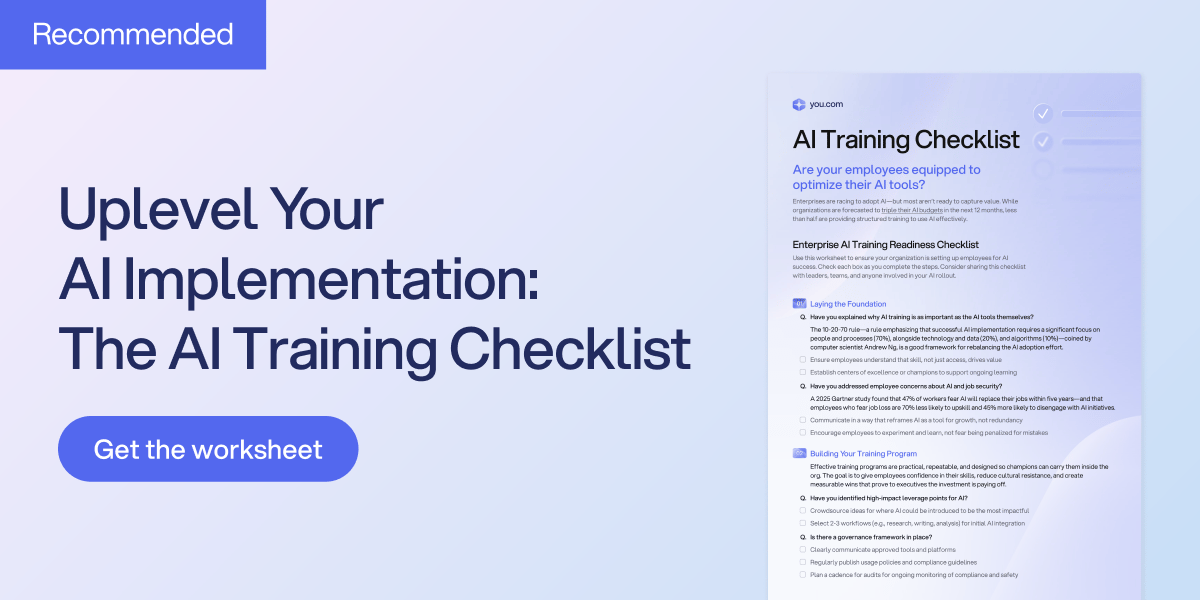
AI implementation often goes sideways due to unclear goals and a lack of a clear framework. This AI Training Checklist from You.com pinpoints common pitfalls and guides you to build a capable, confident team that can make the most out of your AI investment.
What you'll get:
Key steps for building a successful AI training program
Guidance on overcoming employee resistance and fostering adoption
A structured worksheet to monitor progress and share across your organization
AI SOURCES FROM AI FIRE
1. Build your personal AI coach with Google Gemini Gems. Learn to build specialized AI to automate weekly reports, content plans, and more!
2. Ultimate Canva AI workflow: Your A-Z marketing guide. Build a full campaign, including strategy, visuals, content to streamline your entire process
3. How to build a media business without hiring a designer (Part 1). Not paying $500 for graphics. Free way to auto-generate professional infographics in seconds
TODAY IN AI
AI HIGHLIGHTS
🌍 Runway just introduced its first General World Model, GWM-1. It simulates interactive worlds in real time, with explorable environments, talking avatars, and synthetic data for robots. This puts Runway directly in the race with Google DeepMind and World Labs.
📱 Anthropic shipped Claude Code on Android, plus a hotkey model switcher and clear context window indicators. Mobile devs can now code, switch models, and track context limits without guessing.
🧩 OpenAI is quietly adding a Skills framework to ChatGPT and Codex CLI. Users found app-like folders for PDFs and spreadsheets, hinting at modular AI tools you can extend just by adding a script.
🤖 Silicon Valley is still skeptical on AI humanoids, but China is moving fast. At the Humanoids Summit, Chinese firms like Unitree dominated, backed by government incentives and a clear 2025 national roadmap.
🚀 OpenAI says four engineers built the Sora Android app in just 28 days using Codex. The app hit #1 on Google Play, generated 1M+ videos in 24 hours, and shipped with a 99.9% crash-free rate.
💰 AI Talent & Funding Moves: Anthropic opened new cohorts of the Anthropic Fellows Program for May & July 2026, offering a ~$3,850/week stipend, ~$15k/month in compute, and direct mentorship for AI safety research. Over 40% of past fellows later joined Anthropic full-time, signaling a serious long-term investment in safety talent.
HOT PAPERS OF THE WEEK
Adaptation of Agentic AI
UIUC, Stanford, and Berkeley map how agents adapt via tools, rewards, and RLVR. The survey shows interaction-driven adaptation is now a core scaling path. (UIUC • Stanford • Berkeley)Reasoning Models Ace the CFA Exams
Top reasoning models now pass all 3 CFA levels. Gemini 3.0 Pro hits 97.6% on Level I, with GPT-5 and Claude close behind. (Google • OpenAI • Anthropic)AI and Human Co-Improvement
Meta FAIR argues AI should co-research with humans, not replace them. Human-AI collaboration may be faster, safer, and more aligned than full autonomy. (Meta FAIR)Selective Gradient Masking (SGTM)
Anthropic introduces SGTM to remove dangerous knowledge at training time while keeping general skills. It’s 7× more robust than prior unlearning methods. (Anthropic)AI Agent Adoption at Perplexity
A field study of millions of users shows agents are used mainly for productivity and learning (57%), with adoption rising in high-GDP, knowledge-heavy jobs. (Harvard • Perplexity)
NEW EMPOWERED AI TOOLS
🥗 PlanEat AI turns health goals into a 7-day meal plan, complete with a ready-to-shop grocery list.
💞 We2 uses AI-powered questions to spark deeper, fun, and romantic conversations for couples.
💳 Flowglad enables webhook-free payments that AI can set up in one shot, fully open source.
🎬 Google Vids creates AI-powered work videos, from storyboards to polished edits in minutes.
AI BREAKTHROUGH

A new 65-page paper from Stanford, Princeton, Harvard, University of Washington, and other top labs explains agentic AI in a clean way.
The claim is simple: Almost all advanced AI agents adapt in 4 ways.
They fall into 2 buckets:
Agent Adaptation
A1: Learn from tool results (did code run? did search work?)
A2: Learn from output feedback (human or automatic judgment)
Tool Adaptation
T1: Agent fixed, tools improve offline
T2: Agent teaches tools through its own behavior
Big takeaway: Most agent systems are remixing these 4 paths, not creating new ones.
We read your emails, comments, and poll replies daily
How would you rate today’s newsletter?Your feedback helps us create the best newsletter possible |
Hit reply and say Hello – we'd love to hear from you!
Like what you're reading? Forward it to friends, and they can sign up here.
Cheers,
The AI Fire Team
Reply