- AI Fire
- Posts
- 🚀 How to Get Your First AI Client in 7 Days (Step-by-Step System + Proven Proof)
🚀 How to Get Your First AI Client in 7 Days (Step-by-Step System + Proven Proof)
Cold outreach is a trap. Use the Trust Map framework to turn warm conversations into your first four-figure AI project in 7 days.

Max Anh
February 24, 2026

TL;DR BOX
In early 2026, there are too many people selling AI tools but not enough "Partners" who solve real business problems. Cold outreach volume is a trap that treats your high-value skill as a commodity. Christian’s success shows that how you describe your work is very important. Instead of saying "I build bots", say "I give you your time back". This helps you win big contracts.
The 7-day framework prioritizes Trust over Transactions. By starting with your "Trust Map" (warm contacts), conducting low-pressure discovery calls and delivering a "Free Pilot", you eliminate impostor syndrome and pricing paralysis. You aren't "selling"; you are diagnosing a repetitive manual task and proving you can fix it. You will make money as a result of showing people how much you can help them via AI automation.
Key points
Fact: Christian went from 0 results with 450 cold emails/day to a $1,500 deal in 5 days by switching from cold volume to warm discovery.
Mistake: Chasing monthly retainers before delivering a single win. Retainers are earned through proof; start with a project-based pilot to build the relationship.
Action: Open a Google Sheet today and list 20 people you already know (friends, ex-colleagues, local owners). This is your "Trust Map".
Critical insight
The most valuable asset you gain from a free pilot isn't the testimonial, it's the Client's Language. The exact words they use to describe their "annoying" tasks are the high-converting hooks you will use for your future paid marketing.
Table of Contents
I. Introduction: You Can Build AI Automation. You Just Can’t Sell It
You did everything: built AI workflows, learned n8n or Make, watched tutorials and automated your own email sorting.
But you still can't sign a client.
The problem is that you're trying to sell before you've built any trust. In a market where 89% of small businesses are actively looking for AI automation, the problem is your positioning, psychology and process.

Source: AI Software Systems
Today, I’m breaking down the 7-day framework used by Christian, an Arizona native who went from sending 450 cold emails a day with zero results to a $1,500 closed deal in under a week.
🛠️ Are you better at building AI workflows or selling them? |
II. Why Is Sending More Cold Emails a Trap?
Cold volume feels productive. But without proof, it scales rejection. Buyers compare you on price when you sound generic.
Key takeaways
Sending 450 emails does not mean people will trust you.
High open rates don’t mean trust.
Commodity positioning triggers price pressure.
Volume works only after proof exists.
Scale amplifies whatever foundation you already have.
Before Chris found what worked, he followed the common playbook: scrape LinkedIn for leads, pull emails with automation tools, use AI to write outreach messages and send 450 cold emails per day.
On paper, it looked impressive with high open rates and replies came in. But none of it turned into clients.

This pattern feels familiar because most advice in the AI automation space frames outreach as a numbers game.
→ Send enough messages and someone will eventually say yes. That logic only works when you have something to back it up (proof, trust, a reputation or at least a referral).
Without those, volume just means you’re annoying 450 people at once instead of one at a time.
The real issue was positioning. When you say “I build AI automations,” you sound like everyone else using the same script. Buyers don’t see differentiation; they only see a commodity. And when you’re treated like a commodity, they compete on price and you lose every time.
Chris eventually realized the solution wasn’t sending more emails. It was changing how he identified, framed and approached potential clients altogether.
Learn How to Make AI Work For You!
Transform your AI skills with the AI Fire Academy Premium Plan - FREE for 14 days! Gain instant access to 500+ AI workflows, advanced tutorials, exclusive case studies and unbeatable discounts. No risks, cancel anytime.
III. What Mindset Shift Actually Changes Everything?
To succeed in AI automation, you must move from being a vendor to being a consultant. Conversation beats demonstration in early sales.
Key takeaways
“I build automations” creates distance.
“What’s eating your time?” starts the conversation.
Partnership framing builds trust.
Pain-focused positioning differentiates instantly.
Here's where it gets interesting.
At first, Chris approached prospects by saying he builds AI automation templates and asking if they wanted one. It was a product-first pitch that focused on what he could create.

After the shift, it sounded like this: "I help businesses get time back and scale faster. Tell me which tasks waste your time and I will show you how AI can do them for you".
Nothing about his skills changed; only his positioning did. The first version is selling a product (creating distance) and the second version is offering a partnership (creating conversation).
It's a change in how you think about your role. Instead of acting like a vendor pushing workflows, you step into the role of a problem-solver. The focus moves from showcasing capability to understanding pain.
That shift, from "look what I can build" to "tell me what's hurting you", is the entire foundation of why the 7-day framework works.
IV. Three Mental Blocks That Keep Beginners Stuck
Before learning any framework, it's worth naming the 3 things that stop most people before they even start. Chris went through all of them; meanwhile, most people reading this will recognize at least one.
1. Impostor Syndrome
The voice usually sounds like this: “Who am I to charge for this?” “What if I mess it up?” “I don’t want to look like I’m pretending.”
That feeling doesn’t disappear overnight. It fades as results stack up and waiting for confidence before starting only delays progress.
Chris told potential clients straight up: "I am new to AI but I work on it every day. I want to help you fix this specific problem for free".
That kind of honesty doesn't make you sound weak. It makes you sound human. People can smell fake confidence from a mile away and real transparency is disarming in a way polished sales scripts never are.
The practical approach: do your first one or two projects for free or very cheaply. Take the pressure off both sides. Your goal in the beginning isn't money; it's experience and proof.
Make them look at the result and think, "This person actually helped me". Once that happens, the impostor feeling takes a back seat.
2. Pricing Paralysis
A lot of beginners get stuck obsessing over how to structure retainers before they've delivered value to a single person. They want the $3,000/month recurring contract before they've run one successful project.
The problem is that retainers are built on trust and trust takes time and proof to earn. Asking for a retainer before delivering anything is like asking someone to leave a five-star review before you've even served them the food.
Do you know that firms with trust-based retainers hit 85% collection rates (vs. 70% non-trust), which is proof that consistent value earns renewals.
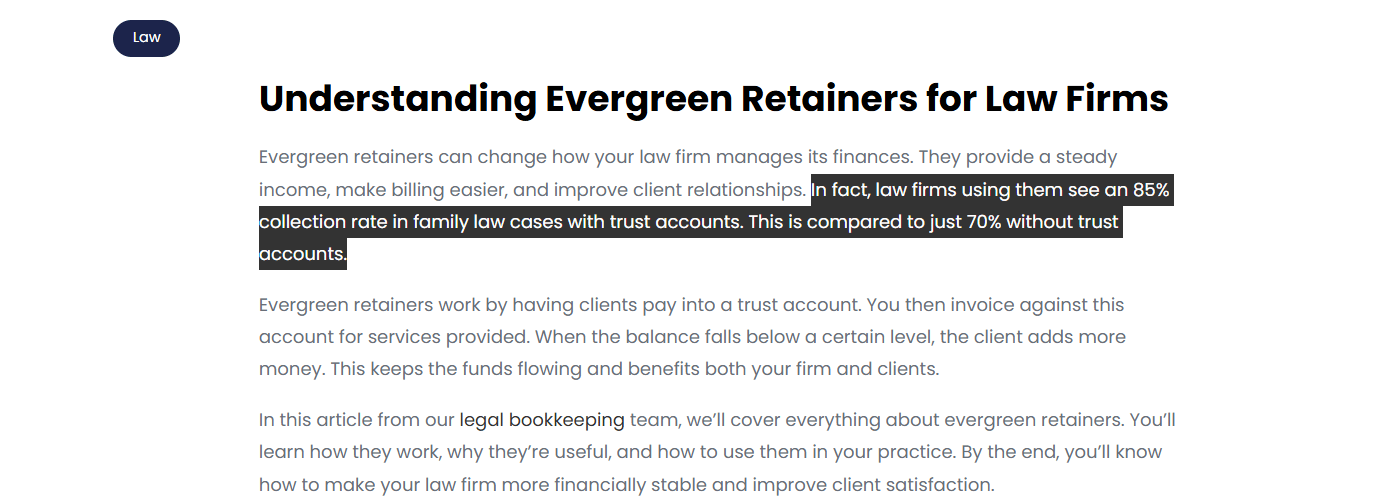
Source: Future Proof Accounting.
The better sequence is simple: get in the door, solve a real problem, make the value obvious, then have a natural conversation about what ongoing support could look like. Retainers are something you earn. They're not a starting point.
3. Fear of Rejection
When you’re new, people will ignore you. Some will say no and some won’t even open your message. That's completely normal and not the problem.
However, the problem is when people keep getting the same response and don't change anything. Getting rejected repeatedly without adjusting isn't persistence; it's just expensive stubbornness.
Every time something doesn't land, there's a question worth asking: Was the message too long? Was it vague? Was there a clear reason for them to care?
That feedback loop (rejection → diagnosis → adjustment) is how outreach actually improves. Winners run that loop, while everyone else just blames their niche.
⭐ How would you rate this "How to Make Money with AI" blog post?Help us improve by picking one that best describes your thoughts: |
|
V. The 7-Day Framework: Exactly What Chris Did
Here's the actual process. It was a simple, focused 7-day sprint.
One important thing to know upfront: Chris didn't start with cold outreach. He started warm with people who already had some level of trust in him, even if it was thin. Warm outreach converts far better than cold because trust isn’t zero.
Day 1: Set Direction and Build Your Trust Map
The first mistake beginners make is over-niching too early. You don’t need a hyper-specific positioning yet. All you need is a clear starting sentence.
So, instead of being “the AI automation specialist for independent optometry clinics in the Pacific Northwest". That kind of specificity is useful later, once you have case studies and proof
You start by saying “I help small businesses save time by automating repetitive tasks with AI.” That’s enough to start conversations.
Next, prepare a short mental menu of the kinds of problems you can help with, things like automating lead follow-up, syncing data between tools, building FAQ chatbots and setting up client update systems. You’re just giving yourself starting points, not committing yet.
Then, do this one exercise: open a Google Sheet and list 20 people where some level of trust already exists. It could be friends, family, former coworkers, managers,… For each person, note:
What they do.
How well you know them.
Whether they could be a client, intro or industry insight.
The reason you do this is simple: it makes the path forward concrete instead of abstract. Most beginners feel stuck because "find clients" is too vague. A list of 20 real people with context is something you can actually act on.

Days 2-3: Have 5-10 Warm, Low-Pressure Conversations
These are not sales calls. Don’t pitch anything.
The goal is simple: understand where repetitive, manual work is eating time in their business or day-to-day life. That's it.
The outreach message is straightforward:
Hey, I'm building something where I help businesses automate repetitive work with AI. I'm not trying to sell you anything but could I ask you a few questions about where things feel manual or annoying in your workflow?"During the conversation, ask open questions: What feels repetitive? What would they love to stop doing? Where does communication break down? What tasks feel annoying but necessary?
Write down the exact words they use. The specific language people use when describing their frustrations is extremely useful later, both for building the right solution and for pitching similar clients.
If you run out of people, don't jump to cold outreach yet. Instead, ask the people you've already talked to: "Is there anyone you know who might find this useful?" That framing is comfortable for people to answer because they're just making a helpful introduction.
Days 4-5: Turn the Best Conversation Into a Free Pilot
Go back through your notes from those conversations. You’ll find the person with the clearest and most painful repetitive task. That's who you build for first.
The pitch is low-pressure and honest:
I’d love to build you a small automation to tackle [specific problem] as a free pilot. My goal is just to show that this can actually save you time. In return, I'd love honest feedback - it'll help me get better.Then you build the simplest version of the solution that actually solves the problem. It’s not the flashiest or the most technically impressive; just something that works and removes friction.
Here’s a simple research AI automation you can build in n8n without much effort. All you need is an OpenAI API key, Tavily API key and a Gmail account to build it.

As you build, notice the exact words the person used to describe the problem and the result they want. Those words matter because they show you exactly how to talk about your services to future clients who have the same issue.
Day 6: Deliver and Get Feedback
Next, you walk them through the automation and make sure they understand it.
Then, you ask three questions:
How does this feel?
Does it solve the problem you described?
What would make it better?
Their answers will tell you everything about whether the project landed, what’s missing and what they’d actually pay for.
Day 7: Decide What Comes Next
Here’s the thing you need to know: The goal on day seven isn't to close a deal. It's to figure out what the logical next step is based on how the pilot went.
If it worked, two paths open:
Maintenance: You stay on to maintain and improve it.
Expansion: You build the next automation.

Here is an advanced research workflow.
Two questions that naturally surface more work: "While I was building this, I noticed [related process] would it help to automate that too?" and "Now that you've seen what this can do, what's the next thing you'd want off your plate?"
If they’re satisfied but not ready to continue, ask for a short testimonial. That proof is more valuable than any cold email campaign you'll run in the next three months.
If the pilot didn’t land well, take the feedback, improve and repeat the loop with someone else. Early on, the goal is experience and proof, not money. The money follows once those two things exist.
If you want to go beyond the first 7 days and build real momentum, follow this 30-day extension plan to turn one pilot into consistent, repeatable client work.
Creating quality AI content takes serious research time ☕️ Your coffee fund helps me read whitepapers, test new tools and interview experts so you get the real story. Skip the fluff - get insights that help you understand what's actually happening in AI. Support quality over quantity here!
VI. AI Automation Is a Loop, Not a One-Time Sprint
The 7-day framework isn’t something you run once and forget. It’s a cycle you repeat.
Each time you run it, you come out with more: more data on what problems people actually have, more confidence in how you explain what you do, better language for describing your value and tighter positioning.
After two or three rounds, the shift becomes obvious. Instead of guessing, you now have real proof and real language. At that point, when you’ve got testimonials, case studies and a clear sense of who you help, cold outreach actually works because there’s something real behind your name.
That's when you build lead lists and run outreach at scale. Not before the proof exists.
VII. What You can Achieve from This AI Automation Results
Chris landed his first client on day 5. The project was a project management assistant chatbot that helped a project manager send client updates, log tasks into a CRM and handle FAQ responses. The price was $1,500.
He later increased the engagement to $2,000 a month.
Three days after closing that first client, he posted about it in an online community. Someone reached out the same day, saying they needed an AI automation specialist. That became his second paying client.
In his case, it took under 2 weeks from learning automation basics to signing two paying clients.
What made it work wasn’t technical skill. Plenty of people have technical skills and no clients. What made it work was the order of operations: trust first, value second, money third.
VIII. Conclusion
The difference between Christian and the 400 people applying for the same job on Upwork is that Christian didn't wait for a "job description" to appear. He went out, found a pain point and fixed it.
Instead of treating this 7-day plan as a one-time event, you need to assume it’s a loop. Every time you run it, you get more data, more confidence and better "business-speak".
So stop building AI tools for yourself. You just need to go find one real person with one real repetitive problem and solve it for free.
That’s your day one and the rest will follow.
If you are interested in other topics and how AI is transforming different aspects of our lives or even in making money using AI with more detailed, step-by-step guidance, you can find our other articles here:
6 ChatGPT Hacks Top 1% Use To Make So Much Money (Most Never Set These Up?)*
Ultimate MoltBot (ClawdBot) Guide: Most Powerful 'Siri Killer' Never Sleeps
How I Built a Free AI Voice Agent That Answers Sales Calls 24/7 (SO Easy)
YouTube Cloning Hack: Reverse-Engineer Any Viral Channel in 10 Minutes (No Guessing)*
*indicates a premium content, if any
Reply